 by
by Europe is the second smallest continent in the world. It sticks out from Eurasia like a westward-projecting peninsula. Its unique shape makes it fascinating for map makers.
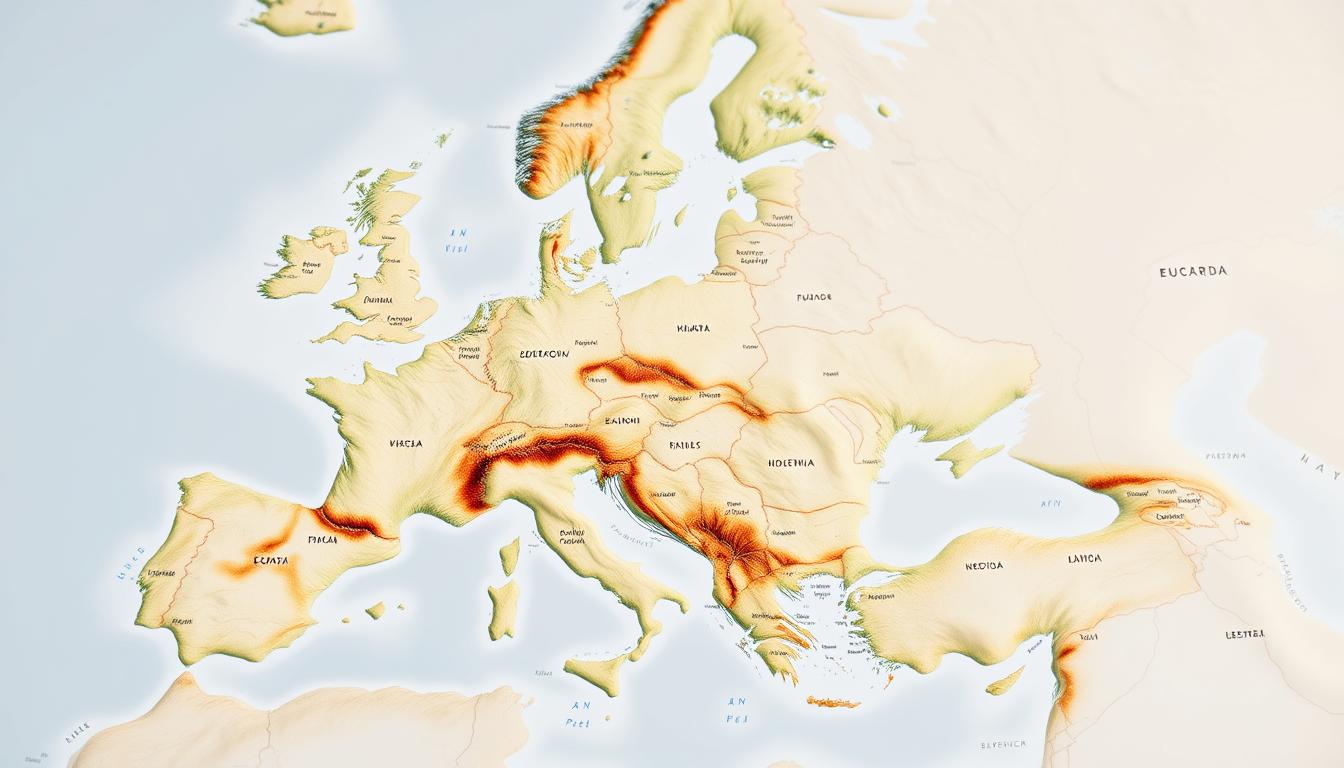
A Europe geographical map is key to understanding the continent. It shows countries, mountains, and rivers. This highlights Europe’s diverse and complex geography.
A detailed Europe Location Map is very important. It gives us insights into Europe’s geography and its effects.
European Geography Fundamentals
Understanding European geography is key to knowing its history, culture, and economy. Europe is a land of varied landscapes and cultures. It is defined by its geographical boundaries and size.
Continental Boundaries and Size
Europe is surrounded by the Arctic Ocean to the north and the Atlantic Ocean to the west. It also borders the Mediterranean Sea, the Black Sea, and the Caspian Sea to the south. This detailed map of Europe shows its unique features. The continent is about 10.18 million square kilometers big.
Europe’s Position in the Global Context
Europe’s location has greatly shaped its role in the world. It is near Asia and Africa, making it a center for cultural, economic, and political exchange. The Europe continent map shows its strategic spot. Many countries have access to important waterways and trade routes.
This location has helped Europe’s economy and cultural diversity. It makes Europe a major player globally.
The Complete Europe Location Map
Exploring Europe starts with a detailed look at its location map. This map is more than just a picture. It opens the door to understanding Europe’s geography, politics, and culture.
Elements of European Cartography
European maps have important parts that make them useful. These include:
- Scale and Legend: These help us grasp the map’s scale and symbols.
- Country Borders and Names: They show Europe’s political divisions clearly.
- Geographical Features: Like mountains, rivers, and coastlines, they outline Europe’s physical shape.
The Europe map with countries is key. It combines these elements for a full view of the continent.
Coordinate Systems and Map Projections
Making an accurate Europe map is a big task. It involves choosing the right coordinate systems and map projections. The Earth is round, and mapping it on a flat surface is tricky.
- Coordinate Systems: Latitude and longitude help pinpoint locations on Earth.
- Map Projections: Methods like Mercator or Robinson are used to map the Earth. Each has its own strengths and weaknesses.
An interactive map of Europe uses these systems. It allows for zooming and panning, making it easier to explore.
Political Divisions of Europe
Europe’s political scene is a mix of countries, regions, and disputed areas. A detailed map of Europe helps us see these divisions clearly.
The continent has over 50 countries, each with its own capital. These capitals are not just government seats. They are also hubs for culture, economy, and politics.
Sovereign States and Their Capitals
Europe has more than 50 countries. Some key ones are Germany, France, and Italy. Their capitals, Berlin, Paris, and Rome, are important in European and global politics.
| Country | Capital |
|---|---|
| Germany | Berlin |
| France | Paris |
| Italy | Rome |
Autonomous Regions and Dependencies
Europe also has regions and dependencies with their own rules. These areas are often different from the rest of the country. For example, Scotland is part of the UK, and Catalonia is in Spain.
Knowing about these areas helps us understand Europe’s political map better.
Disputed Territories
Europe has areas that countries disagree over. Crimea is claimed by Ukraine and Russia, and Kosovo’s status is unclear. A Europe political map must show these disputes to be useful.
Physical Geography of Europe
Europe’s geography is a mix of different landscapes. These have been shaped by millions of years of tectonic activity and climatic changes. You can see this diversity in its varied physical features, like mountain ranges, river systems, and coastal formations.
Major Mountain Ranges
Europe has several significant mountain ranges. Each range has its own unique features. The Alps and Carpathians are among the most notable.
The Alps and Carpathians
The Alps stretch across several countries, including France, Switzerland, Italy, and Austria. They are famous for their beautiful landscapes and diverse ecosystems. The Carpathian Mountains are also significant, covering parts of Romania, Ukraine, and Slovakia.
Pyrenees and Other Ranges
The Pyrenees act as a natural border between France and Spain. They are known for their rugged terrain and stunning scenery. Other notable ranges include the Apennine Mountains in Italy and the Balkan Mountains in Southeastern Europe.
River Systems and Watersheds
Europe’s river systems are vital for its ecosystem and economy. Major rivers like the Danube, Rhine, and Volga play key roles in the regions they flow through.
- The Danube River is the second-longest river in Europe. It flows through several countries before emptying into the Black Sea.
- The Rhine River is important for trade. It connects the Alps to the North Sea.
- The Volga River is the longest river in Europe. It flows entirely within Russia and is vital for the country’s ecosystem and economy.
Coastal Features and Major Peninsulas
Europe’s coastline is dotted with peninsulas and bays. This adds to its diverse geography. Notable peninsulas include the Iberian Peninsula, Italian Peninsula, and the Balkans.
- The Iberian Peninsula includes Spain and Portugal. It is known for its rich cultural heritage and varied landscapes.
- The Italian Peninsula is home to Italy. It is famous for its historical sites and beautiful coastlines.
- The Balkan Peninsula is a complex region. It has a mix of cultures and landscapes, including countries such as Greece and Albania.
Regional Divisions of Europe
Europe is divided into several regions, each with its own culture and politics. These divisions help us understand the continent’s geography and history. Each region adds to Europe’s rich identity.
Western European Countries
Western Europe includes France, Germany, and the UK. It’s known for its strong economy and culture. These countries have greatly influenced European history.
“Western Europe has been the cradle of many significant movements and ideologies that have shaped not just Europe, but the world.”
Eastern European Nations
Eastern Europe has Poland, Russia, and Romania. It’s rich in culture and has seen many political changes. The region’s landscapes, from mountains to plains, add to Europe’s beauty.
The region’s historical significance is huge. It played a big role in many important events.
Northern European States
Northern Europe includes Sweden, Norway, and Denmark. It’s known for its high standard of living and social progress. The region’s natural beauty, like fjords and forests, is stunning.
Strong focus on innovation and sustainability makes Northern Europe stand out.
Southern European Territories
Southern Europe has Spain, Italy, and Greece. It’s famous for its culture, including ancient ruins and art. The region’s warm weather and beautiful coasts attract many tourists.
The historical and cultural significance of Southern Europe is huge. Places like the Colosseum and the Acropolis are landmarks.
Looking at these regions helps us understand Europe better. Each one adds something special to the continent’s culture, politics, and geography. Europe is a fascinating place to study.
Historical Evolution of European Borders
The history of European borders is filled with changes due to wars, treaties, and different beliefs. Knowing these changes helps us understand the complex history and politics of Europe.
Pre-World War European Boundaries
Before World War II, Europe was home to big empires like the Austro-Hungarian and Ottoman Empires. These empires had many different ethnic and linguistic groups. Their borders were shaped by conquest and diplomacy, not just ethnic or linguistic divisions.
After World War I, Europe’s map changed a lot. The Treaty of Versailles created new states and adjusted borders. This was an effort to match borders with ethnic and national identities.
Cold War Division of Europe
The Cold War divided Europe into Eastern and Western blocs. The Iron Curtain separated the Soviet-dominated East from Western capitalist states. This division was both political and physical, with strict borders and limited movement.
The Cold War’s impact was huge on Europe’s politics and economy. Western Europe grew economically and integrated quickly. Eastern Europe, on the other hand, had centrally planned economies and limited freedoms.
Post-1990 Geopolitical Changes
The fall of the Berlin Wall in 1989 and the Soviet Union’s dissolution changed Europe’s borders a lot. New states emerged from the former Soviet Union and Yugoslavia. Germany was also reunified.
This time also saw the EU and NATO expand into Central and Eastern Europe. These countries joined the Western economic and security frameworks.
| Period | Major Events | Impact on Borders |
|---|---|---|
| Pre-World War II | Existence of large empires | Boundaries determined by conquest and diplomacy |
| Cold War | Division into Eastern and Western blocs | Physical and political division, restricted movement |
| Post-1990 | Fall of the Berlin Wall, dissolution of the Soviet Union | Emergence of new states, EU and NATO expansion |
Interactive Maps of Europe
Digital technology has changed how we explore Europe’s geography. Interactive maps now offer a more engaging experience than old static maps.
Digital Mapping Platforms
Digital mapping platforms are key for exploring Europe’s geography. They have features that make using them more enjoyable.
Google Maps and European Navigation
Google Maps is a top choice for navigating Europe. It has street view, real-time traffic updates, and route planning. It’s vital for both locals and tourists.
Specialized European Mapping Tools
There are also tools for specific needs, like hiking trail maps and historical site navigators. These tools offer detailed info not found on general maps.
| Platform | Features | User Base |
|---|---|---|
| Google Maps | Street View, Real-time Traffic, Route Planning | General Public, Tourists |
| Specialized Mapping Tools | Detailed Topography, Historical Data | Researchers, Hikers |
User Experience with Interactive European Maps
Interactive European maps have improved a lot with new tech. Now, users can zoom in and out, switch between map views, and get more info on places.
“Interactive maps have made it possible for users to engage with geographical data in a more intuitive and interactive way, revolutionizing the field of geography.”
As digital mapping gets better, we’ll see even more advanced features. These will help us understand and navigate Europe’s geography even better.
Thematic Maps of Europe
Thematic maps offer deep insights into Europe’s trends. They cover demographics, economy, and environment. These tools help us understand various aspects of the continent.
Demographic and Population Maps
Demographic maps show where people live and how many there are. They highlight growth areas, aging populations, and migration. These maps are key for planning and resource use.
For example, a map can show how crowded cities like Paris are compared to rural areas. The United Nations says Europe’s population will drop by 10% by 2050. These maps are vital for future planning.
| Country | Population (millions) | Density (people/km²) |
|---|---|---|
| Germany | 83 | 233 |
| France | 67 | 123 |
| Italy | 60 | 202 |
Economic and Industrial Activity Maps
Economic maps show where industries and trade routes are. They help us understand Europe’s economic landscape. These maps point out important industrial centers.
For example, a map can show where car makers like Volkswagen and Renault are. This helps businesses and policymakers make better choices.
“The automotive industry is a significant sector in Europe, with major manufacturers like Volkswagen, Renault, and Fiat contributing to the continent’s economy.”
Climate and Environmental Mapping
Thematic maps are also key for understanding Europe’s climate and environment. They show climate zones, pollution, and conservation areas. These maps are essential for environmental research and policy-making.
For instance, maps can show how climate change affects European coastlines. As climate change impacts Europe, these maps will be more important for planning and efforts to mitigate it.
The European Union on the Map
The European Union’s place on Europe’s political map is key to understanding its role. It’s a big player in both politics and economy, made up of many member states.
EU Member States and Their Territories
The European Union has 27 member states, each with its own land and borders. These states are:
| Member State | Capital |
|---|---|
| Austria | Vienna |
| Belgium | Brussels |
| Bulgaria | Sofia |
Maps show the EU’s area, covering all its member states’ lands.
Schengen Area and Border Controls
The Schengen Area lets people move freely without needing passports. It’s a big deal for travel, trade, and services in the EU.
Most EU countries are in the Schengen Area. Maps highlight these countries to show the area.
Brexit and Its Cartographic Impact
When the UK left the EU, it changed how we see Europe on maps. Now, the UK is shown as not part of the EU.
This change shows the UK’s new status on maps. It’s now separate from the EU.
Transportation Networks Across Europe
The European continent is full of transportation networks. These networks are key to its economy and society. They help move goods and people, and help the continent grow together.
Trans-European Highway Systems
Europe’s highways are a big part of its transport system. They link cities and areas, making it easier to move goods and people. The goal is to cut down on traffic, make roads safer, and make travel better.
Key Features of Trans-European Highways:
- Multi-lane highways with controlled access points
- Advanced navigation and traffic management systems
- Integration with other transportation modes, such as rail and maritime
High-Speed Rail Networks
Europe has some of the best high-speed rail systems in the world. They make traveling by land fast, efficient, and comfy. Countries like France, Germany, and Italy have put a lot into their rail systems. This makes rail travel a top choice for many.
| Country | High-Speed Rail Network | Major Routes |
|---|---|---|
| France | TGV | Paris to Lyon, Paris to Bordeaux |
| Germany | ICE | Berlin to Munich, Frankfurt to Cologne |
Maritime Routes and Major Ports
Europe’s sea routes are vital for global trade. Many of the world’s busiest ports are along its coasts. Ports like Rotterdam, Antwerp, and Hamburg are among the biggest in Europe. They handle a lot of cargo and boost the local economy.
“Maritime transport is the backbone of global trade, and Europe’s ports play a vital role in this network.” – European Commission
Locating Specific Places on European Maps
Finding specific places on a European map is key for travelers, researchers, and geographers. The maps show many geographical features and political lines. Knowing how to use these maps is vital.
Using Coordinates and Grid Systems
Coordinates and grid systems are precise ways to find places on a map. The geographic coordinate system uses latitude and longitude. For example, Paris, France is at about 48.8567° N, 2.2945° E. This method is used in interactive maps of Europe for exact locations.
Grid systems help by dividing the map into sections. They are great for military and aviation, where exact locations are key.
| City | Latitude | Longitude |
|---|---|---|
| Paris | 48.8567° N | 2.2945° E |
| Rome | 41.8719° N | 12.5674° E |
| Berlin | 52.5200° N | 13.4050° E |
Landmark-Based Navigation
Landmark-based navigation is also popular. It uses famous buildings, monuments, or natural features as guides. For instance, the Eiffel Tower in Paris helps people find their way around.
“The art of navigation is a vital skill, not just for travelers but for anyone seeking to understand the world around them.” – Anonymous
Combining landmark navigation with Europe Location Maps makes exploring the continent easier. It helps us understand its diverse geography.
Lesser-Known Geographical Features of Europe
Europe is full of hidden gems beyond famous landmarks. Its rich history and geography have created unique places and phenomena. These are worth exploring.
European Microstates
Europe has many microstates, tiny countries with their own governments. Vatican City is the smallest country in the world. Monaco is a tiny principality on the French Riviera. Despite their size, these places have their own cultures and histories.
Exclaves and Enclaves
Exclaves and enclaves are oddities on Europe’s map. An exclave is a part of a country cut off by another country. Kaliningrad Oblast is a Russian exclave. An enclave is a country surrounded by another country. San Marino and Vatican City are examples. Knowing about these helps us understand Europe better.
Unique Geographical Phenomena
Europe has many special places. The Øresund Bridge is a bridge and tunnel that connects Denmark and Sweden. The Douzelage project links towns across Europe, fostering cultural exchange.
| Feature | Description | Example |
|---|---|---|
| Microstates | Sovereign states with very small land areas | Vatican City, Monaco |
| Exclaves | Portion of a state separated from the main part | Kaliningrad Oblast (Russia) |
| Enclaves | Territory entirely surrounded by another state | San Marino, Vatican City |
These hidden features make Europe’s landscape even more fascinating. By exploring them, we learn more about the continent’s complexity.
Europe’s Changing Geography
Climate change and border disputes are changing Europe’s geography. Rising temperatures and changing weather patterns are altering the land. At the same time, political tensions are reshaping the continent’s borders.
Climate Change Effects on European Landscapes
Climate change is affecting Europe’s landscapes in many ways. Rising sea levels are threatening coastal areas. Changes in weather are also altering ecosystems.
The Alps are seeing glaciers melt at an alarming rate. This is affecting biodiversity and water resources. The Encyclopedia Britannica notes that Europe’s climate varies greatly from north to south. This makes it very vulnerable to climate change.
- Coastal Erosion: Rising sea levels are causing erosion and flooding in coastal areas.
- Ecosystem Disruption: Changes in temperature and precipitation patterns are altering the distribution of plants and animals.
- Water Scarcity: Changes in precipitation patterns are leading to water scarcity in some regions.
Contemporary Border Disputes and Developments
Europe’s political geography is also changing due to border disputes and developments. Tensions between Eastern European countries and the European Union are significant. For example, the dispute between Ukraine and Russia over Crimea has had big geopolitical implications.
“The geopolitical landscape of Europe is complex and ever-changing, with historical and contemporary factors influencing border dynamics.”
The map of Europe is being updated, not just because of border disputes. The European Union’s evolving nature and policies are also playing a role. Understanding these changes is key to understanding Europe’s current geography.
Comparing Different Types of European Maps
European maps show us a lot, from borders to landscapes. They help us grasp the continent’s geography and history.
Political vs. Physical Maps
Political maps focus on countries, capitals, and big cities. They show Europe’s political layout. Physical maps, on the other hand, highlight mountains, rivers, and coastlines. For example, a political map will show France and Germany’s borders. A physical map will show the Alps and the Rhine River.
Key differences between political and physical maps include:
- Representation of boundaries vs. natural features
- Focus on human-made structures vs. geographical elements
Historical vs. Contemporary Maps
Historical maps reveal Europe’s past, showing how borders have shifted. Contemporary maps show today’s political scene. For instance, historical maps from the Cold War era show Europe’s division. Today’s maps reflect the current borders and changes like Brexit.
| Map Type | Characteristics | Example |
|---|---|---|
| Historical | Shows past boundaries and territories | Cold War-era map |
| Contemporary | Reflects current geopolitical situation | Post-Brexit map |
Specialized vs. General Purpose Maps
Specialized maps dive into specific topics like climate or economy. General-purpose maps, like a typical Europe Location Map, give a broad view. Specialized maps are great for detailed studies. General-purpose maps are good for quick references.
“Maps are not just representations of geography; they are tools for understanding complex phenomena.”
Conclusion: The Evolving Cartography of Europe
The maps of Europe are always changing. This shows how the continent’s geography, politics, and culture are evolving. A detailed Europe geographical map and Europe continent map are key to grasping Europe’s complex nature.
Maps help us understand Europe’s geography, history, and current issues. They are vital for exploring the continent’s varied areas and territories. The growth of interactive and thematic maps has made it easier to study European geography.
As Europe keeps changing, having accurate maps is more important than ever. These maps are essential for navigation, learning, and research. They help anyone wanting to get to know this diverse continent.