 by
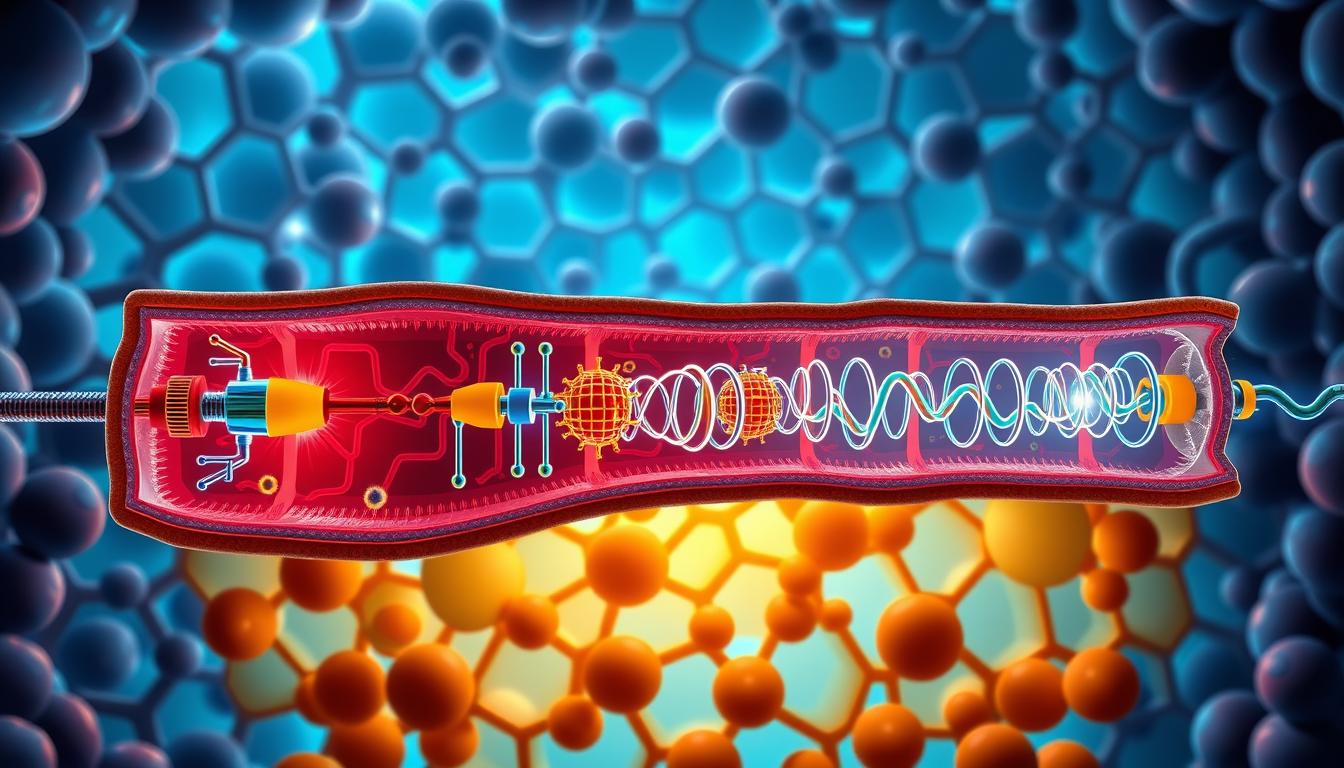
by The Electron Transport Rate is key to grasping many biochemical processes. This includes photosynthesis and respiration. It shows how fast electrons move during these activities.
Knowing about the electron transport chain and oxidative phosphorylation is vital. The Electron Transport Rate is important here. It affects how well cells make energy.
The Science Behind Electron Transport
Electron transport is key in biology, helping transfer and convert energy. It moves electrons through carriers, vital for energy in living things.
Basic Principles of Electron Movement
Electrons move due to redox reactions, passing from one carrier to another. These carriers are special molecules that help electrons move. This flow is called electron flow.
Energy Transfer in Biological Systems
In living systems, electron transport is vital for energy transfer. It releases energy to pump protons across membranes, creating a gradient. This gradient makes ATP, the cell’s main energy source.
Redox reactions are central to electron transport. They transfer electrons, changing oxidation states. This energy drives many cellular processes.
| Component | Function | Role in Electron Transport |
|---|---|---|
| Electron Carriers | Facilitate electron transfer | Critical for electron flow |
| Redox Reactions | Drive energy transfer | Essential for energy conversion |
| Proton Gradient | Stores energy | Used for ATP synthesis |
A leading researcher said, “The electron transport chain is vital for energy in cells. Its problems can cause diseases.” This shows why we must understand electron transport.
Electron Transport Rate: Definition and Importance
Electron Transport Rate, measured in µmol Electrons m⁻² s⁻¹, shows how well plants make food from sunlight. It tells us how fast electrons move during photosynthesis. This helps us see how well plants turn sunlight into energy.
Understanding ETR Measurements
Measuring Electron Transport Rate is key to knowing how well plants photosynthesize. Scientists use methods like Pulse Amplitude Modulation (PAM) fluorometry. This method checks photosynthetic activity by looking at the light plants give off.
These tests show how many electrons move per area per second. This helps scientists compare how well different plants or conditions photosynthesize.
The Significance of µmol Electrons m⁻² s⁻¹
The unit µmol Electrons m⁻² s⁻¹ is important because it makes comparing electron transport easy. It helps scientists see how photosynthesis works in different places and situations.
This standard helps us learn more about photosynthesis. It’s useful in farming, studying nature, and biotechnology. Knowing how to measure ETR helps make plants grow better and handle stress.
Historical Development of ETR Understanding
The idea of ETR has changed a lot over time. It started with early research in bioenergetics and better tools for measuring. This growth has helped us learn more about how electrons move in living things.
Early Discoveries in Bioenergetics
Early bioenergetics studies were key to understanding ETR. Scientists first looked at how energy moves in life forms. They slowly found out how complex electron movement is.
Important experiments in the early 1900s showed how electrons move in cells. These studies were the start of deeper research.
As scientists dug deeper, they saw how ETR is important in photosynthesis and breathing. This was a big step forward.
Evolution of Measurement Techniques
New ways to measure ETR have been vital for research. From old spectroscopy to new PAM fluorometry, each step has made studying ETR more accurate.
New tools have let scientists measure ETR more precisely. This has helped them understand its role in life better.
The journey to understand ETR shows teamwork among scientists. By mixing bioenergetics with new tools, they keep uncovering electron transport secrets.
The Electron Transport Chain Structure
The electron transport chain is a complex system in cells. It is key for making energy through cellular respiration.
Components and Organization
The electron transport chain has different protein complexes in the mitochondrial inner membrane. These complexes work together as electron carriers. They help move electrons, which leads to ATP production.
Key components include:
- Complex I (NADH dehydrogenase)
- Complex II (Succinate dehydrogenase)
- Complex III (Cytochrome b-c1 complex)
- Complex IV (Cytochrome oxidase)
Electron Carriers and Their Functions
Electron carriers are vital in the electron transport chain. They move electrons between the different complexes.
Cytochromes and Iron-Sulfur Clusters
Cytochromes and iron-sulfur clusters are important electron carriers. Cytochromes help transfer electrons. Iron-sulfur clusters help create a proton gradient.
Ubiquinone and Other Mobile Carriers
Ubiquinone, or Coenzyme Q, is a mobile carrier. It moves electrons between Complex I and III, and Complex II and III. Other carriers like cytochrome c also play big roles.
Photosynthetic Electron Transport
Electron transport is key in photosynthesis, mainly in the light-dependent reactions. It’s vital for turning light energy into chemical energy. This energy then fuels the light-independent reactions, known as the Calvin Cycle.
Light-Dependent Reactions
The light-dependent reactions happen in the thylakoid membranes of chloroplasts. They start when light is absorbed by pigments like chlorophyll. This light energy excites electrons, which move through electron carriers. This movement creates a proton gradient across the thylakoid membrane.
“The light-dependent reactions are a critical step in photosynthesis, as they provide the energy and reducing power necessary for the subsequent light-independent reactions.” This quote shows why electron transport is so important for photosynthesis.
Photosystem I and II Interactions
Photosystems I and II are key in the light-dependent reactions. Photosystem II (PSII) starts the light-driven electron transfer. Photosystem I (PSI) then transfers these electrons to make NADPH. The teamwork between these photosystems is vital for making ATP and NADPH.
- Photosystem II captures light energy and initiates electron transfer.
- Photosystem I receives electrons from PSII (via electron carriers) and produces NADPH.
Cyclic vs. Linear Electron Flow
There are two main electron flow paths in the light-dependent reactions: linear and cyclic. Linear flow uses both PSII and PSI to make ATP and NADPH. Cyclic flow only uses PSI and makes ATP but no NADPH.
Cyclic electron flow is very important when plants are stressed. It helps adjust the ATP/NADPH ratio for the Calvin Cycle.
Knowing the differences between these paths helps us understand how plants make energy under different conditions.
Mitochondrial Electron Transport
Mitochondrial electron transport is key in aerobic respiration. It helps cells make energy well. This process moves electrons through proteins in the mitochondrial inner membrane.
Respiratory Chain Complexes
The respiratory chain, or electron transport chain, has big protein complexes (I through IV) and smaller carriers like coenzyme Q and cytochrome c. These work together to move electrons. Complex I (NADH dehydrogenase) and Complex II (succinate dehydrogenase) get electrons from NADH and FADH2.
Electron Flow During Aerobic Respiration
In aerobic respiration, electrons move through the respiratory chain. They reduce oxygen to water. This movement creates a proton gradient.
Proton Pumping Mechanisms
The energy from electron transport pumps protons across the membrane. This creates a force that drives ATP synthesis. Protons flow back through ATP synthase, making ATP from ADP and phosphate.
In summary, mitochondrial electron transport is essential for aerobic respiration. It helps cells make energy efficiently by producing ATP.
Measuring Electron Transport Rate in Research
Scientists use different ways to measure ETR. This helps them understand how electron transport chains work. It’s key to knowing how efficient and strong electron transport is in living things.
Pulse Amplitude Modulation (PAM) Fluorometry
PAM fluorometry is a common method for studying ETR in plants and algae. It checks the light given off by photosystem II. This tells scientists how fast electrons are moving. It’s a gentle way to see how well plants make food from sunlight.
Oxygen Evolution Measurements
Oxygen production shows how well plants photosynthesize. By measuring oxygen, scientists can figure out ETR. This method is great for learning about the light part of photosynthesis.
Spectroscopic Techniques
Spectroscopic techniques, like absorbance spectroscopy, look at the state of electron carriers. They give detailed info on electron transport speed. These methods help study electron transport in plants and animals.
Choosing the right method depends on the research question and the subject being studied. Using several techniques together helps scientists fully understand ETR’s role in life.
Mathematical Aspects of ETR Calculation
ETR calculation needs precise math, using formulas and correction factors. It’s key to know how well electrons move in plants and other living things.
Standard Formulas and Equations
The main formula for ETR is: ETR = (ΔF/Fm’) × PAR × 0.5 × a*. This formula shows how much energy plants use for photosynthesis. It’s important to use it right to get accurate results.
Correction Factors and Considerations
When we calculate ETR, we must think about a few things. These include how much light the leaf absorbs and how much photosystem II uses. Adjusting for these makes sure our ETR numbers are correct.
Interpreting ETR Data
To understand ETR data, we need to know a lot about plant biology. ETR tells us how well plants are doing and how they handle stress. Looking closely at the numbers and what they mean is key to getting the most out of ETR data.
Factors Affecting Electron Transport Rate
Many environmental and biological factors impact the electron transport rate. This rate is key to photosynthesis and respiration. Knowing these factors helps us understand how energy is converted in living things.
Environmental Influences
Environmental conditions greatly affect the electron transport rate. Temperature and pH are two main factors.
Temperature and pH Effects
Temperature changes the energy of electrons, affecting electron transport. Each organism has an optimal temperature. Being too far from this can lower ETR.
pH levels also matter. They affect the proton gradient needed for electron transport. Extreme pH can damage proteins, reducing ETR.
Light Intensity and Quality
Light is vital for photosynthetic organisms. The amount and type of light impact electron transport in photosynthesis. Too much light can cause photoinhibition.
The quality of light, like wavelengths absorbed by pigments, also affects ETR.
Biological Factors
Biological traits of organisms also affect their electron transport rates. Membrane integrity and enzyme activity are key.
Membrane Integrity
Membrane structure is vital for the proton gradient needed for electron transport. Damage to membranes can disrupt ETR.
Enzyme Activity and Inhibition
Enzymes are essential in the electron transport chain. Their activity can be influenced by various factors. Inhibitors and substrate availability can reduce ETR.
In summary, both environmental and biological factors are important for electron transport rate. Understanding these factors helps us grasp energy conversion in living organisms.
ETR and Oxidative Phosphorylation
Understanding ETR and oxidative phosphorylation is key to knowing how cells make energy. The electron transport rate (ETR) is closely tied to oxidative phosphorylation. This process makes most of the ATP during cellular respiration.
The Chemiosmotic Theory
The chemiosmotic theory was proposed by Peter Mitchell. It explains how energy from electron transport makes ATP. According to this theory, the electron transport chain makes a proton gradient. This gradient drives ATP synthesis.
ATP Synthesis Coupling
ATP synthesis is linked to the electron transport rate through the proton gradient. As electrons move, protons are pumped across the membrane. This creates a gradient that ATP synthase uses to make ATP.
Efficiency and Energy Conservation
The efficiency of oxidative phosphorylation depends on the ETR. A higher ETR can lead to more ATP production. But, efficiency can be affected by many factors. These include the integrity of the mitochondrial membrane and alternative electron paths.
- The chemiosmotic theory provides a mechanistic understanding of ATP synthesis.
- ATP synthesis is directly coupled to the electron transport rate.
- Efficiency in oxidative phosphorylation is key for energy conservation in cells.
Redox Reactions in the Electron Transport Process
Understanding redox reactions is key to knowing how electron transport works. These reactions, or oxidation-reduction reactions, are essential. They help transfer energy.
Oxidation-Reduction Principles
Oxidation-reduction reactions are about moving electrons between molecules. One molecule loses electrons, and another gains them. This is vital for energy creation in photosynthesis and respiration.
Electron Donors and Acceptors
In these reactions, donors give up electrons, and acceptors take them in. The success of electron transport depends on these donors and acceptors. For more on electron transport, check out this resource.
Redox Potentials
The redox gradient shows how likely a molecule is to lose or gain electrons. This gradient pushes electrons through the chain, making energy.
| Component | Function | Redox Gradient |
|---|---|---|
| Electron Donors | Release electrons | Low |
| Electron Acceptors | Accept electrons | High |
| Electron Carriers | Transfer electrons | Variable |
ETR Applications in Plant Science
In plant science, ETR applications are key for checking crop health and boosting photosynthesis. The Electron Transport Rate (ETR) shows how well plants photosynthesize.
Crop Productivity Assessment
ETR helps measure crop productivity by tracking electron transport in photosynthesis. It shows how well crops are doing. High ETR values mean crops are healthy and productive.
Stress Response Monitoring
Stress changes a plant’s ETR, making it a great tool for tracking stress. By checking ETR, scientists can spot stress early and find ways to fix it. Stress like drought, salt, and extreme weather can be seen in ETR changes.
Photosynthetic Efficiency Optimization
Boosting photosynthetic efficiency is vital for better crops. ETR helps find what slows photosynthesis down. This lets us work on fixing it.
- Light intensity
- Water availability
- Nutrient supply
By improving these areas, we can make photosynthesis better. This leads to more productive crops.
Medical Relevance of Electron Transport Rate
Research into ETR is revealing its medical importance. It helps us understand and treat diseases linked to mitochondrial problems.
Mitochondrial Disorders
Mitochondrial disorders affect the mitochondria, often because of electron transport chain defects. These issues can cause muscle weakness, neurological problems, and metabolic issues. Studying ETR aids in diagnosing and managing these conditions.
Oxidative Stress and Disease
Oxidative stress happens when free radicals outbalance the body’s defenses. ETR is key in this, affecting reactive oxygen species (ROS) production. Diseases like cancer, neurodegenerative disorders, and heart disease are linked to oxidative stress.
Therapeutic Targets in the Electron Transport Chain
The electron transport chain is a promising area for new treatments. It could help manage mitochondrial disorders and diseases caused by oxidative stress. Researchers are looking for compounds to boost or block certain parts of the chain.
Understanding ETR’s medical role opens doors to new treatments. It helps tackle mitochondrial issues and related diseases.
ETR in Environmental Research
ETR is key in environmental research. It helps us understand how ecosystems work and how climate change affects them. Scientists use ETR to check the health of places like forests, grasslands, and water bodies.
Ecosystem Productivity Measurements
ETR helps us see how well ecosystems work. This is important for knowing about the carbon cycle and ecosystem health. Studies show ETR can track changes in ecosystem health over time. This lets scientists spot trends and patterns.
Climate Change Impact Assessment
Climate change harms ecosystems all over the world. ETR helps scientists see how climate change impacts photosynthetic life and ecosystem health. By looking at ETR data, researchers find out which areas are most at risk from climate change.
Pollution Effects on Photosynthetic Organisms
Pollution is bad for photosynthetic life, like plants and algae. ETR helps track how pollution affects these organisms. This gives insights into ecosystem health. Knowing how pollution impacts ETR helps scientists find ways to lessen its effects.
Cutting-Edge Research and Future Directions
The field of ETR is seeing big breakthroughs. New technologies and creative uses are leading the way. These advances are not just improving our knowledge of electron transport. They’re also opening up new ways to use this knowledge.
Emerging Technologies in ETR Measurement
New tools are being made to measure ETR better and faster. Pulse amplitude modulation (PAM) fluorometry and oxygen evolution measurements are getting better. This means we can get more accurate data.
| Technology | Application | Advantages |
|---|---|---|
| PAM Fluorometry | Measuring photosynthetic activity | High precision, non-invasive |
| Oxygen Evolution Measurements | Assessing photosynthetic efficiency | Direct measurement of oxygen production |
Artificial Photosynthesis Applications
Artificial photosynthesis is a new area that tries to copy natural photosynthesis to make clean energy. ETR research is key to making these systems work better.
Bioengineering of Electron Transport Systems
Scientists are working on bioengineering to improve electron transport systems. This is for things like making biofuels and cleaning up pollution. By tweaking electron transport chains, they aim to make biological systems more efficient.
These new developments in ETR research and its uses show how fast and exciting this field is. It’s leading the way for future discoveries and innovations.
Conclusion
Understanding Electron Transport Rate (ETR) is key in many areas. It shows how fast electrons move during photosynthesis and respiration. This gives us clues about how energy changes in living things.
ETR’s importance is huge. It helps us see how well energy moves in living things. By looking at ETR, scientists can check how well plants grow, see how stressed they are, and make them more efficient.
ETR’s uses are wide and important. It helps in plant science, studying the environment, and medicine. It’s used to check how well crops grow, understand climate change, find new treatments for diseases, and more.
In short, Electron Transport Rate is very important. It helps us understand energy changes in living things. Its study and use are key for new discoveries and solutions in many fields.