 by
by Hispaniola Island is in the Caribbean Sea and is home to two countries: the Dominican Republic and Haiti. It’s the second-largest island in the Caribbean. The island has everything from lush mountains to long coastlines.
A Caribbean island map is key to understanding Hispaniola’s layout and its political divisions. Looking at a detailed Hispaniola Map helps us see the island’s geography and the unique traits of the Dominican Republic and Haiti.
The island’s geography and the division between the two countries make it very interesting. Knowing how Hispaniola is laid out helps us appreciate its culture, economy, and environment.
Geographic Overview of Hispaniola Island
Hispaniola is the second-largest island in the Caribbean. It’s known for its varied landscapes and rich culture. Located at 19°N 71°W, it’s a key landmass in the region.
Location in the Caribbean Sea
Hispaniola is in the Caribbean Sea. It’s shared by two nations: the Dominican Republic and Haiti. Its location makes it a key geopolitical spot in the Caribbean.
Size and Physical Dimensions
The island covers 76,192 km², making it a big part of the Caribbean. It has mountains, valleys, and plains. These features add to its size and shape.
Neighboring Islands and Countries
Hispaniola is surrounded by the Atlantic Ocean to the north and the Caribbean Sea to the south. Cuba is to the west, and Puerto Rico is to the east. Its location in the Caribbean archipelago highlights its regional importance.
Historical Formation of Hispaniola’s Political Boundaries
The island of Hispaniola has been split into two countries for centuries. This division has seen both conflict and cooperation. The island’s strategic location and cultural mix have shaped its political lines.
Colonial Division Between France and Spain
In the 17th century, Hispaniola was split between France and Spain. The Treaty of Ryswick in 1697 made this split official. The French got the west, now Haiti, and the Spanish got the east, now the Dominican Republic. This division set the stage for today’s borders.
Independence and Border Establishment
After gaining freedom, Haiti and the Dominican Republic defined their border. Haiti broke free from France in 1804, and the Dominican Republic from Spain in 1844. Setting the border was a slow, sometimes tense process.
Modern Border Disputes and Resolutions
Even with a border, Haiti and the Dominican Republic have had issues. Lately, they’ve worked to solve these problems and improve their relationship. The border remains a key part of Hispaniola’s politics and geography.
| Year | Event | Impact on Hispaniola |
|---|---|---|
| 1697 | Treaty of Ryswick | Division of Hispaniola between France and Spain |
| 1804 | Haiti’s Independence | Establishment of Haiti as a sovereign nation |
| 1844 | Dominican Independence | Establishment of the Dominican Republic as a sovereign nation |
Comprehensive Hispaniola Map and Its Features
To understand Hispaniola’s geography and political divisions, a comprehensive map is key. It should show major cities and landmarks. A detailed map helps see the island’s layout and the unique features of Haiti and the Dominican Republic.
Political Boundaries Between Haiti and Dominican Republic
The border between Haiti and the Dominican Republic is vital on any Hispaniola map. It marks the separation between the two countries. Knowing this border is key to understanding their history and current relations.
The border has changed over time, shaped by colonial pasts and modern agreements. A detailed map shows this boundary, giving insights into the island’s politics.
Major Cities and Capitals
A Hispaniola map also shows major cities and capitals. In the Dominican Republic, Santo Domingo is the capital, one of the oldest in the New World. Haiti’s capital, Port-au-Prince, is known for its culture and history.
Other big cities include Cap-Haïten in Haiti and Santiago de los Caballeros in the Dominican Republic. These cities are important for their economy, culture, and history.
Key Geographic Landmarks
Key geographic landmarks on Hispaniola include mountains, rivers, and coastlines. The highest peak in the Caribbean, Pico Duarte, is in the Dominican Republic. The Cordillera Central mountain range also plays a big role in climate and ecosystems.
Rivers like the Artibonite and Yaque del Norte are essential for farming and water. A detailed map of Hispaniola shows these features, giving a full view of the island’s geography.
Topography and Terrain of Hispaniola
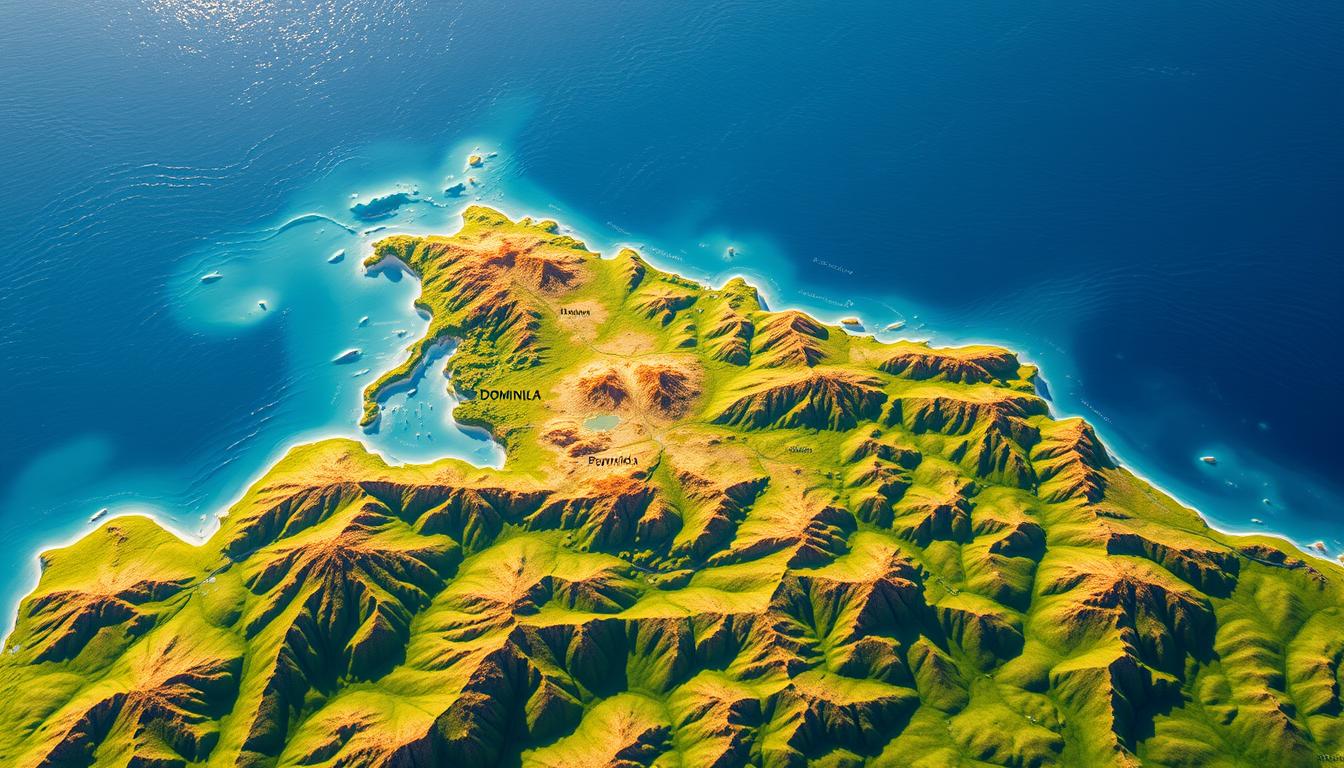
The topography of Hispaniola shows big changes in elevation. The island’s highest point, Pico Duarte, stands out. It is shared by the Dominican Republic and Haiti. The island has varied landscapes, from steep mountains to green valleys and coastal plains.
Mountain Ranges and Peaks
Hispaniola boasts several major mountain ranges, with the Cordillera Central being the most notable. Pico Duarte, at 3,098 meters, is the highest peak in the Caribbean. The mountains greatly influence the island’s ecosystems and climate.
“The rugged beauty of Hispaniola’s mountains has captivated travelers and locals alike, with breathtaking views and diverse wildlife.”
Valleys and Plains
On the other hand, Hispaniola has vast valleys and plains. The Cibao Valley in the Dominican Republic is very fertile, known for its crops. The coastal plains are also important, providing homes for many species and people.
Elevation Variations Across the Island
Elevation changes a lot across Hispaniola, from the high mountains to the low coastal areas. This variety leads to different ecosystems, from tropical forests to alpine zones. Below is a table showing the main elevation points on the island.
| Location | Elevation (meters) |
|---|---|
| Pico Duarte | 3,098 |
| Cibao Valley | approx. 100-200 |
| Coastal Plains | near sea level |
The varied topography of Hispaniola not only makes it beautiful but also affects its climate, ecosystems, and human activities.
Hydrography of Hispaniola
The island of Hispaniola, shared by the Dominican Republic and Haiti, has a rich hydrographic network. This network includes major rivers, lakes, and coastal features. These are vital for the island’s ecosystem and human activities.
Major Rivers and Their Courses
Hispaniola has several important rivers. The Yaque del Norte River in the Dominican Republic is key for irrigation and power. The Artibonite River, part of the border, supports agriculture and fishing.
Lakes and Watersheds
The island is also home to lakes and watersheds. The Étang Saumâtre in Haiti is a big lake for wildlife and fishing. Watersheds help manage water, prevent floods, and keep water quality good.
These areas are key for conservation and human use.
Coastal Features and Bays
Hispaniola’s coastline has many bays and features. These provide natural harbors and support marine life. They are also vital for fishing and tourism.
The diverse coastline adds to the island’s beauty and economy.
Climate Zones Across Hispaniola
Hispaniola has many climate zones, thanks to its varied geography. The island’s mountains and coastal plains create different weather conditions. This diversity affects the ecosystems across the island.
Regional Climate Variations
The climate in Hispaniola changes a lot from one place to another. Mountains are cooler, while the coast is warmer. Pico Duarte, the highest peak, even gets snow in winter, unlike the tropical lower areas.
Being in the Caribbean Sea also affects the climate. Hurricanes bring heavy rain and strong winds, mainly to the coast.
Seasonal Weather Patterns
Hispaniola has a tropical climate with clear seasons. The wet season is from May to October, and the dry season is from November to April. The wet season sees a lot of rain, which can cause flooding in mountains.
The dry season is drier and less humid. It’s the best time for tourists. Knowing these seasons helps with farming, water use, and tourism planning.
Impact of Climate on Geography
The climate greatly shapes Hispaniola’s geography. Weather affects soil erosion, land damage, and natural landscape formation. For example, heavy rain can cause landslides and flooding, changing the landscape.
| Climate Factor | Impact on Geography |
|---|---|
| Heavy Rainfall | Landslides and Flooding |
| Hurricanes | Coastal Erosion and Damage |
| Dry Seasons | Soil Degradation and Drought |
The table shows how climate and geography interact. Managing these effects is key to keeping the island beautiful and its resources safe.
Dominican Republic’s Geographic Regions
The Dominican Republic takes up the eastern two-thirds of Hispaniola. It has different landscapes, from mountains to coastal plains. This variety makes it unique.
Northern Region (Cibao Valley)
The Cibao Valley in the north is very fertile. It’s called the “breadbasket” because of its rich soil. It grows crops like rice, tobacco, and coffee.
The valley is surrounded by mountains. The Cordillera Septentrional creates a special climate. The region’s farming is key to the country’s economy.
Central Highlands
The Central Highlands are rugged and mountainous. They include Pico Duarte, the Caribbean’s highest peak. This area is full of natural beauty.
It’s great for hiking and eco-tourism. You can see unique wildlife and explore valleys. The highlands also supply much of the country’s water.
Eastern Coastal Plains
The Eastern Coastal Plains are flat and by the sea. They have beautiful beaches and resorts. The area is important for tourism.
The coastal ecosystems are vital for marine life. They attract many visitors.
Southern Region
The Southern Region has farms, coastlines, and cities. It includes Santo Domingo, the capital. The city is the heart of politics, culture, and economy.
A famous geographer once said,
“The Dominican Republic’s diverse regions add to its wealth and culture.”
Knowing these areas helps us understand the country’s geography. It shows how it fits into the Hispaniola map.
Haiti’s Geographic Regions
Haiti, located in the western part of Hispaniola, has different geographic areas. These areas affect its climate, economy, and culture. The country’s landscape includes peninsulas, plateaus, and valleys, making it interesting to study.
Northern Peninsula
The Northern Peninsula, also called the Septentrional Peninsula, is a key part of Haiti. It is famous for its lush landscapes and agricultural productivity.
Central Plateau
The Central Plateau is also very important. It has fertile land and mineral resources. This region is vital for Haiti’s farming and economy.
Southern Peninsula
The Southern Peninsula is known for its rugged terrain and scenic beauty. It has important cities and ports.
La Gonâve Island
La Gonâve Island is the biggest island in the Gulf of Gonâve. It is famous for its natural beauty and is a key ecological area.
| Region | Characteristics | Economic Importance |
|---|---|---|
| Northern Peninsula | Lush landscapes, agricultural productivity | Agriculture, tourism |
| Central Plateau | Fertile land, mineral resources | Agriculture, mining |
| Southern Peninsula | Rugged terrain, scenic beauty | Tourism, ports |
Historical Maps of Hispaniola Through the Centuries
From early colonial times to today, mapping Hispaniola has been key to understanding its history. Cartography on the island shows changes in geography, politics, and culture. These changes have shaped the Dominican Republic and Haiti.
Early Colonial Maps (1492-1700)
Early maps of Hispaniola were made by European explorers. They were often wrong because of limited knowledge. Christopher Columbus’s arrival in 1492 started detailed mapping of the island. These maps helped with navigation and setting colonial boundaries between Spain and France.
- Early maps showed major bays and harbors, like Port-au-Prince and Santo Domingo.
- Cartographers like Juan Vespucci and Gerardus Mercator helped map the island early on.
18th and 19th Century Cartography
The 18th and 19th centuries saw big improvements in mapping Hispaniola. As colonial powers grew, maps became more accurate. Border treaties between France and Spain in the late 17th and early 18th centuries divided the island. This division led to Haiti and the Dominican Republic.
- The Treaty of Ryswick (1697) officially split the island, shaping future maps.
- Later, maps showed topographical features, like the Central Mountain Range.
Evolution of Mapping Techniques
Mapping techniques have changed a lot over time. From manual surveying to aerial photography and satellite imagery, modern maps are very precise. Geographic Information Systems (GIS) help analyze and show geographical data better.
- Today’s maps have detailed topographical and demographic information.
- Satellite imagery makes maps very accurate.
Tourist Destinations and Points of Interest on Hispaniola Maps
Hispaniola, made up of the Dominican Republic and Haiti, has many exciting places to visit. The island’s varied landscapes, deep history, and lively culture draw in tourists. Maps of Hispaniola help visitors find and explore these spots.
Major Attractions in the Dominican Republic
The Dominican Republic has many famous places to see. Punta Cana is famous for its beautiful beaches and fancy resorts. Santo Domingo, the capital, shows off the island’s colonial history with its Zona Colonial.
Other highlights include the Cordillera Central mountains and the lovely lakes of Las Tunas.
Notable Sites in Haiti
Haiti has its own special culture and attractions. The Citation Soleil area in Port-au-Prince gives a look at modern city life. Bassin-Bleu is a natural spot with amazing waterfalls and pools.
The historic La Citadelle Laferrière is a UNESCO World Heritage Site. It shows Haiti’s rich history.
Natural Wonders and Protected Areas
Hispaniola has many natural wonders and protected places. The Pico Duarte in the Dominican Republic is the Caribbean’s highest peak. Jaragua National Park is known for its diverse wildlife.
In Haiti, the Pic Macaya National Park is great for hiking. It lets visitors see the island’s unique plants and animals.
Interactive and Digital Maps of Hispaniola
Digital technology has changed how we explore Hispaniola. This island, made up of Haiti and the Dominican Republic, is now easier to understand. Thanks to digital maps, its complex landscape and varied features are more accessible than ever.
Online Mapping Resources and Applications
Many online platforms offer interactive maps of Hispaniola. They provide detailed topographical information, political boundaries, and key geographical features. These tools are great for researchers, travelers, and educators who need accurate and current info about the island.
GIS Data and Satellite Imagery
GIS (Geographic Information System) data and satellite imagery are key in mapping Hispaniola. They help analyze geographical phenomena like deforestation, urban growth, and climate change impacts. With GIS data, users can understand the island’s environmental and socio-economic dynamics better.
3D Topographic Visualizations and Virtual Tours
3D topographic visualizations and virtual tours give an immersive experience. They let users explore Hispaniola’s diverse landscapes in detail. From mountains to coastal plains, these technologies offer a deep understanding of the island’s geography. They enhance education and research.
Printable Hispaniola Maps for Educational Use
Printable maps of Hispaniola are great for learning. They show the island’s political, physical, and thematic sides. These maps help teach geography and other subjects well.
Political and Administrative Maps
Political and administrative maps of Hispaniola are key. They show the split between Haiti and the Dominican Republic. These maps point out capitals, major cities, and boundaries. This helps students understand the island’s politics.
Physical and Topographic Maps
Physical and topographic maps reveal Hispaniola’s varied geography. They show mountains, valleys, and coastlines. By looking at these maps, students learn about the island’s terrain. They see how it affects climate, where people live, and the economy.
| Map Type | Features Highlighted | Educational Value |
|---|---|---|
| Political | Administrative boundaries, capitals, major cities | Understanding political divisions and governance |
| Physical/Topographic | Mountain ranges, valleys, coastal features | Gaining insights into geography and its impact on human activities |
| Thematic | Climate zones, population density, natural resources | Analyzing specific themes and their interrelations |
Thematic Maps for Classroom Use
Thematic maps focus on certain topics like climate, population, and resources. They help students break down complex themes. This improves their understanding of Hispaniola’s geography.
“Maps are a fundamental tool in geography education, allowing students to visualize and understand complex spatial relationships.”
Using printable Hispaniola maps in class makes learning fun and informative. Teachers can make lessons more engaging for their students.
Environmental Challenges Visible on Hispaniola Maps
The Hispaniola Map shows big differences between the Dominican Republic and Haiti. These differences include deforestation and soil erosion. These issues are not just between countries but also show the island’s environmental challenges.
Deforestation Patterns and Contrast Between Countries
Deforestation is a big problem on Hispaniola, with clear differences between the Dominican Republic and Haiti. The Dominican Republic has worked hard to keep its forests. Haiti, on the other hand, has lost a lot of its forests due to farming, charcoal making, and other human actions.
“The difference in forest cover between Haiti and the Dominican Republic is a big environmental problem,” says an environmental report. “It shows we need better ways to manage land and protect forests, mainly in Haiti.”
Soil Erosion and Land Degradation
Soil erosion and land degradation are big problems caused by deforestation. Without trees, soil can easily wash away, losing fertile land and making water dirty. This hurts farming, water quality, and makes natural disasters like landslides and floods more likely.
Natural Disaster Vulnerability Zones
Hispaniola faces many natural disasters like hurricanes, earthquakes, and floods. The damage from these disasters gets worse because of environmental harm. Losing forests and soil makes landslides and floods more common. Also, it makes the island less able to handle disasters.
Looking at the Hispaniola Map helps us understand these problems. It shows us where to focus our efforts. Maps are key in managing the environment and saving natural spaces on the island.
Comparing Modern and Historical Hispaniola Maps
Looking at modern and historical maps of Hispaniola shows how the island has changed. These maps highlight shifts in the island’s landscape and political lines. They also shed light on what caused these changes.
Changes in Coastlines and Waterways
Historical maps of Hispaniola show big changes in coastlines and waterways. Coastal erosion and sedimentation have altered the island’s shores over time. For example, the Artibonite River, the longest river on the island, has moved its path, changing the landscape around it. Modern maps show these changes, pointing out the effects of nature and human actions.
Urban Development and Expansion
The cities of Hispaniola have grown a lot. Historical maps show that cities like Santo Domingo and Port-au-Prince have spread out a lot. Modern maps show how fast cities are growing and new buildings are going up. This shows the island’s population and economy are getting bigger.
Shifting Political Boundaries Over Time
Hispaniola’s political lines have changed a lot over time. The border between Haiti and the Dominican Republic has been a big issue. Historical maps show how control over land has shifted and disputes have happened. Modern maps show the current political lines.
Comparing modern and historical maps of Hispaniola shows the island’s complex past and geography. Knowing about these changes helps us understand the island today and its future challenges.
Conclusion: Understanding Hispaniola Through Maps
Maps are key for grasping Hispaniola’s geography, history, and environmental hurdles. The Hispaniola Map shows the island’s complex layout. It highlights the split between the Dominican Republic and Haiti.
Looking at the Caribbean island map gives us a peek into its topography, waterways, and climate. Hispaniola’s spot in the Caribbean Sea has greatly influenced its past and environment.
Different maps, like political, physical, and thematic ones, help us understand the island’s features and problems. These maps are vital for exploring the island’s geography, history, and tackling issues like deforestation and soil erosion.
In summary, the Hispaniola Map is a must-have for anyone wanting to dive into the island’s intricacies. By using these maps, we can truly appreciate Hispaniola’s unique geography, history, and culture.