 by
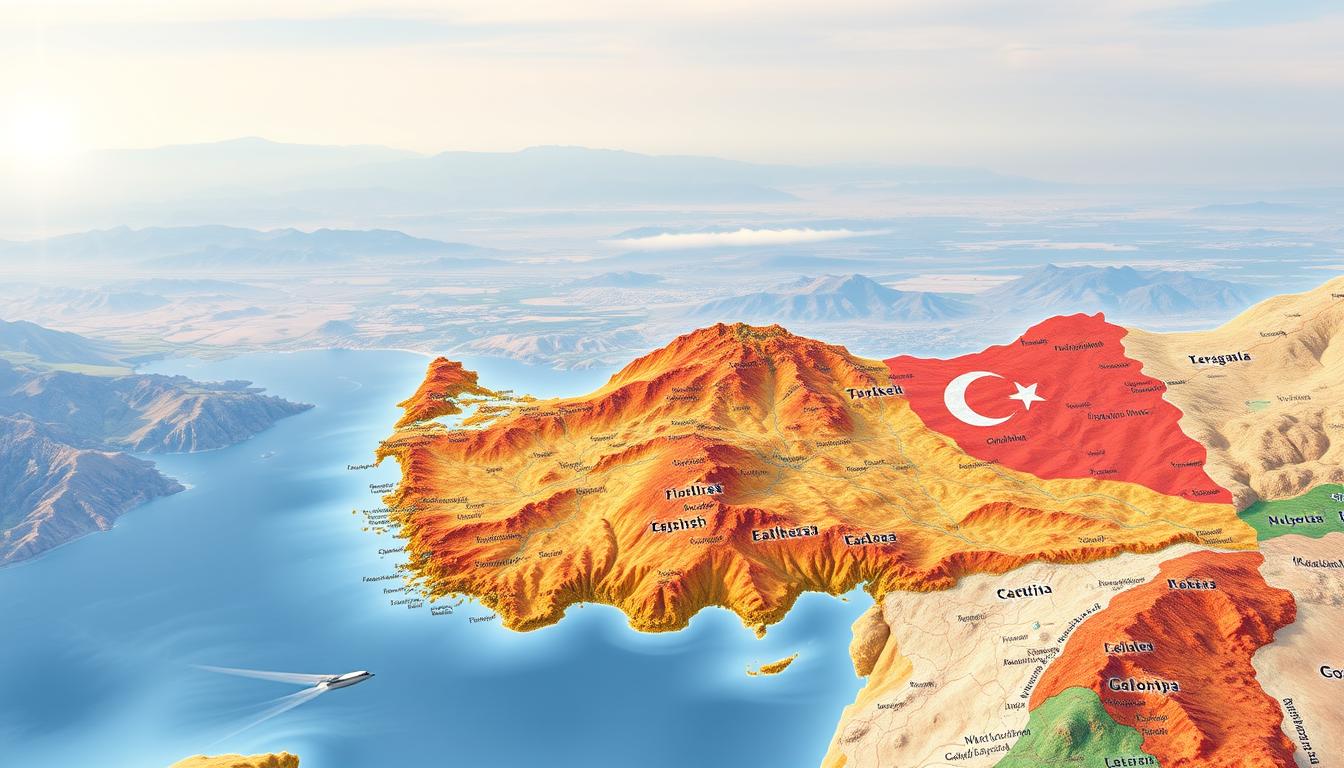
by Turkey sits at the crossroads of southeastern Europe and western Asia. It spans a total area of 783,562 km². Knowing its regional geography helps us understand its culture and economy.
Turkey’s location is key to its role in regional affairs. Its regional geography shapes the climate, physical features, and economy of the area.
The country’s varied landscape and strategic spot make its geography fascinating. This article will give you a detailed look at Turkey’s geography and its neighbors.
Geographical Overview of Turkey
Turkey sits at the crossroads of Europe and Asia, making its geography both diverse and strategic. Its unique spot allows it to connect southeastern Europe and western Asia. This makes Turkey a key player in global politics.
Turkey’s Strategic Location Between Continents
Turkey’s location between two continents is key. It has helped in cultural, economic, and historical exchanges between Europe and Asia. The country’s landscape varies, with mountains, plains, and coasts. These features create a rich variety of ecosystems.
Key Geographical Statistics
- Total land area: 783,562 km²
- Total land border: 2,648 km
- Neighboring countries: Armenia, Azerbaijan, Georgia, Greece, Iran, Iraq, and Syria
- Geographical coordinates: 39°00’N 35°00’E
Knowing these geographical statistics helps us understand Turkey’s importance in the region and globally.
The Complete Turkey Map: Understanding the Nation’s Geography
To explore Turkey’s varied landscapes, one needs detailed and accurate maps. Knowing the nation’s geography is key for many reasons. This includes navigating, planning the economy, and working together across regions.
Turkey’s maps and cartography show its importance. Its spot between Europe and Asia makes it a key area for global and economic studies.
Reading and Interpreting Turkey Maps
Understanding Turkey maps means knowing about scales, legends, and projections. It’s important to grasp cartography basics and analyze geographical data well.
- Understanding map scales and legends
- Recognizing different map projections
- Analyzing geographical features and data
Evolution of Turkey’s Cartography
Turkey’s cartography has grown with its strategic role and need for precise maps. It has moved from old mapping ways to new satellite tech.
Modern Mapping Technologies for Turkey
Modern tools like GIS and satellite images have changed Turkey’s mapping. They help make very accurate and detailed maps.
Finding Accurate and Updated Turkey Maps
It’s important to find up-to-date Turkey maps for tasks like city planning and emergency responses. Good places to find these maps include government sites, schools, and mapping services.
- Government agencies responsible for mapping
- Academic institutions conducting geographical research
- Professional mapping services providing current maps
Types of Turkey Maps for Different Purposes
Turkey’s geography is complex and best understood through various maps. These maps are for political, physical, and educational uses. Turkey’s unique position between Europe and Asia makes it fascinating for cartographers.
Maps of Turkey meet different needs, from political to educational and recreational. The variety shows Turkey’s complex geography and rich history.
Political Maps of Turkey and Border Demarcations
Political maps of Turkey show the country’s administrative divisions and borders. They highlight provinces, districts, and major cities. This gives a clear view of Turkey’s political geography.
Physical and topographic maps of Turkey display the country’s varied terrain. They include mountains, valleys, and coastlines. These maps are key to understanding Turkey’s natural geography and its effects on climate, economy, and settlements.
Printable and Educational Turkey Maps
Printable and educational maps of Turkey are great for students and teachers. They simplify Turkey’s geography, making complex concepts easier to grasp. This helps in understanding the relationships between different regions.
Interactive and Digital Turkey Maps
Interactive and digital maps of Turkey are engaging and dynamic. They include extra information like demographic data and economic indicators. This makes them useful for research and education.
Turkey maps come in many types, meeting various needs and purposes. From political and physical to educational and digital, each type has its own value. Understanding these maps helps us appreciate Turkey’s complex geography and its importance in the region.
Physical Geography of Turkey
Turkey’s landscape is full of varied features. These features shape the country’s climate and ecosystems. The country has mountains, rivers, and coastlines, making its geography diverse.
Major Mountain Ranges and Elevations
Turkey has big mountain ranges like the Pontus Mountains and the Taurus Mountains. These mountains make the country’s geography rich and diverse. They also affect local climates and ecosystems. The Anatolian Plateau, with its hills and plains, is another key feature.
River Systems and Lakes
Turkey’s rivers, like the Euphrates and Tigris, are important for irrigation and power. They also support a wide range of life. The country has many lakes, natural and artificial, which are vital for the ecosystem.
Coastal Features and Peninsulas
Turkey’s coastlines along the Black Sea, Mediterranean, and Aegean Sea have many shapes. There are bays, peninsulas, and deltas. The Bosphorus and Dardanelles are key waterways. They connect the Black Sea to the Mediterranean and divide Europe from Asia.
| Geographical Feature | Description | Significance |
|---|---|---|
| Pontus Mountains | Mountain range along the Black Sea coast | Influences local climate and biodiversity |
| Taurus Mountains | Mountain range in southern Turkey | Creates a rain shadow effect, affecting regional climate |
| Anatolian Plateau | Large plateau in central Turkey | Supports agriculture and is a key geographical feature |
For more detailed information on Turkey’s geography, visit Britannica’s page on Turkey.
Turkey’s Climate Zones and Regional Variations
The climate in Turkey changes a lot from one place to another. This is because of its varied geography. You can find everything from the Mediterranean climate by the sea to the continental climate in the middle.
Mediterranean Climate Regions
The Mediterranean parts of Turkey have hot, dry summers and mild, wet winters. These areas, along the Aegean and Mediterranean coasts, are loved by tourists and farmers. The mild winters help crops like citrus fruits and olives grow well.
Continental Climate Areas of Central Anatolia
Central Anatolia has cold winters and hot summers. The area is dry, with little rain, mostly in the summer. This makes farming there different, with crops like wheat being more common.
Black Sea Climate Zone
The Black Sea area gets a lot of rain all year, leading to dense forests and green plants. The weather is mild and wet, even in summer. This place is famous for its tea and diverse farming.
| Climate Zone | Characteristics | Agricultural Produce |
|---|---|---|
| Mediterranean | Hot summers, mild winters | Citrus fruits, olives |
| Continental (Central Anatolia) | Cold winters, hot summers | Wheat |
| Black Sea | High precipitation, mild temperatures | Tea, diverse agricultural produce |
Knowing about Turkey’s climate zones helps us understand its different areas. It shows how these climates support farming and tourism.
Political Divisions and Major Cities of Turkey
It’s important to know about Turkey’s political divisions to understand its geography and cities. The country has different administrative regions and provinces. Each one has a big role in the country’s governance and economy.
Administrative Regions and Provinces
Turkey is split into 81 provinces, grouped into 7 regions. These are the Marmara, Aegean, Mediterranean, Central Anatolia, Black Sea, Eastern Anatolia, and Southeastern Anatolia regions. These regions help with geography and statistics. For more info, check Wikipedia’s page on Geographical Regions.
Istanbul, Turkey’s biggest city, sits on both Europe and Asia. It’s a key spot for business, culture, and history. Istanbul connects Europe and the Middle East, helping with trade and culture.
Ankara and Other Major Urban Centers
Ankara, Turkey’s capital, is important for politics and culture. Other big cities like Izmir, Bursa, and Antalya also play big roles. They help the economy and add to the country’s culture.
Population Distribution Across Turkish Regions
The population in Turkey’s regions is not even. The Marmara region, where Istanbul is, has the most people. The Aegean and Mediterranean regions also have a lot of people. The western regions are more crowded than the east, because of jobs and history.
In short, Turkey’s divisions and cities are key to its geography, economy, and culture. Knowing about Istanbul and Ankara helps us see Turkey’s importance in the region.
Turkey’s European Neighbors
Turkey shares borders with Greece and Bulgaria, countries with complex histories and current relations. These ties are shaped by geography, politics, and economy.
Turkey-Greece Border and Relations
The Turkey-Greece border is more than just a line on a map. It’s a source of tension, with disputes over the Aegean Sea and minority rights.
Aegean Sea Boundary Issues: The Aegean Sea boundary is a big problem. It affects both countries’ rights to the sea and their economic interests, like oil and gas.
Turkey-Bulgaria Border and Relations
The Turkey-Bulgaria border is also key. Their relationship is influenced by history, economic ties, and sometimes, disagreements over minorities and energy.
Economic Cooperation: Despite some issues, Turkey and Bulgaria work together on trade and energy projects.
| Country | Border Length with Turkey (km) | Key Issues |
|---|---|---|
| Greece | 206 | Aegean Sea boundary disputes, minority issues |
| Bulgaria | 240 | Minority issues, energy policies, trade |
Turkey’s ties with its European neighbors are complex. They involve history, politics, and economy. Understanding these is key to seeing the bigger picture.
Turkey’s Caucasus Neighbors
Turkey shares borders with Georgia, Armenia, and Azerbaijan, making it key in the Caucasus. The area is filled with complex history, culture, and politics. These factors deeply affect Turkey’s foreign policy and how it interacts with others.
Turkey-Georgia Border and Relations
The Turkey-Georgia border is a key part of regional cooperation. They work together in trade, energy, and security. The Turkey-Georgia border is about 273 kilometers long, connecting the two countries.
Turkey-Armenia Border and Historical Context
The Turkey-Armenia border is marked by history. It’s been closed off for over 25 years because of Turkey’s support for Azerbaijan. The history between these countries is complex, with many political and social changes in the 20th century.
Turkey-Azerbaijan Connection and Cultural Ties
Turkey and Azerbaijan share a deep cultural and linguistic bond. They are often seen as “one nation, two states.” Their partnership is strong in energy, trade, and military affairs. This connection is vital for regional stability and growth.
The Caucasus region is very important to Turkey’s foreign policy. Its neighbors play a big role in the area’s dynamics. Understanding these relationships helps us see the region’s complexities.
In summary, Turkey’s neighbors in the Caucasus are key to its influence and strategy. The ties with Georgia, Armenia, and Azerbaijan are rich in history, culture, and politics.
Turkey’s Middle Eastern Borders
Understanding Turkey’s borders with Iran, Iraq, and Syria is key to grasping Middle Eastern geopolitics. These borders are more than just lines on a map. They are vital for regional cooperation, trade, and security.
Turkey’s Middle Eastern borders are at the heart of many regional issues. These include political alliances, trade agreements, and security concerns. Turkey’s strategic location makes it a key player in the region.
Turkey-Iran Border and Regional Dynamics
The Turkey-Iran border is a critical part of regional dynamics. Both countries share historical and cultural ties. Their border is important for trade and energy cooperation.
The region is also home to various ethnic groups. Cultural understanding is essential for peace. The Turkey-Iran border has seen cooperation on counter-terrorism and energy projects. This cooperation is vital for regional stability and energy security.
The Turkey-Iraq border is another critical area, with security being a major concern. Various militant groups in the region pose a significant threat. Turkey has been involved in military operations against these groups to ensure its security and stability.
Turkey-Syria Border and Contemporary Issues
The border between Turkey and Syria has been a hotspot due to the Syrian Civil War. Turkey has hosted a large number of Syrian refugees. It has also been involved in various military operations in Syria.
The border region continues to be a challenge for Turkey. Issues include security, refugee management, and regional stability. In conclusion, Turkey’s Middle Eastern borders are complex and multifaceted. They involve various regional dynamics, security challenges, and cooperation efforts. Understanding these borders is essential for grasping the broader geopolitical landscape of the region.
Maritime Boundaries of Turkey
Knowing Turkey’s maritime boundaries is key to understanding its role in the world. Its long coastlines along the Black Sea, Mediterranean Sea, and Aegean Sea are vital. They help with trade, security, and cooperation in the region.
Black Sea Maritime Borders and Resources
The Black Sea is very important for Turkey. It offers shipping routes and natural resources. Turkey’s border in the Black Sea is set by agreements with its neighbors. This helps in areas like fishing and protecting the environment.
The Black Sea is also rich in oil and gas. This makes setting its maritime borders very important for energy exploration. Turkey is working to improve its energy infrastructure in the area.
The Mediterranean Sea is also key for Turkey, affecting trade and energy. But, setting its borders here is hard because of claims with other countries.
Turkey’s search for resources in the Mediterranean has caused tensions. This is true with countries like Greece and Cyprus. These issues show the need for diplomacy to solve border disputes.
Aegean Sea Maritime Complexities
The Aegean Sea is special because of its geography and history of disputes. Turkey’s border here is affected by its relationship with Greece. Both countries have different views on their maritime zones.
| Sea | Maritime Boundary Features | Economic Significance |
|---|---|---|
| Black Sea | Defined by bilateral agreements | Shipping, fisheries, hydrocarbon resources |
| Mediterranean Sea | Complex delimitation, disputes with neighbors | Trade, energy exploration |
| Aegean Sea | Influenced by territorial disputes | Fisheries, tourism, possible hydrocarbon resources |
In summary, Turkey’s maritime boundaries are very important. They affect its role in the region and its economy. Understanding these boundaries helps us see Turkey’s complex position and its relations with others.
Economic Geography of Turkey and Its Neighbors
Turkey’s economy is shaped by its natural resources and key trade routes. Its location is perfect for growth and working with neighbors.
Natural Resources Distribution
Turkey has many natural resources like chromium, copper, and boron. It also grows a lot of food. But, these resources are not spread evenly across the country.
Trade Routes and Transportation Networks
Turkey is a key spot for trade between Europe, the Middle East, and Asia. Its roads, railways, and ports help move goods and products.
| Transportation Mode | Major Routes | Economic Impact |
|---|---|---|
| Road | E80 Highway connecting Europe to the Middle East | Facilitates trade and tourism |
| Rail | Iron Silk Road connecting China to Europe | Enhances cargo transport efficiency |
| Maritime | Bosphorus and Dardanelles Straits | Critical for international trade and energy transport |
Regional Economic Cooperation and Challenges
Turkey works with other countries through groups like the Black Sea Economic Cooperation Organization. It also has a Customs Union with the EU. But, it faces issues like currency changes and political tensions.
Knowing Turkey’s economic geography helps us understand its role in the region. Its resources, trade paths, and cooperation efforts shape its economy.
Cultural and Historical Geography of the Region
Turkey’s cultural and historical geography is a mix of many cultures. It sits between Europe and the Middle East. This spot has helped cultures, ideas, and traditions blend, making Turkey a unique place.
Historical Territorial Changes in Anatolia
Anatolia, Turkey’s Asian part, has seen many changes over time. Different civilizations have come and gone. These changes have shaped the area’s culture and history.
Cultural Regions and Ethnic Distribution
Turkey has many cultural regions with different ethnic groups. These groups add to the country’s rich culture. The ethnic mix is tied to Anatolia’s past changes.
Religious Geography of Turkey and Surrounding Areas
In Turkey and nearby, most people follow Islam. But, there are also many followers of other faiths. This mix of religions has shaped the area’s culture.
| Cultural Region | Ethnic Groups | Predominant Religion |
|---|---|---|
| Anatolia | Turks, Kurds, Armenians | Islam |
| Istanbul | Turks, Greeks, Armenians | Islam, Christianity |
| Southeastern Turkey | Kurds, Arabs | Islam |
Turkey’s culture shows its complex history, diverse people, and religious mix. Knowing these aspects helps us understand Turkey’s cultural value today.
Conclusion: Understanding Turkey’s Regional Significance
Turkey’s unique geography is key to its role in the region. It sits between Europe and the Middle East, making it vital in regional talks.
Knowing Turkey’s geography helps us see its rich culture and economic value. Its varied land and climate shape its economy and culture.
Turkey’s location as a bridge between continents boosts regional cooperation and trade. This makes it a key partner for its neighbors.
To truly grasp Turkey’s importance, we must understand its geography and how it affects its economy and culture. By looking at Turkey’s geography, we can see its impact on regional and global issues.