 by
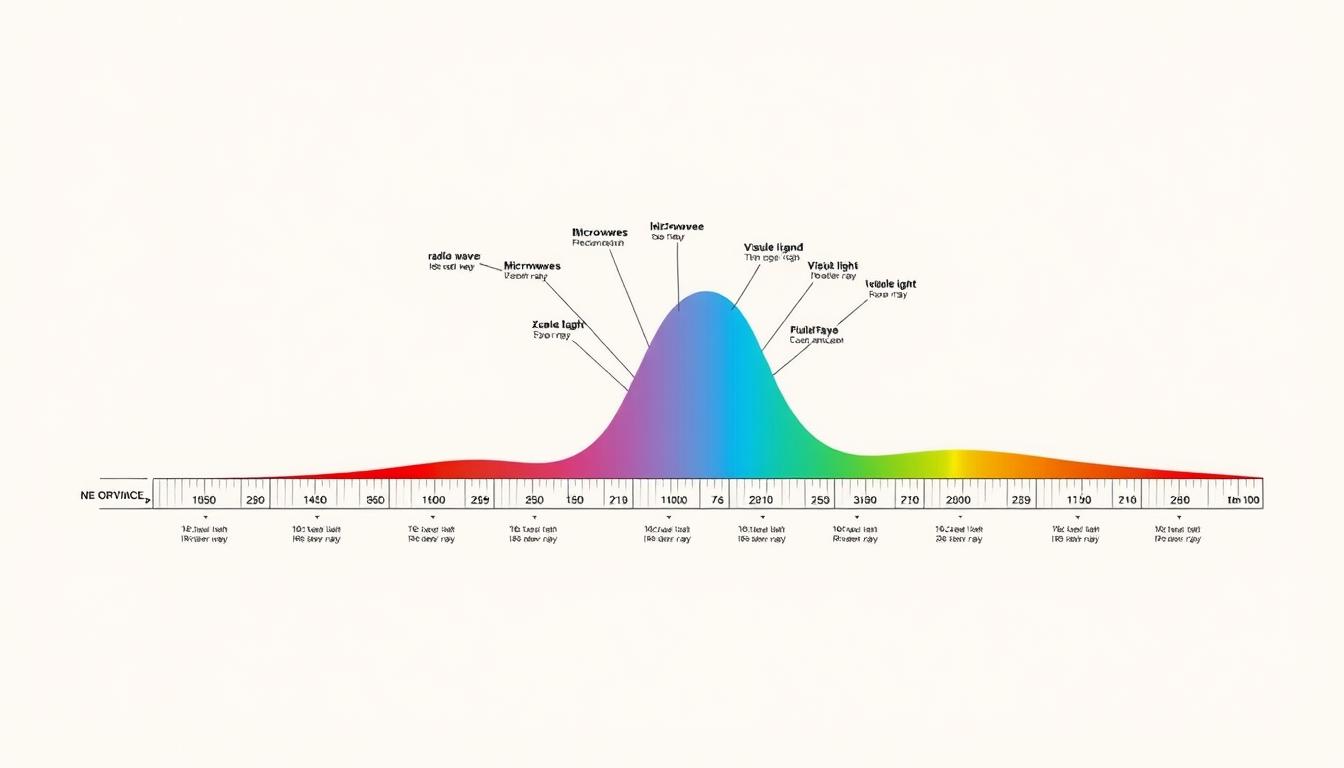
by Understanding the Electromagnetic Spectrum is key in physics. It covers all kinds of electromagnetic radiation. A big part of this is the Emission Spectra. This is the range of wavelengths that different light sources emit.
The diagram of Emission Spectra shows us a lot about light sources like stars and glowing gases. Scientists use these spectra to figure out what stars and other celestial bodies are made of.
This diagram helps us see the differences between various spectra. It’s important for learning about our universe.
The Science Behind Light and Color
Understanding light and color is key to grasping emission spectra. Light is more than just light; it tells us about the world. It shapes how we see colors and understand the universe.
How Light Carries Information
Light has many properties like intensity, frequency, and polarization. Our eyes and brains decode this information, letting us see colors and understand our surroundings. Spectral lines are important because they show specific wavelengths of light.
The Nature of Visible Light
Visible light is a small part of the electromagnetic spectrum. It ranges from 380 to 780 nanometers, showing us the colors of the rainbow. This light has both wave and particle properties. Visible emission lines help us understand light sources.
Color Perception and Spectral Distribution
Color perception is tied to light’s spectral distribution. Different wavelengths mean different colors. The mix of these wavelengths creates the color we see. For example, rainbows show the continuous spectrum of sunlight.
| Wavelength Range (nm) | Color | Spectral Line Examples |
|---|---|---|
| 380-450 | Violet | Mercury (Hg) emission lines |
| 450-495 | Blue | Hydrogen (H) beta line |
| 495-570 | Green | Neon (Ne) emission lines |
| 570-590 | Yellow | Sodium (Na) D lines |
| 590-780 | Red | Hydrogen (H) alpha line |
Fundamentals of Emission Spectra
Emission spectra help us understand how light is emitted. They show how different materials light up when excited. This is key to knowing how they react to energy.
Definition and Basic Principles
Emission spectra are the light wavelengths or frequencies given off by atoms or molecules. They move from a high energy state to a low one. This happens based on quantum mechanics, where the energy gap equals the photon’s energy.
The Physics of Light Emission
Light is emitted when an atom or molecule gets excited. This can be from heat, electricity, or other radiation. When it goes back to its normal state, it releases energy as photons. The energy of these photons decides the spectrum’s characteristics.
Continuous vs. Discrete Spectra
Emission spectra fall into two types: continuous and discrete. Continuous spectra have all wavelengths in a range, like incandescent solids or dense gases. Discrete spectra, on the other hand, have clear lines or bands, seen in excited atoms or molecules in gas.
Knowing the difference between these spectra is vital. It helps us understand and use this knowledge in fields like astrophysics and materials science.
The Electromagnetic Spectrum in Context
The electromagnetic spectrum includes all kinds of electromagnetic radiation. It ranges from low-frequency, long-wavelength forms like radio waves to high-frequency, short-wavelength forms like gamma rays. This wide range is key to understanding many physical phenomena and technological uses.
Wavelength, Frequency, and Energy Relationships
The electromagnetic spectrum shows a link between wavelength, frequency, and energy. Wavelength and frequency are opposites, as shown by the speed of light equation: c = λν. Here, c is the speed of light, λ is the wavelength, and ν is the frequency. The energy of electromagnetic radiation goes up with its frequency, as E = hν shows. Here, E is the energy and h is Planck’s constant.
Visible Light Region
The visible light region is what we can see, from 380 nm to 740 nm. It includes the colors of the rainbow, from violet to red. This part of the spectrum is vital for understanding how we see colors and how light behaves.
Beyond Visible: UV and IR Emissions
Electromagnetic radiation also includes ultraviolet (UV) and infrared (IR) emissions. UV radiation, with shorter wavelengths than visible light, can start chemical reactions. It’s used in sterilization. IR radiation, with longer wavelengths than visible light, is linked to heat. It’s used in thermal imaging and heating.
Quantum Mechanics and Atomic Structure
Quantum mechanics helps us understand the atomic structure. It introduces new ideas that differ from classical physics. These ideas give us a deeper look into how atoms work.
Bohr’s Atomic Model
In 1913, Niels Bohr came up with a new atomic model. It showed that energy levels are not continuous but are instead quantized. This means electrons can only be in certain energy levels around the nucleus.
Bohr’s model was a big improvement over earlier models. It explained why atomic spectra show only certain lines.
Electron Energy Levels and Transitions
Electrons in atoms are in specific energy levels or shells. When they move between these levels, they emit or absorb photons. This is why we see different wavelengths in atomic spectra.
| Energy Level Transition | Wavelength (nm) | Emission/Absorption |
|---|---|---|
| n=2 to n=1 | 121.6 | Emission |
| n=3 to n=2 | 656.3 | Emission |
| n=1 to n=2 | 121.6 | Absorption |
Quantum Numbers and Selection Rules
Quantum numbers describe the energy and shape of atomic orbitals. They also tell us about the spin of electrons. The four quantum numbers (n, l, m_l, m_s) fully describe an electron’s state.
Selection rules tell us which energy level transitions are possible. These rules affect what we see in atomic spectra.
Understanding these principles is key to interpreting emission spectra. It helps us learn more about atomic structure.
Types of Emission Spectra Explained
Emission spectra are divided into different types based on their features and sources. Knowing these types is key for analyzing spectra and for use in physics and other sciences.
Line Spectra Characteristics
Line spectra show up as distinct lines at specific wavelengths. They come from excited atoms in gases. Line spectra are unique to each element, helping us identify them. For example, hydrogen’s spectrum shows a series of lines for different energy levels.
Band Spectra Formation
Band spectra are made of many lines close together, looking like bands. They are mainly from molecules, not atoms. Band spectra are complex and tell us a lot about molecular structure.
Continuous Spectra Sources
Continuous spectra have wavelengths that go on without breaks. They come from solids or dense gases when they’re heated. Things like incandescent bulbs and stars give off continuous spectra. The temperature of these sources shapes their spectrum.
| Type of Spectrum | Characteristics | Sources |
|---|---|---|
| Line Spectra | Discrete lines, specific wavelengths | Excited atoms in gases |
| Band Spectra | Closely spaced lines, band appearance | Molecules, molecular gases |
| Continuous Spectra | Continuous range of wavelengths | Solid or dense gases when heated |
A physicist once said, “The variety in emission spectra shows the diversity of atomic and molecular structures. It gives us a peek into the physical properties of different substances.” Knowing about these different spectra is vital for progress in physics, chemistry, and astronomy.
Atomic Emission Spectra: Element Fingerprints
Every element has a special atomic emission spectrum. It’s like a fingerprint that lets scientists tell elements apart.
The special thing about these spectra is their unique spectral signatures. When atoms get excited, they send out light at certain wavelengths. This light is unique to each element. It comes from how electrons move and change energy levels.
Unique Spectral Signatures
The spectral signatures come from an element’s atomic structure. They show how electrons move. These signs are so clear that scientists can spot elements in complex mixtures. They match the spectrum to known standards to confirm an element’s presence.
Spectral Line Series (Lyman, Balmer, Paschen)
Atomic emission spectra show series of lines, like the Lyman, Balmer, and Paschen series. These lines are from specific electron transitions in hydrogen atoms. The Lyman series goes to n=1, the Balmer series to n=2, and the Paschen series to n=3. These series help us understand how atoms are structured.
Intensity Patterns and Their Significance
The intensity of spectral lines tells us about the elements’ amounts and how they’re emitting light. By looking at wavelengths and intensities, scientists learn more about what’s emitting the light.
In short, atomic emission spectra are key for identifying elements and learning about their properties. The unique signatures, spectral lines, and intensity patterns all add to the spectrum’s rich information.
Visualizing Emission Spectra: Physics Diagrams
Physics diagrams are key for showing emission spectra. They make it easy to see the spectral lines and how intense they are. This helps us understand the properties of elements and their atomic structure.
Standard Spectral Notation
Standard spectral notation is a way to show the spectral lines of elements. It uses symbols and formats to mark different transitions and energy levels. This notation is crucial for comparing and analyzing the emission spectra of various elements.
Energy Level Diagrams
Energy level diagrams show the energy states of electrons in an atom. They help us see how electrons move between energy levels, emitting or absorbing photons. The diagrams have energy levels as horizontal lines, with arrows showing the transitions.
Spectral Line Plots
Spectral line plots are graphs of emission spectra. They show the intensity of spectral lines against wavelength or frequency. These plots help identify elements in a sample and their concentrations.
Intensity vs. Wavelength Graphs
Intensity vs. wavelength graphs are a type of spectral line plot. They show the intensity of emitted light against its wavelength. These graphs are great for analyzing the emission spectra of gases and plasmas.
3D Spectral Representations
3D spectral representations offer a detailed view of emission spectra. They add dimensions like time or spatial distribution. These representations give deeper insights into emission processes.
| Visualization Method | Description | Application |
|---|---|---|
| Standard Spectral Notation | Systematic representation of spectral lines | Comparing emission spectra |
| Energy Level Diagrams | Illustration of atomic energy states | Understanding electron transitions |
| Spectral Line Plots | Graphical representation of emission spectra | Identifying elements and concentrations |
Emission Spectra of Common Elements
Studying the emission spectra of common elements shows how complex their atoms are. These spectra help us understand the properties of elements. They also show how elements are used in different fields.
Hydrogen: The Simplest Spectrum
Hydrogen has the simplest emission spectrum because it has only one electron. The emission spectrum of hydrogen includes several series of lines. These lines show different energy transitions.
The Balmer series is important because it’s in the visible part of the spectrum. This makes it easy to see with simple tools.
Helium and Noble Gases
Helium and other noble gases have more complex emission spectra than hydrogen. Their spectra have many lines for different energy transitions. These spectra are used in lighting, like neon signs and plasma TVs.
Metals: Sodium, Mercury, and Neon
Metals like sodium and mercury have unique emission spectra. Sodium’s bright yellow light is used in street lights. Mercury vapor lamps give off a blue-white light for industrial uses.
Neon, not a metal but often talked about, has a bright red emission. This is seen in neon signs.
Complex Elements and Their Patterns
Complex elements have detailed emission spectra because of many energy transitions. Knowing these spectra is key for spectroscopy and analytical chemistry.
| Element | Characteristic Emission Lines | Applications |
|---|---|---|
| Hydrogen | Lyman, Balmer, Paschen series | Spectroscopic analysis |
| Helium | Multiple lines in visible and UV | Lighting, plasma TVs |
| Sodium | Yellow emission (589 nm) | Street lighting |
| Mercury | Blue-white emission | Industrial lighting |
Artificial Light Sources and Their Characteristic Spectra
Artificial light sources have changed how we light up our world. Each type has its own special light spectrum. This variety shows how science and tech have grown, meeting many different needs.
Incandescent Lighting
Incandescent lighting is one of the oldest types. It works by heating a filament until it glows. The light it makes is like a blackbody radiator.
The temperature of the filament decides the light’s color. It can range from warm yellow to bright white.
Fluorescent and Gas Discharge Lamps
Fluorescent lamps make light by exciting gas, which then creates ultraviolet light. This light is turned into visible light by phosphor coatings. The light from these lamps comes from the phosphor’s emission and the gas’s spectral lines.
Gas discharge lamps, like neon signs, light up at specific wavelengths. This depends on the gas used.
LED Technology
LEDs (Light Emitting Diodes) make light through electroluminescence. The energy gap in the semiconductor material decides the light’s wavelength. LEDs can light up in many colors, with spectra that are narrower than incandescent or fluorescent lamps.
Laser Light Emission
Lasers make light through stimulated emission. They produce a very monochromatic and coherent beam. The spectrum of a laser is very narrow, often just one wavelength.
The light spectra of these artificial sources define their uses. They also affect their efficiency, color, and environmental impact. Knowing about these spectra helps improve lighting tech and meet energy needs.
Natural Light Sources and Their Emission Patterns
Natural light sources, like the sun and bioluminescent creatures, amaze and teach us. They help us understand the physical and biological world around us.
The Sun’s Spectrum
The Sun is key for Earth, sending out a wide range of light and radiation. The Sun’s spectrum includes visible light, UV, and IR. Each part affects our climate and daily life.
Stellar Classification Through Spectroscopy
Stars, like the Sun, have their own light patterns. Spectroscopy lets scientists figure out a star’s temperature and what it’s made of by looking at its spectrum.
| Stellar Type | Spectral Characteristics |
|---|---|
| O-Type | High temperature, ionized helium lines |
| M-Type | Low temperature, molecular bands |
Atmospheric Phenomena (Aurora, Airglow)
Things like aurora and airglow are natural light sources too. They happen when solar radiation meets our atmosphere, creating beautiful colors.
Bioluminescence Spectra
Bioluminescence is when living things make and send out light. It’s seen in fireflies and some sea creatures. It helps them talk and protect themselves.
In summary, natural light sources show us many different ways of shining. By studying these, scientists learn about the world’s physical and biological sides.
Spectroscopy Techniques and Instrumentation
Understanding spectroscopy techniques and instrumentation is key to interpreting emission spectra data. Spectroscopy is a basic tool in physics and chemistry. It helps scientists study how matter interacts with electromagnetic radiation.
Prism and Grating Spectroscopes
Traditional spectroscopy uses prism or grating spectroscopes. Prism spectroscopes refract light through a prism, spreading it into colors. Grating spectroscopes use a diffraction grating to spread light. Both are good for analyzing emission spectra, depending on the application and needed resolution.
Modern Digital Spectrometers
Modern spectroscopy has been changed by digital spectrometers. They are precise and easy to use. These tools use gratings and CCDs to detect and measure spectral lines. For more on spectroscopy basics, check out Webb Telescope’s Spectroscopy 101.
Resolution and Sensitivity Factors
The resolution and sensitivity of spectroscopic tools are very important. Resolution is about seeing differences in spectral lines. Sensitivity is about detecting the smallest signals. The entrance slit width, grating quality, and detector sensitivity all affect the spectrometer’s performance.
Calibration Methods
Calibration is vital in spectroscopy to ensure accurate spectra. Common methods include using calibration lamps (like mercury or neon lamps) and comparing spectra. Proper calibration is key for quality data and accurate interpretations.
Interpreting Emission Spectrum Data
Looking at emission spectra gives us important clues about what’s emitting light. This is key to understanding different light sources, both natural and man-made.
“The art of interpreting emission spectra lies in understanding the intricacies that show what’s emitting,” say spectroscopy experts. To do this well, we need both qualitative and quantitative methods.
Qualitative Analysis Approaches
Qualitative analysis helps us figure out what’s in a substance by looking at its emission spectrum. We compare the spectrum with known patterns of elements. Qualitative analysis is vital for identifying unknown substances.
Quantitative Measurement Techniques
Quantitative methods let us measure how much of something is in a substance. We do this by looking at how strong certain spectral lines are. Quantitative measurement is key in fields like environmental science and materials research.
Spectral Line Broadening Effects
Spectral line broadening can change how we read emission spectra. Effects like Doppler and pressure broadening can make lines wider and less clear. It’s important to understand these to analyze spectra correctly.
Common Challenges and Solutions
There are hurdles in interpreting emission spectrum data, like spectral overlap and instrument limits. To overcome these, we use better spectroscopic tools and improve our instruments. This makes our analysis more accurate and trustworthy.
Real-World Applications of Emission Spectroscopy
Emission spectroscopy is used in many ways, beyond just the lab. It helps in science and technology, giving us new insights and ideas. This method is key in many fields, helping us learn and grow.
Astronomical Research and Discoveries
In space research, emission spectroscopy is very important. It helps scientists understand what stars and galaxies are made of. For example, the Hubble Space Telescope uses it to find new things about our universe.
“The universe is full of mysteries, and emission spectroscopy is helping us unravel them, one spectrum at a time.”
Material Science and Engineering
In material science, emission spectroscopy helps us study materials. It’s used to find out what materials are made of. This is key for making new materials and improving how we make things.
| Material | Application | Benefit of Emission Spectroscopy |
|---|---|---|
| Metals | Aerospace Industry | Precise composition analysis for quality control |
| Semiconductors | Electronics | Detection of impurities and defects |
Environmental Monitoring
Emission spectroscopy is also used to check the air, water, and soil for pollutants. This is important for keeping our environment safe and following rules. For example, LIBS can spot soil pollution, helping clean up dirty areas.
Medical and Biological Applications
In medicine, emission spectroscopy helps diagnose diseases. It looks at the chemicals in tissues and fluids. For example, fluorescence spectroscopy can find diseases early, helping doctors treat them better.
By using emission spectroscopy, scientists and experts in many fields are making big discoveries. They’re helping us understand the world better and live healthier lives.
Future Frontiers in Emission Spectra Research
New technologies and better ways to compute are changing how we study emission spectra. These changes help us understand light better. They also make emission spectroscopy useful in more areas.
Emerging Technologies
Emerging technologies like nanotechnology and advanced materials are changing emission spectra research. They help make new light sources and detectors that are better and more flexible.
Computational Spectroscopy
Computational spectroscopy is key in analyzing and understanding emission spectra. New computer models and algorithms help predict spectral patterns. This makes it easier to figure out complex molecules.
Interdisciplinary Applications
The study of emission spectra is getting more interdisciplinary. It’s used in astronomy, environmental science, and biomedical research. This teamwork leads to new ideas and discoveries.
As research keeps moving forward, the future of emission spectra looks bright. There’s a lot of promise for new discoveries and uses.
Conclusion: The Enduring Value of Understanding Emission Spectra
Understanding emission spectra is key in many scientific fields. This includes astronomy and materials science. It helps researchers figure out what stars and planets are made of, and what’s in our atmosphere and materials.
Studying emission spectra leads to big breakthroughs. It helps in spectroscopy, quantum mechanics, and optical technology. Scientists can make new tools, better ways to analyze things, and find new uses.
As science keeps moving forward, knowing about emission spectra will become even more important. It helps us learn more, innovate, and solve big problems. By exploring emission spectra, we can find new things and understand the world and universe better.