 by
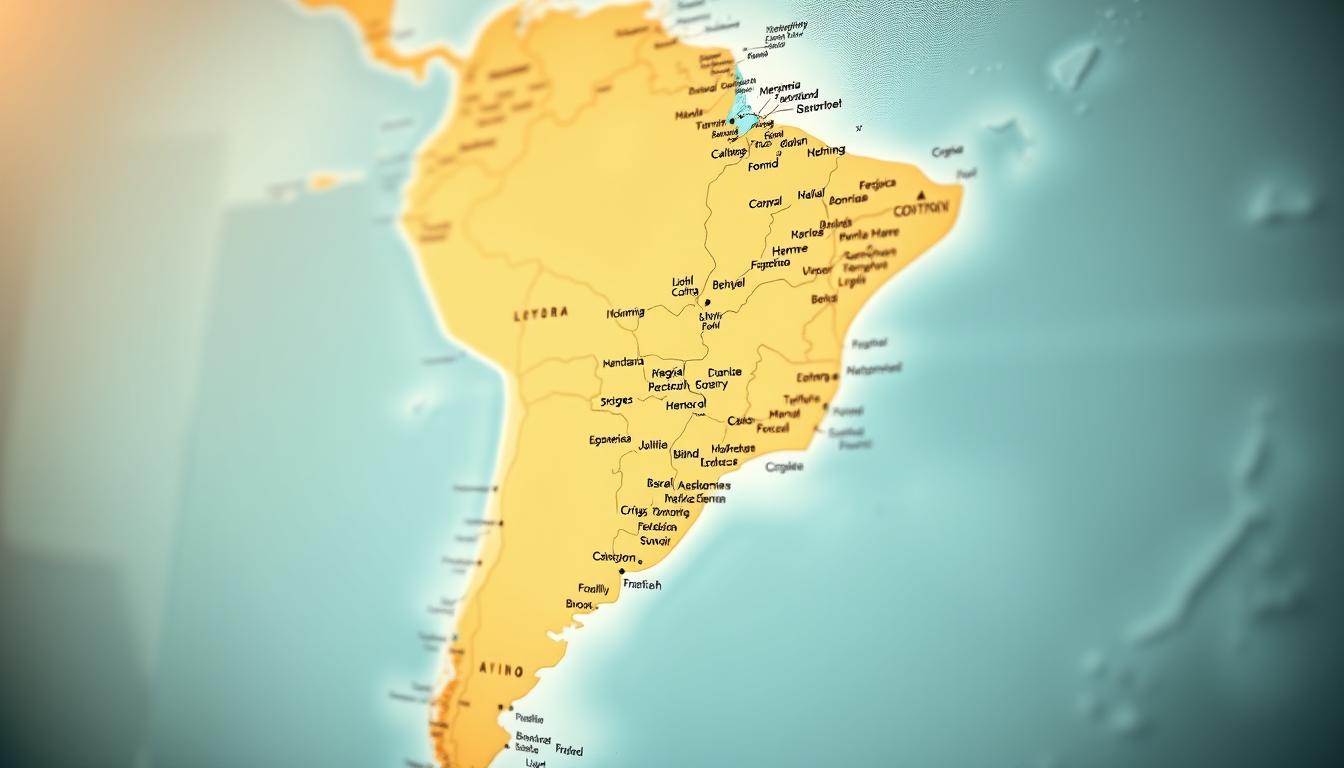
by The Brazilian Institute of Geography and Statistics (IBGE) is the top source for Brazil’s geographical data. This includes its administrative divisions and territorial organization. The political map of Brazil is key to understanding its geography.
This map is vital for many reasons. It helps with education, research, and planning policies. It shows the country’s states and their borders clearly. This makes it essential for making decisions and governing.
IBGE’s accurate and current data is key to supporting these efforts. It helps a lot.
The Significance of Brazil’s Political Geography
Brazil’s political geography is very important. It has a huge area and a key location. This makes it a big player in both local and global politics.
Brazil’s Position in South America
Brazil is right in the middle of South America. It borders countries like Argentina, Bolivia, and Peru. Its central spot makes it very important in regional politics and trade.
Its long coastline along the Atlantic Ocean adds to its importance. This makes it a key player in international trade and maritime connections.
- Shares borders with 10 countries, making it a key player in regional integration efforts.
- Has a significant coastline, facilitating international trade and maritime connections.
Territorial Size and Global Importance
Brazil is the biggest country in South America and the fifth-largest worldwide. Its huge size gives it a lot of power. It has many different environments, like the Amazon rainforest, savannas, and coastal areas.
Key aspects of Brazil’s territorial size include:
- Occupies nearly half of the South American continent.
- Hosts a significant portion of the Amazon rainforest, impacting global environmental policies.
The Official Brazil Political Map: IBGE as the Authoritative Source
The Brazilian Institute of Geography and Statistics (IBGE) is key in making Brazil’s official political map. It shows its importance as the top place for gathering and mapping Brazil’s geography.
IBGE started in 1934. It has helped Brazil understand its geography, from maps to ecosystems, ever after.
History and Role of the Brazilian Institute of Geography and Statistics
IBGE began when Brazil was changing a lot. It was made to give accurate geography info. Now, it uses new tech and methods to keep Brazil’s map reliable for many uses.
IBGE does more than just maps. It also does censuses and surveys. These help shape policies and plans for Brazil.
IBGE’s Cartographic Standards and Methodologies
IBGE follows strict map-making rules. It uses satellite images, GIS, and field checks to make sure Brazil’s map is right.
IBGE keeps its methods up to date. This makes Brazil’s map a key tool for understanding its complex geography.
| Year | Significant Cartographic Achievement | Technologies Used |
|---|---|---|
| 1934 | Establishment of IBGE | Traditional Surveying |
| 1980s | Introduction of Satellite Imagery | Satellite Imagery, GIS |
| 2000s | Digital Mapping Initiatives | GIS, Digital Cartography |
IBGE is dedicated to top-notch cartography and geography data. It keeps Brazil’s complex political map accurate and up to date.
Historical Evolution of Brazil’s Political Divisions
Brazil’s political divisions have a rich history. They started as colonial captaincies and grew into modern states. Many factors have shaped these divisions, including colonial legacy, independence, and territorial reforms.
From Colonial Captaincies to Modern States
The Portuguese set up colonial captaincies in Brazil in the 16th century. These were large areas given to nobles and explorers. They were responsible for administration and defense.
Over time, these captaincies turned into provinces. After Brazil became independent in 1822, they became the states we know today. The journey was not easy, with many changes along the way.
The Imperial Constitution of 1824 was key in setting up the first provincial boundaries. These boundaries later influenced the state boundaries.
| Period | Major Political Divisions | Key Features |
|---|---|---|
| Colonial Era (1500-1822) | Captaincies, later Provinces | Established by Portuguese; large land grants to nobles |
| Imperial Period (1822-1889) | Provinces | Defined by Imperial Constitution of 1824 |
| Republican Period (1889-present) | States | Provinces became states; ongoing territorial adjustments |
Key Territorial Reforms
After gaining independence, Brazil saw many territorial changes. One big change was the creation of the Federal District in 1960. This led to Brasília becoming the new capital, moving from Rio de Janeiro.
Other changes included redrawing state boundaries and creating new states. For example, Tocantins was created in 1988 from Goiás. These changes show how Brazil’s political map has evolved over time.
Federal Structure on the Political Map of Brazil
To understand Brazil’s political map, you need to know about its federal structure. It has many layers of government. The map shows how power is spread out across different areas.
Three Levels of Government: Federal, State, and Municipal
Brazil has three main government levels: federal, state, and municipal. The federal government deals with national issues, defense, and foreign relations. State governments manage their areas, like education and security. Municipal governments handle local issues, like city planning and buses.
It’s important how powers are divided among these levels. This setup helps each government focus on its own tasks. It makes sure everyone knows their role.
Constitutional Division of Powers Across Territories
The Constitution of Brazil explains how powers are divided. Some things, like defense and foreign policy, belong only to the federal government. Other things, like education and health, are shared among all levels.
| Level of Government | Responsibilities | Examples |
|---|---|---|
| Federal | National policies, defense, foreign affairs | National security, international relations |
| State | State-level policies, education, security | State highways, public safety |
| Municipal | Local affairs, urban planning, public transportation | Local roads, zoning regulations |
This setup helps balance power across Brazil’s vast and varied areas. Knowing this is key to understanding Brazil’s political landscape and its map.
The Five Geographic Regions of Brazil
Brazil is divided into five geographic regions. Each region shows the country’s varied geography and culture. These areas are connected and are key to Brazil’s politics, economy, and society.
North Region: The Amazon and Beyond
The North Region makes up nearly 45% of Brazil. It’s mostly the Amazon rainforest. This region is very big but not very populated. It’s full of life and is important for saving the environment.
Northeast Region: Cultural and Historical Heartland
The Northeast Region is rich in culture and history. It was the first place the Portuguese colonized. It’s known for its festivals and traditions. The economy here is based on farming, tourism, and making things.
Central-West Region: Agricultural Frontier and Capital
The Central-West Region is all about farming. It’s called Brazil’s farming frontier. Brasília, the capital, is here. It’s a city planned for the future.
Southeast Region: Economic Powerhouse
The Southeast Region is Brazil’s economic center. It has big cities like São Paulo and Rio de Janeiro. This region is very populated and makes a lot of money. It’s where most of Brazil’s business happens.
South Region: European Influence and Development
The South Region has a strong European feel. You can see it in its culture, buildings, and food. It’s very developed, with a focus on farming, making things, and tourism. It’s one of the wealthiest parts of Brazil.
| Region | Key Characteristics | Economic Activities |
|---|---|---|
| North | Amazon rainforest, biodiversity | Environmental conservation, eco-tourism |
| Northeast | Cultural heritage, historical significance | Agriculture, tourism, manufacturing |
| Central-West | Agricultural frontier, Brasília | Agriculture, government services |
| Southeast | Economic hub, major cities | Industry, finance, commerce |
| South | European influence, developed economy | Agriculture, industry, tourism |
All 26 States and the Federal District on Brazil’s Political Map
Brazil’s political scene is made up of 26 states and the Federal District. Each is shown on a detailed political map. This map helps us understand Brazil’s administrative setup and its complexities.
State Boundaries, Capitals, and Key Characteristics
The 26 states of Brazil vary in size, population, and economy. Each has its capital, like São Paulo, which is also Brazil’s financial center. Rio de Janeiro, the capital of Rio de Janeiro state, is famous for its culture and landmarks.
The states are divided into five main regions: North, Northeast, Central-West, Southeast, and South. Each region has its own history, culture, and geography. For example, the North is home to the Amazon rainforest, while the Northeast is known for its rich culture.
- The Southeast Region is Brazil’s economic heart, led by São Paulo and Rio de Janeiro.
- The South Region has a European feel and is known for farming.
- The Central-West Region, where Brasília is, is important for farming and is the capital.
Brasília: The Planned Federal District
Brasília, Brazil’s capital, is in the Federal District. It was designed by Lúcio Costa and Oscar Niemeyer and opened in 1960. It’s a symbol of modernity and a planned city.
“Brasília represents a bold experiment in urban planning, combining modernist architecture with a futuristic vision for the country’s capital.”
The Federal District is key for politics and administration. It’s also a sign of Brazil’s vision for the future in urban planning. Brasília’s design shows a mix of function and beauty, making it a standout in modern urban planning.
Major Urban Centers and Metropolitan Regions
Major urban centers and metropolitan regions in Brazil are key to its economy and society. These areas are not just crowded but also drive growth, innovation, and diversity.
São Paulo, Rio de Janeiro, and Other Megacities
Brazil has some of the biggest cities globally, with São Paulo and Rio de Janeiro leading the pack. São Paulo is a financial powerhouse, while Rio is famous for its culture and landmarks. Other big cities like Brasília and Salvador also have important roles in Brazil’s urban scene.
- São Paulo: Financial and economic hub
- Rio de Janeiro: Cultural significance and tourism
- Brasília: Planned capital with administrative importance
- Salvador: Cultural heritage and historical significance
Population Distribution and Urbanization Patterns
The population in Brazil is mostly found in the southeast, around São Paulo and Rio de Janeiro. Knowing these urbanization patterns helps policymakers tackle issues like housing and transportation. The Brazil territory map shows the country’s size and population density differences.
Urbanization trends include:
- Rapid growth in metropolitan areas
- More people moving to cities for jobs
- Difficulty in providing enough infrastructure and services
By studying the Brazil government map and urban center dynamics, we can plan for a better future. This ensures sustainable growth and a better life for everyone.
Brazil’s International Borders and Territorial Waters
Brazil shares borders with several countries and has a vast coastline. Its international borders and territorial waters are key for its economy and security. Being the largest country in South America, Brazil’s location is strategic, affecting regional and global politics.
The country’s extensive borders and territorial waters are vital for its economy and environment. Understanding these aspects is key to knowing Brazil’s role in the world.
The Ten Neighboring Countries
Brazil is bordered by ten countries, making it one of the countries with the most neighbors. These countries are:
- Argentina
- Bolivia
- Colombia
- French Guiana
- Guyana
- Paraguay
- Peru
- Suriname
- Uruguay
- Venezuela
These borders are more than just lines on a map. They are important for cultural and economic exchange. The diversity of neighboring countries enriches Brazil’s culture and shapes its foreign policy and trade.
| Country | Border Length (km) | Key Features |
|---|---|---|
| Argentina | 1,263 | Shared cultural heritage, significant trade |
| Bolivia | 3,423 | Energy resources, historical ties |
| Colombia | 1,644 | Amazon rainforest, biodiversity |
| French Guiana | 673 | Amazon rainforest, overseas department of France |
| Guyana | 1,308 | Diverse ecosystems, historical border disputes |
| Paraguay | 1,371 | Hydroelectric resources, agricultural trade |
| Peru | 2,695 | Amazon rainforest, indigenous communities |
| Suriname | 597 | Tropical rainforest, cultural diversity |
| Uruguay | 985 | River Plate basin, cultural exchange |
| Venezuela | 2,200 | Energy resources, geopolitical significance |
Maritime Boundaries and the “Blue Amazon”
Brazil’s maritime boundaries are also key, with a vast coastline along the Atlantic Ocean. The “Blue Amazon” refers to Brazil’s Exclusive Economic Zone (EEZ), rich in marine life and resources.
The “Blue Amazon” is vital for Brazil’s economy, providing fishing resources, oil and gas reserves, and trade routes. Protecting this area is a top priority for Brazil, for both environmental and economic reasons.
As Brazil develops its maritime resources, balancing economic growth and environmental protection is a challenge. The “Blue Amazon” is not just a national issue but also a regional and global concern, due to its marine biodiversity and the effects of climate change.
Natural Features on Brazil’s Political Map
Brazil’s geography has shaped its political map in many ways. The country’s vast landscape, from the Amazon rainforest to coastal mountains, has influenced its political divisions. This diversity has played a big role in how Brazil is divided.
How Geography Shapes Political Boundaries
The connection between Brazil’s natural features and its politics is clear. Major rivers, like the Amazon and Paraná, have divided the country. They have shaped the state and municipal boundaries.
The terrain has also shaped Brazil’s politics. For example, mountains have isolated areas. This has led to the growth of unique cultures.
Major Rivers, Mountains, and Ecosystems as Political Dividers
Brazil’s political map is marked by key natural features. The Amazon River, for instance, is a vital ecological and political boundary. It separates states and affects governance.
Mountain ranges, like the Serra do Mar, also define political boundaries. They often mark state and municipality limits. Ecosystems like the Pantanal and Caatinga shape regional identities and divisions.
It’s important to understand how these natural features impact Brazil’s politics. The detailed political map of Brazil, provided by the IBGE, shows how geography influences the nation’s politics.
Electoral Geography and the Brazil Political Map
Brazil’s electoral landscape is closely tied to its political map. This map affects many parts of the democratic process. It shapes electoral districts, voting patterns, and how politicians represent their areas.
Congressional and Senatorial Districts
The political map of Brazil shows where congressional and senatorial districts are. These areas are key for federal political representation. Congressional districts help ensure fair representation in the Chamber of Deputies. Senatorial districts match state lines, with each state getting three senators.
How these districts are drawn can change election results. For example, breaking states into smaller areas can affect which parties get represented. Important points to remember include:
- The number of deputies each state gets based on its population.
- States are equally represented in the Senate, no matter their size.
- Gerrymandering can sway election results.
Regional Voting Patterns and Political Representation
Voting patterns in Brazil vary by region, showing the country’s cultural, economic, and social diversity. The political map helps us see these differences and their impact on political representation.
Each region votes differently, based on local issues, economic conditions, and history. For example:
- The Northeast, rich in culture, often supports specific political parties.
- The Southeast, Brazil’s economic hub, may focus on different issues than poorer areas.
- The North and Central-West, with the Amazon, might emphasize environmental and indigenous rights.
Knowing these regional voting patterns is vital for political campaigns and policy-making. It helps parties target their efforts and ensures policies address regional needs.
Indigenous Territories and Protected Areas
Indigenous territories and protected areas are key to Brazil’s nature and balance. Brazil has a lot of biodiversity. Keeping this natural wealth safe depends on how we manage indigenous lands and conservation areas.
Legal Status and Governance of Indigenous Lands
The Constitution in Brazil protects the lands of indigenous peoples. The Brazilian Institute of Geography and Statistics (IBGE) helps mark these lands. They work with the government and indigenous groups.
Setting up these lands is a big deal. It involves talks between the government, indigenous people, and others. The Brazilian government’s commitment to respecting indigenous rights shows in its agreements and policies.
| Indigenous Territory | State | Area (km²) |
|---|---|---|
| Yanomami | Amazonas, Roraima | 9,600 |
| Kayapó | Pará, Mato Grosso | 3,300 |
Conservation Units and Their Administration
Brazil has a big system to protect its nature. These areas are managed by the government and local groups. The National System of Conservation Units (SNUC) helps keep these places safe and sustainable.
Managing these areas is a challenge. It’s about finding a balance between nature, local people, and growth. Working together is key to success.
- Protected areas cover about 18% of Brazil’s land.
- These areas are vital for keeping nature diverse.
- Getting local people involved is important for managing these areas well.
It’s important to understand the issues with indigenous lands and protected areas. This helps us protect the environment and respect indigenous rights. This is shown in the Brazil government map and Brazil territory map.
Practical Applications of Brazil’s Political Map
The detailed political map of Brazil has many uses. It helps in business, tourism, education, and governance. It offers insights into the country’s divisions, geography, and infrastructure.
For Business, Tourism, and Education
In business, the map aids in market analysis and finding new areas to grow. Companies can spot key areas for agriculture and see the best routes for transport.
- Tourism boards use it to show off attractions and plan for the future.
- Schools teach geography, history, and culture with this map.
For Policy Planning and Governance
The political map is key for policy and governance. It helps officials understand regions and plan projects. It also helps in allocating resources well.
Key applications include:
- Urban planning and development
- Environmental conservation efforts
- Disaster management and response planning
Using the map, government agencies can make better decisions. These decisions help the country grow and improve life for its people.
Accessing and Using IBGE’s Official Political Maps
Getting accurate political maps of Brazil is easy with the Brazilian Institute of Geography and Statistics (IBGE). They offer digital resources and GIS data. These tools help understand Brazil’s geography and its administrative parts.
Digital Resources and GIS Data
IBGE has many digital tools, including GIS data. These tools help users dive into geographical data. They provide shapefiles for states, municipalities, and more, useful for planning and studies.
Here’s what you can find on IBGE’s platform:
- Interactive maps for detailed exploration of Brazil’s geography.
- Downloadable datasets, like GIS shapefiles and statistics.
- APIs for adding IBGE’s data to custom apps.
Understanding Map Scales and Projections
It’s key to know about map scales and projections when using IBGE’s maps. Map scale shows the ratio of map distance to Earth’s surface distance. Larger scales offer more detail.
Map projections flatten the Earth’s surface. IBGE uses various projections, each with its own benefits and drawbacks. Knowing these helps in accurate map interpretation and decision-making.
Important points about map scales and projections include:
- Picking the right scale for your needs.
- Understanding projection distortions.
- Checking if map data fits your software.
By using IBGE’s maps well, users can learn a lot about Brazil’s geography. This knowledge is useful for many things, from planning policies to business strategies.
Conclusion: Brazil’s Political Map as a Dynamic Document
Brazil’s political map is a key tool for understanding the country. It shows Brazil’s complex geography and political landscape. The map also shows how Brazil has changed over time, from its colonial past to today.
The Brazil Political Map divides the country into five regions and 26 states, plus the Federal District. These Political regions in Brazil are important for the country’s politics and economy.
Knowing Brazil’s political geography is vital for many. It helps policymakers, researchers, businesses, and the public. It guides policy, investments, and education. As Brazil grows, its political map changes, showing updates in its divisions, cities, and environment.
The Brazil Political Map is more than a map. It’s a way to understand Brazil’s future and its challenges.