 by
by St. Helena island is a hidden gem in the South Atlantic Ocean. It has a unique geography that draws both travelers and historians.
It’s about 1,900 km west of the Angola/Namibia border. Its coordinates are 15°55’24.3″S; 5°43’3.5″W. This makes it a special spot in the Atlantic.
The isolated location of St. Helena adds to its allure. It attracts those who want to learn about its history and see its natural beauty.
We’ll dive into the island’s geography, history, and attractions. This guide will help you discover the charm of St. Helena.
St. Helena Location: An Overview of the Remote Island
St. Helena is over 1,800 kilometers west of Angola’s coast. It’s one of the most isolated inhabited islands globally. This isolation greatly affects its ecosystem and the lives of its people.
Geographical Coordinates and Position in the South Atlantic
St. Helena is at 15°55′S 5°42′W, in the South Atlantic Ocean. It’s 16 km long and 8 km wide, covering 121 km². Its unique location gives it a subtropical climate.
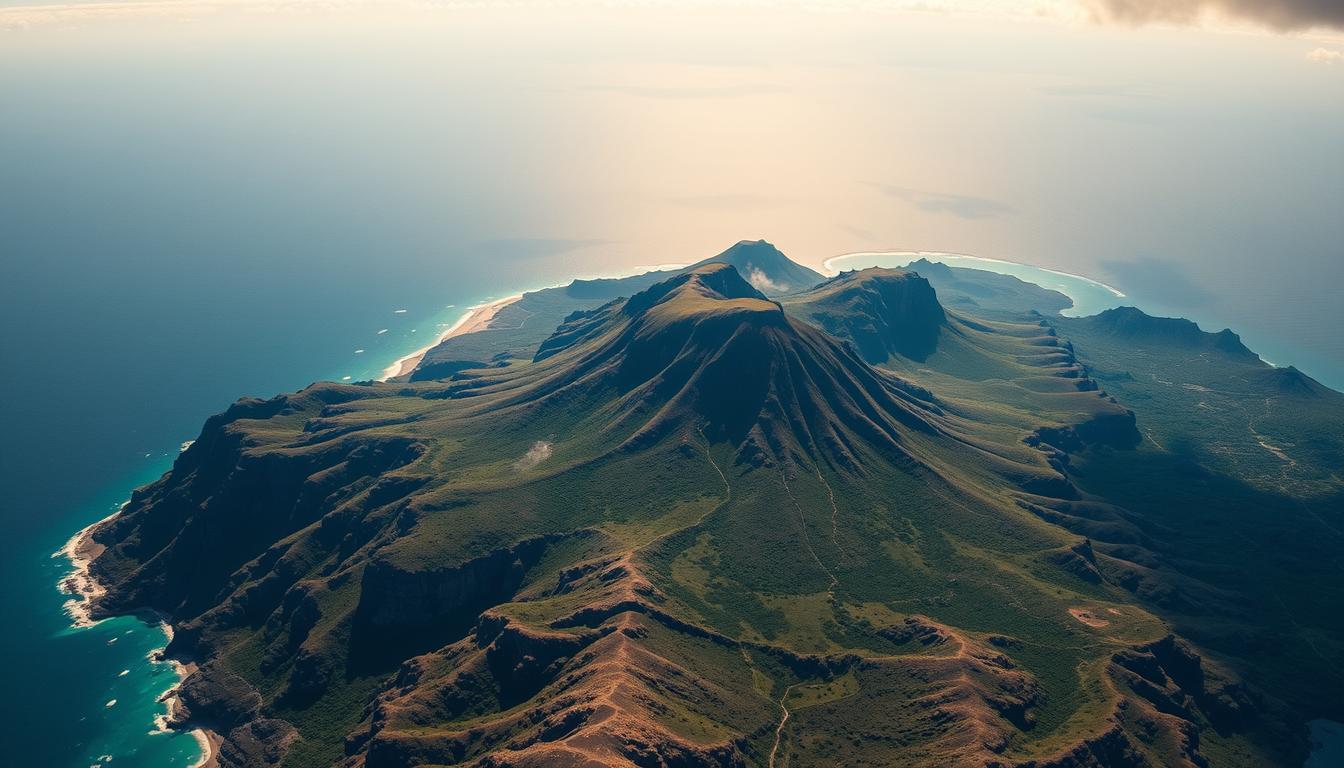
The island’s terrain is rugged, with steep slopes and deep valleys. This is due to its volcanic origins.
St. Helena’s Isolation: One of the World’s Most Remote Inhabited Islands
St. Helena’s isolation has both benefits and drawbacks. It has helped preserve the island’s natural beauty and biodiversity. Yet, it also makes life challenging, with limited access to goods and services.
The island’s remote spot has also made it historically significant. It was where Napoleon Bonaparte was exiled.
As a historian noted,
“St. Helena’s isolation has been a defining characteristic of the island, shaping its history, culture, and environment.”
The Geography of St. Helena
St. Helena is a remote island in the South Atlantic. It has a unique geography that fascinates many. The island’s landscape is shaped by its volcanic origins and erosion over millions of years.
Volcanic Origins and Terrain Features
St. Helena is a volcanic island, reaching 820 meters at its highest point. Its terrain is rugged, with steep slopes and deep valleys. These features are a result of volcanic activity and erosion.
Climate and Weather Patterns
The climate on St. Helena is mild, with temperatures between 15°C and 28°C all year. The subtropical climate is moderated by the ocean. The trade winds bring moisture, creating unique microclimates.
Flora and Fauna of the Island
St. Helena has a diverse range of flora and fauna, despite its remote location. Its unique biodiversity is due to its isolation. This allows endemic species to thrive.
The island’s flora includes many plant species found nowhere else. This makes St. Helena tourism appealing for nature lovers. Visitors can use a St. Helena map to explore the island’s natural wonders.
Finding St. Helena on Google Maps (2018 Version)
Google Maps makes finding St. Helena easy, even if you don’t know where it is. It shows the island’s terrain, roads, and landmarks. This makes it a great tool for travelers and fans of the island.
Step-by-Step Guide to Locating St. Helena
To find St. Helena on Google Maps, start by going to the Google Maps site. Type “St. Helena” in the search bar. The map will then zoom in on the island.
You can also use the coordinates (15.95° S, 5.72° W) to find it. Once you’ve found the island, you can see its roads, settlements, and landmarks.
Using the search function or entering the coordinates helps you find St. Helena. This is true even if you’re not sure where it is in the South Atlantic Ocean.
Using Satellite View for Better Visualization
Google Maps has a satellite view that shows St. Helena’s terrain in detail. To switch to satellite view, click on the layer icon and choose “Satellite.” This view is great for seeing the island’s geography, like its volcanic origins and terrain layout.
Saving and Sharing St. Helena’s Location
After finding St. Helena on Google Maps, you can save or share its location. To save it, click the “Save” button, which looks like a star. You can also share it by clicking “Share.” This lets you send the map link via email or social media.
This feature is handy for planning trips or sharing info about the island with others.
Exploring St. Helena with Google Maps Features
Google Maps lets travelers see St. Helena in a new way. It has many features for exploring this isolated place in detail.
Street View Availability and Limitations
Google Maps has Street View for some parts of St. Helena. It shows the terrain and buildings. But, because the island is far away, Street View only covers main roads and Jamestown.
3D Terrain View of St. Helena’s Landscape
The 3D terrain view on Google Maps is very immersive. It shows St. Helena’s volcanic origins and rough landscape. Users can explore valleys, peaks, and coastlines.
This feature is key for understanding the island’s geography. It helps plan hikes or sightseeing tours.
Measuring Distances and Planning Routes
Google Maps also lets users measure distances and plan routes. This is very useful for travelers. It helps them navigate the island on foot or by car.
By knowing the distances between places, visitors can plan their trip better. They can make the most of their time on the island.
| Feature | Description | Usefulness |
|---|---|---|
| Street View | Visualize main roads and settlements | High |
| 3D Terrain View | Explore island geography and terrain | High |
| Distance Measurement | Plan routes and calculate distances | High |
Major Settlements and Urban Areas
The island of St. Helena has many charming urban areas. Jamestown, the capital, is at the heart of it all. These places are filled with history and culture.
Jamestown: The Capital and Main Port
Jamestown is the capital and main port of St. Helena, with a population of about 1,500. It’s the island’s central spot, with shops, restaurants, and places to stay. The town’s buildings show off a blend of old and new styles.
Jamestown is more than just a government center. It’s also a cultural hub, hosting many events. You can see historic sites like the Castle, now the government’s home.
Other Notable Settlements and Districts
St. Helena has other important places too. Half Tree Hollow is a residential area with different homes. St. Paul’s is known for its beautiful views. Longwood is famous for its link to Napoleon Bonaparte, who was exiled there.
These areas, though smaller than Jamestown, show the island’s varied landscapes and communities. They add to the island’s charm and are key to its social life.
Historical Significance of St. Helena
St. Helena is more than just a remote island. It has a rich history that has shaped its identity. Its location in the South Atlantic made it valuable to colonial powers, like the British Empire.
Napoleon Bonaparte’s Exile and Death
Napoleon Bonaparte spent his final years on St. Helena, exiled after Waterloo in 1815. The island’s remote spot made escape impossible. He lived at Longwood House until his death on May 5, 1821. Today, Longwood House and Napoleon’s tomb are key attractions.
Napoleon’s time on St. Helena is well-documented. It gives us a glimpse into his life before he died. The British government made sure he stayed captive, with a strong military presence on the island.
Colonial History and Strategic Importance
St. Helena’s colonial history is also significant. It was first found by the Portuguese in 1502, then the Dutch, and later the British in 1659. The British saw its value as a strategic military outpost to protect their sea routes and trade.
- The island was a key stop for ships going between Europe and Asia.
- Its spot in the South Atlantic was vital for watching and controlling sea traffic.
- The British built strong defenses, like Jamestown, to ward off threats from other European powers.
St. Helena’s history is rich, from Napoleon’s exile to its colonial past. These stories have made the island unique, drawing historians and tourists.
St. Helena’s Top Landmarks and Attractions
St. Helena is a mix of history and nature, making it exciting for visitors. The island has landmarks that show its past and stunning views.
Longwood House and Napoleon’s Tomb
Longwood House was Napoleon Bonaparte’s home during his exile. It’s now a key historical spot. You can see how it looked back then.
Nearby, Napoleon’s Tomb is a big draw for history fans. Both Longwood House and Napoleon’s Tomb are managed by the French government, keeping them safe for the future.
Jacob’s Ladder and Heart-Shaped Waterfall
Jacob’s Ladder is a must-see for adventure seekers. It’s a long staircase with 699 steps. The climb is tough but the views are worth it.
The Heart-Shaped Waterfall is another natural beauty. It’s in a beautiful valley and has a unique shape. It’s peaceful and stunning.
Diana’s Peak National Park
Diana’s Peak National Park is perfect for nature fans. It’s the only national park on the island. You can see unique animals like the St. Helena earwig and the St. Helena plover.
The park’s highest point, Diana’s Peak, has amazing views. There are trails through lush greenery. It’s a great way to see St. Helena’s plants and animals up close.
In short, St. Helena has something for everyone. From historical sites like Longwood House to natural spots like Diana’s Peak National Park, it’s a place full of wonder.
Natural Wonders and Outdoor Activities
The island of St. Helena is a paradise for those who love the outdoors. It offers many activities in its stunning natural setting. Visitors can explore different landscapes, from rocky coastlines to green interiors.
Hiking Trails and Viewpoints
St. Helena has many hiking trails for all levels. The Peak National Park is a top spot, with trails through unique forests and to Diana’s Peak. From there, you can see amazing views of the island and the ocean.
Marine Life and Diving Opportunities
The waters around St. Helena are full of marine life. It’s a great place for divers. The island’s remote spot has kept its marine world untouched, letting divers see rare creatures like whale sharks and sea turtles.
Bird Watching and Endemic Species
St. Helena is a dream for bird watchers, with many species found only here. The St. Helena Plover, or Wirebird, is the national bird. Visitors can find these special birds in the island’s different environments.
| Activity | Location | Best Time |
|---|---|---|
| Hiking | Peak National Park | Early morning |
| Diving | Coastal waters | Year-round |
| Bird Watching | Varied habitats | Dawn and dusk |
Transportation to and Around St. Helena
Getting to St. Helena is part of the fun, with flights and ships leading to this hidden gem. The island’s spot in the South Atlantic Ocean makes it hard to get to. But with good planning, the trip can be smooth.
St. Helena Airport: Flight Options and Schedules
The main entry point for air travelers is St. Helena Airport. St. Helena Airport gets flights from Johannesburg and Cape Town with South African Airways. It also gets flights from the UK by charter.
The airport has been improved to handle bigger planes. This makes it easier to get there.
| Airline | Route | Frequency |
|---|---|---|
| South African Airways | Johannesburg/Cape Town to St. Helena | Weekly |
| Charter Flights | UK to St. Helena | Bi-Weekly |
Sea Access via Ship
For those who like the sea, RMS St. Helena offers a calm trip. The journey has had some hiccups, but other ships and cruise liners sometimes stop by. This gives travelers another way to reach the island.
“The sea journey to St. Helena is as much about the destination as it is about the journey itself, showing stunning views of the Atlantic Ocean.”
Local Transportation and Road Network
Once you arrive, you can get around with buses and taxis. The roads connect key places and sights, making it easy to see St. Helena.
St. Helena’s transport options are limited but work well. It offers a special travel experience that’s both far-off and accessible.
Accommodation and Dining Options
When you arrive on St. Helena, you’ll find many places to stay. There are hotels, guesthouses, and self-catering options for everyone. The island has something for every taste and budget, making your stay comfortable and fun.
Hotels, Guesthouses, and Self-Catering Facilities
St. Helena has a wide range of places to stay. Hotels vary from affordable to luxurious, with amazing views. Guesthouses offer a cozy, family-run feel. For those who like to cook, self-catering facilities let you make your own meals.
| Accommodation Type | Description | Price Range |
|---|---|---|
| Hotels | Luxury and budget options with various amenities | $100-$300 per night |
| Guesthouses | Family-run, personalized service | $80-$200 per night |
| Self-Catering | Independent living with kitchen facilities | $60-$150 per night |
Restaurants and Local Cuisine
Eating on St. Helena is a treat. You’ll find restaurants serving local and international dishes. Enjoy fresh seafood, traditional British food, and dishes that reflect the island’s culture. Many places use local ingredients, making meals tasty and supporting the local economy.
- Fresh seafood at island restaurants
- Traditional British cuisine
- Locally sourced ingredients
Connectivity and Communication on St. Helena
St. Helena’s connectivity has improved a lot. This change helps both visitors and locals. Now, it’s easier to stay connected thanks to better internet and mobile services.
Internet Access and Mobile Coverage
The island’s internet and mobile services have gotten much better. Reliable internet access is now available. This makes it easier to communicate and get information.
Mobile coverage has also grown. But, it’s important to remember that the island’s remote location can sometimes limit connectivity.
St. Helena has adopted modern telecommunications. This means visitors can easily stay in touch with loved ones or handle business needs. The expansion of mobile networks has been a big help in this area.
Using Google Maps Offline on the Island
For travelers, having maps is key, even without internet. Google Maps lets you save maps for offline use. This is super useful on St. Helena.
To use Google Maps offline, open the app, search for St. Helena, and download the map. This feature is great for exploring the island, even in areas with no internet.
Planning Your Visit to St. Helena
To enjoy your trip to St. Helena, knowing the island’s climate and entry rules is key. You also need to think about your budget. Planning well ensures a great visit to this remote island in the South Atlantic.
Best Time to Visit
The spring and autumn months are the best times to visit St. Helena. The weather is mild and nice during these times. Temperatures range from 15°C to 28°C (59°F to 82°F) all year.
Avoid summer if you don’t like the heat.
Visa Requirements and Entry Procedures
To visit St. Helena, you need a visa. You can get one from the St. Helena Government’s website. The entry process is simple, but following the rules is important.
Make sure your passport is valid for at least six months after your stay.
“St. Helena is a haven for those seeking a tranquil and unspoiled environment. The island’s unique blend of history, culture, and natural beauty makes it an attractive destination for travelers looking for an off-the-beaten-path experience.”
Budgeting for Your St. Helena Adventure
Planning your budget for St. Helena includes thinking about where to stay, eat, and what to do. The island has many places to stay, from luxury hotels to self-catering options. Plan your budget for flights, accommodation, and activities.
| Expense Category | Estimated Cost |
|---|---|
| Accommodation (per night) | $100-$250 |
| Food (per meal) | $15-$30 |
| Transportation (local) | $10-$20 |
Conclusion: The Allure of St. Helena’s Remote Location
St. Helena’s isolated spot in the South Atlantic is truly captivating. It offers a unique and untouched destination for travelers. The island’s volcanic origins and rugged terrain make its geography breathtaking and untouched.
Visitors can dive into St. Helena’s rich history, from Napoleon’s exile to its colonial past. They can also enjoy the island’s natural beauty and peaceful surroundings. The varied flora and fauna make it perfect for outdoor activities like hiking and diving.
St. Helena is a peaceful escape from the world’s noise. It promises an unforgettable experience for those brave enough to visit. With its history, natural beauty, and isolation, it’s a hidden gem waiting to be found.