 by
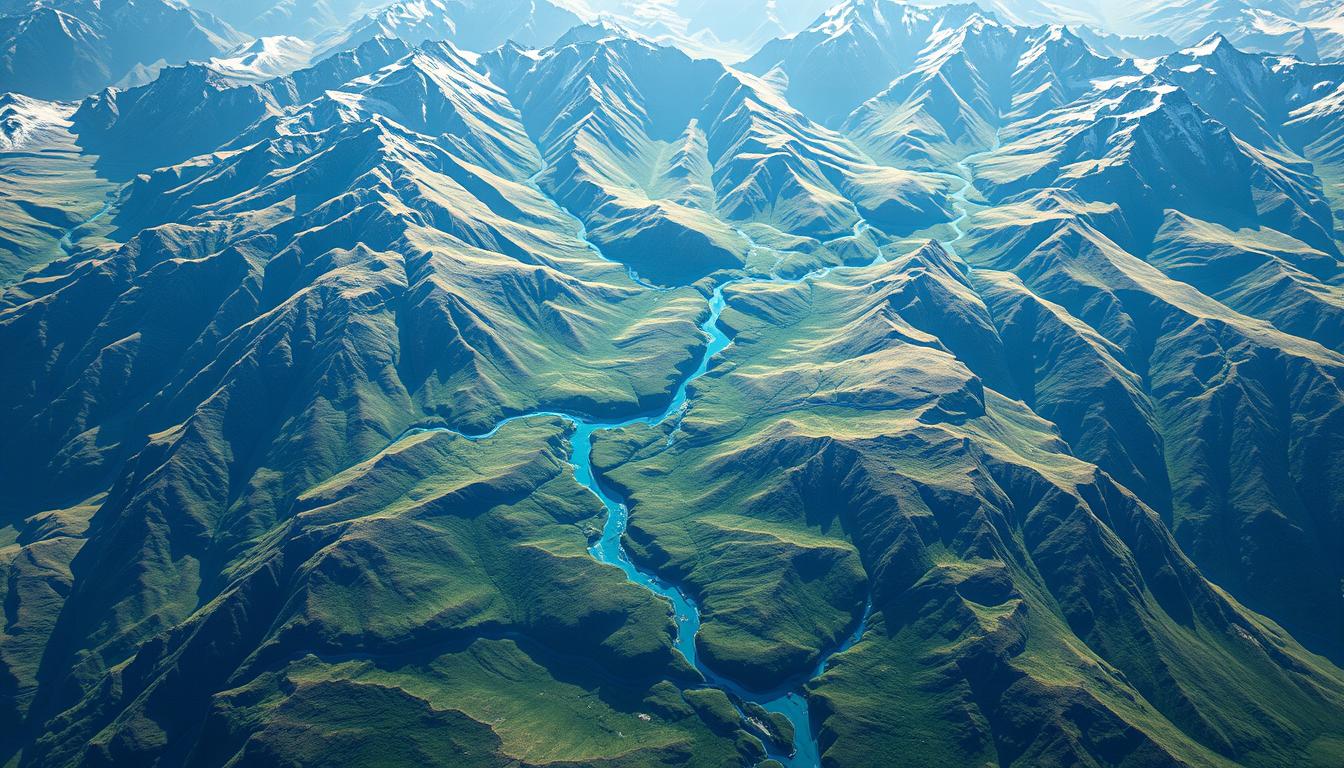
by The Indus River System is a key waterway in Asia. It starts near Lake Mansarovar in Tibet and ends in the Arabian Sea near Karachi, Pakistan.
A detailed map of Pakistan shows the river’s path. It’s vital for understanding the country’s geography. The Indus River map highlights the vast areas it covers, shaping Pakistan’s landscape.
Knowing Pakistan geography helps us see why the Indus River System is so important. This introduction gives a brief look at the river’s role and the areas it touches.
The Geographical Canvas of Pakistan
Pakistan’s geography is complex and fascinating. It has a variety of features that affect its climate, ecosystems, and where people live.
Topographical Features of Pakistan
Pakistan’s topography varies greatly. It can be divided into mountain ranges, highlands, plains, and deserts.
Mountain Ranges and Highlands
The north of Pakistan boasts some of the world’s most stunning mountains. The Himalayas and Karakoram ranges are breathtaking. They also shape the country’s climate and weather.
In contrast, the south of Pakistan has vast plains and deserts. The Indus River Plain is very fertile, perfect for farming. But the desert areas are harsh, with little rain and plants.
| Geographical Feature | Description | Significance |
|---|---|---|
| Mountain Ranges | Includes the Himalayas and Karakoram ranges | Influences climate and weather patterns |
| Plains | Fertile regions like the Indus River Plain | Supports intensive agriculture |
| Deserts | Arid regions with limited vegetation and rainfall | Harsh environment with unique ecosystems |
The Indus River System: Lifeline of Pakistan
The Indus River System stretches over 3,180 kilometers. It’s more than a river; it’s Pakistan’s lifeline. It supports agriculture, industry, and cities.
Overview of the River Network
The Indus River System is vast, covering about 1,120,000 km². It includes the main Indus River and many tributaries. Together, they form a system that supports life in the area.
Length, Volume, and Flow Statistics
The Indus River is about 3,180 km long. It flows at an average of 207 cubic kilometers each year. Its flow is key for irrigation, power, and water.
Key Statistics:
| Parameter | Value |
|---|---|
| Length | 3,180 km |
| Total Drainage Area | 1,120,000 km² |
| Average Annual Flow | 207 cubic kilometers |
Comparison with Other Major River Systems
The Indus River System is as significant as the Nile and Amazon. It may not be the longest, but its importance is unmatched.
The Indus River System’s unique features are vital for Pakistan. Knowing its length, volume, and flow helps manage its resources well.
Historical Journey of the Indus River
The Indus River’s history is closely linked to the Indus Valley Civilization. This ancient civilization thrived around 3300 BC. It shows how the river helped grow human settlements and cultures.
The Ancient Indus Valley Civilization
The Indus Valley Civilization is famous for its smart city planning, buildings, and water systems. Archaeological discoveries have found cities like Mohenjo-Daro and Harappa. These cities show off advanced buildings and a high quality of life.
Archaeological Discoveries Along the River
Excavations along the Indus River have found many artifacts. These include beautiful pottery, jewelry, and tools. They show the civilization’s skill in making things and their trade networks.
| Archaeological Site | Notable Discoveries |
|---|---|
| Mohenjo-Daro | Advanced irrigation systems, sophisticated urban planning |
| Harappa | Granaries, distinctive pottery, and a well-organized city structure |
River’s Role in Civilization Development
The Indus River was key to the Indus Valley Civilization’s growth. It helped with farming, trade, and travel. This made the civilization prosperous and big.
The civilization’s need for the Indus River shows its big role in history. Looking at the Indus River’s history, we see it’s more than just a waterway. It shaped the culture, economy, and society of the areas it touches.
Origin and Source of the Indus River
The Indus River starts near Lake Mansarovar in the Tibetan Plateau. It’s a key water source and plays a big role in the geography and culture of the areas it flows through.
Tibetan Highlands: The Birthplace
The Tibetan Highlands are known for their high altitude and unique features. The Indus River begins here, showing its importance in the region’s water and ecological balance.
Geographical Coordinates and Elevation
The Indus River’s source is at a high elevation. Geographically, it is positioned near Lake Mansarovar, a key spot in the Tibetan Plateau. Knowing the exact coordinates and elevation helps us understand where the river starts.
Surrounding Landscape Features
The area around the Indus River’s source is filled with high-altitude plateaus and mountain ranges. This landscape shapes the river’s early flow and path.
| Feature | Description | Significance |
|---|---|---|
| Lake Mansarovar | A high-altitude lake in the Tibetan Plateau | Marks the origin of the Indus River |
| Tibetan Highlands | A region of high elevation and unique geology | Birthplace of the Indus River |
| Mountain Ranges | Surrounding the Indus River’s source | Influences the river’s initial flow |
The Majestic Course of the Indus
The Indus River’s path is a wonder as it moves through northern Pakistan. It creates a stunning landscape and is vital for the environment.
Journey Through Northern Pakistan
The Indus River flows through northern Pakistan. It goes through Gilgit-Baltistan and Khyber Pakhtunkhwa. Along the way, the river’s landscape and speed change dramatically.
Passage Through Gilgit-Baltistan
In Gilgit-Baltistan, the Indus River is fast and clear. It flows through deep valleys and gorges. This area is known for its beauty and supports many plants and animals.
Khyber Pakhtunkhwa Segment
When the Indus River reaches Khyber Pakhtunkhwa, it continues its grand journey. It shapes the land and feeds the local ecosystem. This part of the river is key for nature and the economy.
The Indus River’s path through northern Pakistan shows the area’s beauty. It is a vital source of life for the people living there.
| Region | Characteristics | Ecological Significance |
|---|---|---|
| Gilgit-Baltistan | Swift current, clear waters, deep gorges | Supports diverse flora and fauna |
| Khyber Pakhtunkhwa | Continues majestic course, shapes landscape | Ecological and economic importance |
Major Tributaries of the Indus River
The Indus River system has major tributaries that add a lot to its water resources. These tributaries are key for keeping the river flowing and supporting life around it.
Eastern Tributaries: The Punjab Rivers
The eastern tributaries of the Indus River are called the Punjab Rivers. They are very important for the region’s water and help with farming and industry.
The Five Rivers: Jhelum, Chenab, Ravi, Beas, and Sutlej
The Punjab Rivers include five big rivers: Jhelum, Chenab, Ravi, Beas, and Sutlej. Each river is special and helps the Indus River’s water flow. The Jhelum and Chenab rivers are big contributors, while the Ravi, Beas, and Sutlej are also very important.
Contribution to Water Volume and Flow
The Punjab Rivers add a lot to the Indus River’s water and flow. Their combined water is key for the river’s health and for activities downstream. This water is used for farming, drinking, and power, making them essential for the economy and people’s lives.
The Indus River tributaries are vital not just for water but also for the landscape and wildlife. The Punjab Rivers have supported civilizations and are now key for the economy and nature.
The Indus River Basin: A Geographical Marvel
The Indus River Basin is key to Pakistan’s geography. It’s not just a big feature but also a lifeline for millions.
Extent and Characteristics of the Basin
The Indus River Basin is huge, covering about 1,120,000 km². It includes different regions, each with its own traits.
Total Area and Geographical Boundaries
The basin spans across Pakistan, India, China, and Afghanistan. It’s bounded by the Himalayas to the north and the Arabian Sea to the south.
Population Distribution Within the Basin
Many people live in the Indus River Basin. Most live in Punjab and Sindh’s fertile plains. The area’s farming and water shape where people settle.
Key characteristics of the Indus River Basin include:
- A vast network of rivers and tributaries
- Diverse geographical features, from mountains to plains
- A significant population dependent on its resources
The basin’s features make it vital for the region. It supports farming, industry, and cities.
In conclusion, the Indus River Basin is a marvel. It supports a large population and diverse ecosystems. Knowing its size, features, and people is key to using its resources well.
The Indus Delta: Where River Meets Sea
The Indus Delta is in southern Pakistan. It’s made from sediment from the Indus River. This area is key for the country’s ecosystem and supports many species.
Formation and Evolution of the Delta
The Indus Delta formed through the Indus River’s sediment and the Arabian Sea’s tides. It has changed over time, influenced by nature and humans.
Historical Changes in Delta Configuration
The Indus Delta has seen big changes. These include the Indus River’s course shifts and human actions like deforestation and dam building. These changes have altered its shape and size.
Key historical changes include:
- The natural migration of the Indus River’s course over centuries.
- The construction of dams and barrages upstream, affecting sediment load.
- Human activities such as agriculture and urbanization in the delta region.
Current Geographical Extent
The Indus Delta now spans a large area in Sindh province. It’s filled with distributaries, wetlands, and mangrove forests.
The delta’s current state is influenced by both natural processes and human interventions.
The Indus Delta is more than a geographical spot. It’s a vital home for many species and a cultural treasure. Protecting and managing this area is vital for its future.
Cartography of the Indus River System
The Indus River System is vital for millions. It has been mapped for ages, with maps improving as we learn more about it.
Mapping the Indus River is a story of progress in cartography. It shows how our understanding of the region has grown.
Historical Mapping of the Indus
For ages, people have tried to map the Indus River. Early maps were simple, based on what explorers saw.
Ancient and Colonial Era Maps
In ancient and colonial times, maps of the Indus River were made in different ways. Surveys and star observations were used. These maps showed the river’s path and its importance for trade and farming.
Key features of ancient maps include:
- Hand-drawn illustrations
- Use of symbolic representations
- Emphasis on significant landmarks and settlements
Evolution of Indus River Cartography
Modern cartography has greatly improved Indus River maps. Aerial photos and satellite images have made maps more precise and detailed.
The evolution of cartography has been influenced by:
- Technological advancements
- Explorations and surveys
- Geographical discoveries
| Era | Cartographic Techniques | Notable Features |
|---|---|---|
| Ancient | Hand-drawn, observations | Symbolic representations, significant landmarks |
| Colonial | Surveys, astronomical observations | Detailed river courses, settlements |
| Modern | Aerial photography, satellite imaging | High accuracy, detailed topography |
Today, the Indus River System’s cartography keeps getting better. Modern methods give us accurate maps. These maps help us manage the river’s resources and deal with its changing nature.
Cultural Significance of the Indus Waters
The Indus River deeply influences Pakistani culture, seen in art, literature, and stories. It is the lifeblood of Pakistan, inspiring and supporting those who live by its shores.
River in Art, Literature, and Folklore
Many artists, writers, and musicians find inspiration in the Indus River. Its beauty and history are reflected in various art forms and stories. Folklore in the area tells tales of the river, passed down through generations.
Symbolic Representations in Pakistani Culture
In Pakistani culture, the Indus River is seen as a source of life and wealth. It symbolizes the area’s rich heritage and history. The river also brings people together, uniting them across different areas.
The Indus River has been mentioned in many literary works. From ancient texts to modern stories, it remains a key theme. Poets, writers, and historians have been inspired by its grandeur and importance.
“The Indus, with its waters flowing from the Tibetan plateau, has been the cradle of civilization, nurturing some of the oldest cultures known to humanity.” This quote shows the Indus River’s cultural and historical value. It highlights its role in shaping the region’s identity.
The cultural importance of the Indus River is also seen in festivals and celebrations along its banks. These events show the river’s role in people’s lives and cultural practices.
Economic Importance and Water Management
The Indus River is key to Pakistan’s economy, mainly because of its role in agriculture. It supports large irrigation networks that are vital for farming.
Agricultural Dependence on the Indus
The Indus River is essential for Pakistan’s farming. It supplies water for irrigation, drinking, and farming. The river’s water goes through a complex system of canals. This supports crops like cotton, wheat, and rice.
Irrigation Networks and Canal Systems
The Indus Basin Irrigation System (IBIS) is huge, covering over 16 million hectares. It includes:
- Major canals like the Nara Canal and the Panjnad Canal
- Barrages such as the Sukkur Barrage and the Guddu Barrage
- A network of distributaries and watercourses
This system is key for managing water and ensuring farming success.
Crop Production in the Indus Basin
The Indus Basin is very productive. It grows major crops like:
- Cotton
- Wheat
- Rice
- Sugarcane
These crops are vital for both local use and exports, boosting Pakistan’s economy.
The Indus River’s role in agriculture is vital for Pakistan’s economic stability and food security. Good water management is critical for farming success and fighting climate change.
In summary, the Indus River is vital for Pakistan’s farming sector. It supports millions of people and greatly boosts the national economy.
Environmental Challenges and Conservation Efforts
The Indus River System is facing many environmental challenges. It needs urgent conservation efforts. The river is key to Pakistan’s ecosystem and economy. It supports biodiversity, agriculture, and human life.
Threats to the River Ecosystem
The Indus River ecosystem is threatened by pollution and climate change. Industrial waste, agricultural runoff, and sewage pollute its waters. These threats harm the river and its inhabitants.
Pollution Sources and Impacts
Pollution in the Indus River comes from many sources. Industrial effluents, agricultural chemicals, and sewage are major culprits. These pollutants harm aquatic life and human health, as the river is a main water source.
Climate Change Effects on the River System
Climate change is another big threat to the Indus River System. Changes in temperature and rain patterns affect the river’s flow. This impacts agriculture, which relies heavily on the river’s waters.
Conservation efforts are underway to tackle these challenges. Improving wastewater treatment and promoting sustainable agriculture are key. Protecting the Indus River is not just an environmental imperative but also an economic necessity. By addressing these challenges, we can ensure the river’s long-term sustainability.
Conclusion
The Indus River System is key to Pakistan’s geography, economy, and culture. It has been the lifeblood of the area, supporting farming, industry, and cities.
The Indus River’s journey from the Tibetan Highlands to the Arabian Sea has changed the landscape. It has also deeply influenced the lives of millions. Its cultural importance is seen in the art, literature, and stories of the region.
The Indus River faces many environmental challenges like pollution, climate change, and water management. It’s important to protect this vital resource. This will help the region’s growth and development.
In conclusion, the Indus River System is a unique and valuable asset. It needs careful management and conservation. By understanding its importance and tackling its challenges, we can ensure a sustainable future for the region.