 by
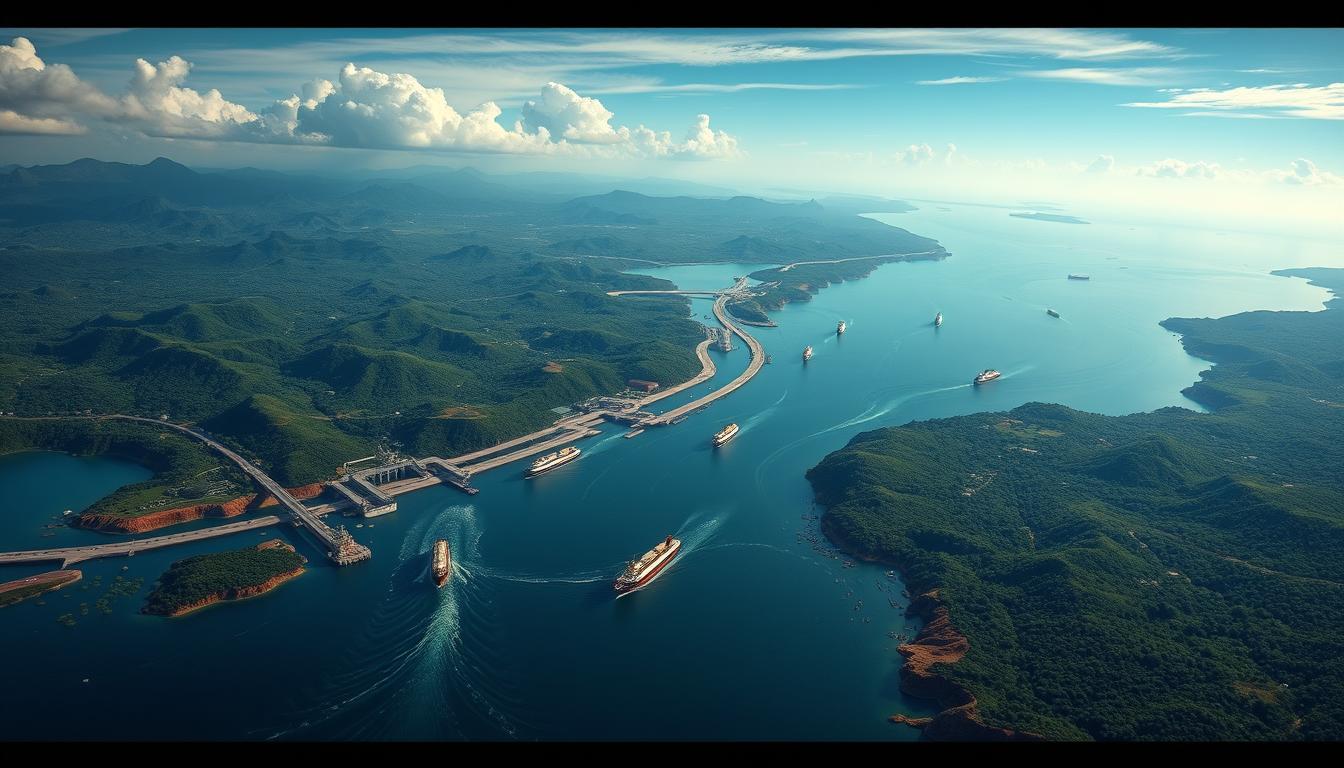
by The Panama Canal is a modern engineering wonder. It connects the Caribbean Sea to the Pacific Ocean through an 82-kilometer artificial waterway. This waterway has changed global trade and commerce. It allows ships to pass through the Isthmus, saving time, fuel, and resources.
Building the Panama Canal was a huge challenge. It needed new solutions and careful planning. The canal’s significance goes beyond its engineering. It’s now a key route for international maritime trade.
The canal has a complex system of locks and water management. It lets ships go up and down between the two oceans. This article will explore the Panama Canal’s waterway and locks in more detail.
The Panama Canal at a Glance
The Panama Canal is a key waterway that links the Atlantic and Pacific Oceans. It’s a vital artery of global trade that has been in use for over a century. It changed how goods move around the world.
Key Statistics and Dimensions
The Panama Canal is about 82 km (51 miles) long. It has a minimum width of 500 feet (150 meters). It takes 8-10 hours for a ship to go through the canal.
The canal’s lock system helps ships move between the oceans. There are three sets of locks: Gatun, Pedro Miguel, and Miraflores.
The canal’s size shows its engineering complexity. The maximum allowable vessel size, known as Neopanamax, is 51.25 meters (168 feet) wide and 366 meters (1,201 feet) long.
Strategic Importance in Global Shipping
The Panama Canal is crucial for global shipping. It saves time, fuel, and resources by avoiding the long route around South America. This shortcut boosts international trade, helping move goods between Europe, Asia, and the Americas.
The canal can handle many types of vessels. From small yachts to large container ships and tankers, it’s versatile.
Historical Development of the Waterway
For over 400 years, the idea of building a canal through Panama has fascinated many. It has seen many attempts, faced big challenges, and had changes in leadership.
Early Canal Concepts and Attempts
The idea of a canal through the Isthmus of Panama started in the 16th century. Early explorers and leaders saw its value. They knew it could cut travel time between the Atlantic and Pacific Oceans. But, it took a long time before serious work began.
The French Canal Effort (1881-1894)
In 1881, the French started working on the Panama Canal. Led by Ferdinand de Lesseps, who built the Suez Canal, they faced huge engineering problems. Tropical diseases also killed many workers. Despite these issues, the French made good progress before stopping in 1894.
American Construction Period (1904-1914)
In 1904, the U.S. took over the project after the French left. President Theodore Roosevelt and the U.S. Army Corps of Engineers, led by Colonel George W. Goethals, finished it in 1914. The Americans improved engineering, sanitation, and worker conditions.
Transition to Panamanian Control
On December 31, 1999, the Panama Canal was handed over to Panama. This was a big step for Panama, giving it control over a key asset. The Panama Canal Authority (ACP) was set up to manage the canal and keep it running well.
| Period | Key Events | Leadership |
|---|---|---|
| Early Concepts | 16th century interest in canal | Various explorers and leaders |
| French Effort | 1881-1894 construction attempt | Ferdinand de Lesseps |
| American Construction | 1904-1914 completion | Theodore Roosevelt, George W. Goethals |
| Transition to Panama | December 31, 1999 | Panama Canal Authority |
Geographical Context of the Panama Canal
The Isthmus of Panama is a narrow land bridge between North and South America. It hosts the Panama Canal, a waterway that connects the Atlantic and Pacific Oceans. The geography of this area was key in building and running the canal.
Isthmus of Panama Topography
The Isthmus of Panama is covered in dense rainforests and rugged terrain. Its landscape includes hills, valleys, and lakes. The Chagres River is a major feature here. The varied topography made building the canal both hard and rewarding.
Watershed and Water Supply Systems
The Panama Canal needs its watershed and water supply systems to work. It uses artificial Lake Gatun, fed by the Chagres River and other water bodies. This system is key for the locks that lift and lower ships between oceans.
Managing the watershed is essential for the canal’s water levels. It involves dams, reservoirs, and water management. This balance is important for the canal and the ecosystem around it.
Comprehensive Map of the Panama Canal
A detailed map of the Panama Canal is key to understanding its layout. It shows the journey from the Atlantic Ocean to the Pacific. The canal has locks, dams, and waterways, making a map essential.
Atlantic Entrance to Gatun Locks
The Atlantic entrance of the Panama Canal is marked by the Gatun Locks. These three locks lift ships up to Gatun Lake’s level. The locks are a marvel of modern engineering.
The Gatun Locks use gravity-fed water systems. This means no pumps are needed, making them efficient. They can handle Neopanamax ships, the largest vessels in the canal.
Gatun Lake and Culebra Cut
Gatun Lake is a man-made lake that’s a big part of the canal. It’s created by the Gatun Dam on the Chagres River. The lake helps ships go over the Isthmus of Panama.
The Culebra Cut, or Gaillard Cut, connects Gatun Lake to the Pacific. It’s a narrow valley that’s hard to navigate because of its terrain.
Pacific Approach and Locks
The Pacific side of the canal has locks that lower ships to sea level. The Miraflores and Pedro Miguel Locks are on this side. The Miraflores Locks are the last step to the Pacific.
The Pacific locks handle the ocean’s tidal range. This ensures ships can safely enter and leave the canal.
Map Sources and Historical Cartography
Creating accurate maps of the Panama Canal has been ongoing. Historical maps help us understand the canal’s growth and changes.
| Map Source | Description | Year |
|---|---|---|
| U.S. Army Corps of Engineers | Original construction maps | 1904-1914 |
| Panama Canal Authority | Official navigation charts | 1977-Present |
| Historical Archives | Early 20th-century maps and documents | 1880s-1940s |
These maps and documents offer insights into the canal’s history and design. They show human ingenuity and engineering skills.
The Panama Canal
The Panama Canal is a key route for global trade. It connects the world’s major economies by moving goods. The canal has different zones and sections, each important for its operation.
Canal Zones and Sections
The Panama Canal is split into several areas. These include the Atlantic and Pacific sides, Gatun Lake, and the Gaillard Cut. Each area has its own challenges and features. For example, the Gaillard Cut is a narrow path that needs careful navigation.
Distance and Transit Time Comparisons
The time it takes to cross the Panama Canal depends on the ship and its cargo. Generally, a ship takes 8-10 hours. The Panama Canal Authority says it saves ships 7,872 miles and 21 days compared to going around Cape Horn.
| Route | Distance (miles) | Transit Time (hours) |
|---|---|---|
| Atlantic to Pacific via Panama Canal | 50 | 8-10 |
| Atlantic to Pacific via Cape Horn | 7,922 | 504 |
Elevation Changes Throughout the Route
The Panama Canal uses locks to lift ships up to Gatun Lake, 85 feet above sea level. The route’s elevation changes require careful navigation. The locks use water from Gatun Lake, making the system efficient and innovative.
Engineering of the Lock System
The lock system of the Panama Canal is a major engineering feat of the 20th century. It allows ships to move between the two oceans, boosting global trade.
Original Locks Design and Function
The original locks were made for different-sized ships, from yachts to container ships. They are key to the Panama Canal, helping ships go between the Atlantic and Pacific Oceans.
Gatun Locks Specifications
The Gatun Locks lift ships up to Gatun Lake. Each chamber is 1,000 feet long, 110 feet wide, and 70 feet deep.
Pedro Miguel Lock Details
The Pedro Miguel Lock lowers ships from Gatun Lake to Miraflores Lake. It’s 1,000 feet long and 110 feet wide.
Miraflores Locks Configuration
The Miraflores Locks are two chambers that lower ships to the Pacific Ocean. They have a system to handle water level changes.
Lock Gates and Operating Mechanisms
The lock gates are strong and watertight. They use motors, gears, and hydraulics for safe vessel transit.
The mechanisms work fast, filling or emptying a chamber in about 8 minutes.
Water Management Technology
The Panama Canal has a smart water management system. It controls water flow between locks and lakes, keeping levels right for ships.
This tech uses gravity to supply water, needing fewer pumps.
Key Features of the Lock System:
- Complex engineering design
- Accommodates various vessel sizes
- Advanced water management technology
- Efficient operating mechanisms
The Panama Canal Expansion Project
The Panama Canal expansion project was finished in 2016. It was a big step in the canal’s history. The goal was to let bigger ships pass through, making the canal more competitive worldwide.
Planning and Development (1999-2007)
Planning for the expansion started in 1999 and ended in 2007. The Panama Canal Authority (ACP) did lots of studies and talks to figure out if it was possible. They got the green light in 2006, starting the building phase.
Construction Phase (2007-2016)
Building began in 2007 and ended in June 2016. New channels were dug, new locks were built, and water-saving basins were put in. A team led by Grupo Unidos por el Canal (GUPC) did the work, with help from international contractors.
New Locks: Agua Clara and Cocoli
Two new lock complexes were added: Agua Clara on the Atlantic side and Cocoli on the Pacific side. These locks can handle bigger ships than before. They use new technology to save water.
Comparison Between Original and New Locks
The old locks were built in the early 1900s. They were 320 meters long, 33.3 meters wide, and 12.8 meters deep. The new locks are much bigger, measuring 427 meters long, 55 meters wide, and 18.3 meters deep. This shows how much better the canal is now.
| Characteristics | Original Locks | New Locks |
|---|---|---|
| Length | 320 meters | 427 meters |
| Width | 33.3 meters | 55 meters |
| Depth | 12.8 meters | 18.3 meters |
Vessel Transit Through the Waterway
The Panama Canal Authority has put in place many measures to keep vessels safe and moving efficiently. These steps are key to keeping the canal as a major trade route.
Ship Classification and Panamax Standards
The Panama Canal has specific size and capacity limits, known as Panamax standards. Ship classification is important to see if a vessel fits these standards. Vessels are sorted by size, type, and other features for safe passage.
Over time, Panamax standards have grown. The canal’s expansion in 2016 brought in Neopanamax standards. These changes let in bigger, more efficient ships, making the canal more competitive.
Scheduling and Transit Procedures
Vessels planning to go through the Panama Canal must follow a strict schedule. The Panama Canal Authority sets specific times to avoid delays and make the most of the waterway. Scheduling happens online, so shipping lines can book ahead.
After scheduling, vessels must follow exact transit procedures. This includes arriving on time and following the canal’s rules and regulations.
Pilot Operations and Tugboat Assistance
Pilotage is vital for safe passage through the Panama Canal. Experienced pilots guide vessels through the waterway. Pilot operations start at the entrance and end at the exit.
Tugboat assistance is also needed, mainly for larger vessels. Tugboats help guide ships through the locks and narrow parts of the canal.
Transit Restrictions and Regulations
The Panama Canal Authority has strict transit restrictions and rules for safe and efficient travel. These include size, draft, and cargo limits, as well as safety equipment and emergency plans.
Vessels must follow these rules to avoid delays or fines. The authority regularly updates these rules to keep up with maritime safety best practices.
Economic Significance of the Canal
The Panama Canal is a key link in global trade, moving goods between the Atlantic and Pacific Oceans. It’s more than just a waterway. It shapes global trade and boosts Panama’s economy.
Toll Structure and Calculation Methods
The Panama Canal Authority has a fair toll system. Tolls depend on cargo type, vessel size, and more. Transparency and predictability help shipping companies plan better.
Annual Revenue and Traffic Statistics
The canal makes a lot of money each year from tolls. It’s seen more traffic, with all kinds of ships. Annual traffic statistics show the canal’s health and global trade trends.
Impact on Global Trade Routes
The Panama Canal changes global trade routes. It saves time and fuel for ships. Enhancing competitiveness of goods, it’s key for international trade.
Economic Benefits to Panama
The canal is a big win for Panama. It’s a major revenue source, boosting the GDP and supporting growth.
“The Panama Canal is the backbone of Panama’s economy, providing significant revenue and driving economic growth.”
It also creates jobs and attracts investment in related fields.
Environmental Aspects and Ecosystem
The Panama Canal’s construction changed the Isthmus of Panama’s environment. It altered the physical landscape and deeply affected the local ecosystem.
Ecological Impact of Canal Construction
The canal’s creation involved a lot of excavation and the making of artificial lakes, like Lake Gatun. This disrupted habitats and changed water flow and quality. It had a big impact on plants and animals in the area.
Lake Gatun’s Artificial Ecosystem
Lake Gatun is a key part of the Panama Canal. It’s an artificial lake with its own ecosystem. The lake flooded a big area of tropical forest, creating a unique environment.
This environment supports many aquatic and terrestrial species. It’s essential for the canal’s operation, providing water for the locks.
Conservation Programs and Initiatives
To address the Panama Canal’s environmental challenges, many conservation efforts have been started. These programs aim to protect wildlife, manage water resources, and reduce the canal’s ecological impact. Examples include reforestation and controlling invasive species.
Visitor Experience and Tourism
The Panama Canal is a wonder of engineering and a top tourist spot. It offers many experiences for visitors. You can watch the canal in action, take a boat tour, or just enjoy the views.
Miraflores Visitor Center
The Miraflores Visitor Center is a hit with tourists. It shows how the canal works. You can see ships pass through the locks and learn about the canal’s history and tech through interactive exhibits. It’s a key spot for understanding the canal.
Agua Clara Visitor Center
The Agua Clara Visitor Center is on the Atlantic side. It focuses on the canal’s new locks from the expansion. You can see ships in the new locks and learn about the canal’s history and construction. It showcases the innovative engineering of the expansion.
Partial and Complete Transit Tours
For a deeper dive, take a partial or complete transit tour. These tours let you see the canal’s inner workings. It’s a unique experience that many visitors love.
Best Viewing Locations and Photography Points
The Panama Canal has many great spots for viewing and photos. The Miraflores Locks are famous for watching ships move up or down. You can also find stunning views at the Centennial Bridge or along Gatun Lake. A visitor said, “The Panama Canal is a photographer’s dream, with its mix of industrial and natural beauty.”
“The sheer scale and complexity of the Panama Canal make it a fascinating subject for photography.”
The Panama Canal offers a rich mix of education, technology, and natural beauty. It’s a unique experience for visitors.
Future Challenges and Developments
The Panama Canal is getting ready to celebrate its 100th year. But, it faces new challenges that will show if it’s ready for today’s shipping world. Its success depends on how well it can change with the times and new tech.
Climate Change and Water Supply Concerns
Climate change is a big worry for the Panama Canal, mainly because of water. With less rain and more evaporation, the canal’s water levels might drop. Managing water well is key to keeping the canal working.
Competing Routes and Alternatives
New shipping paths, like the Arctic route, might challenge the Panama Canal’s role. But, the canal’s reliability and speed are likely to keep it vital in world trade.
Technological Innovations and Efficiency Improvements
New tech can make the Panama Canal better and greener. Improvements in lock systems and water management could keep the canal ahead of the game.
| Challenge | Impact | Potential Solution |
|---|---|---|
| Climate Change | Water supply issues | Improved water management |
| Competing Routes | Reduced traffic | Enhanced efficiency and services |
| Technological Innovations | Increased efficiency | Adoption of new technologies |
The Panama Canal Authority says, “The canal’s future depends on innovation and adapting to global changes.” This shows how important it is to tackle challenges and grab opportunities for growth.
Conclusion: A Century of Connecting Oceans
The Panama Canal has been key for over a century. It has changed global trade by linking the Atlantic and Pacific Oceans. Its impact goes beyond just moving ships, as it has changed how we trade and grown our economy.
The canal’s role is clear in making trade faster and cheaper. This makes global trade more efficient. Building and expanding the canal have shown our ability to innovate and adapt.
As trade evolves, the Panama Canal stays essential. It’s getting better to meet new trade needs and environmental challenges. Its future depends on how well it adapts.
The Panama Canal’s history and ongoing role in trade show our creativity and teamwork. It will keep shaping global trade and commerce.