 by
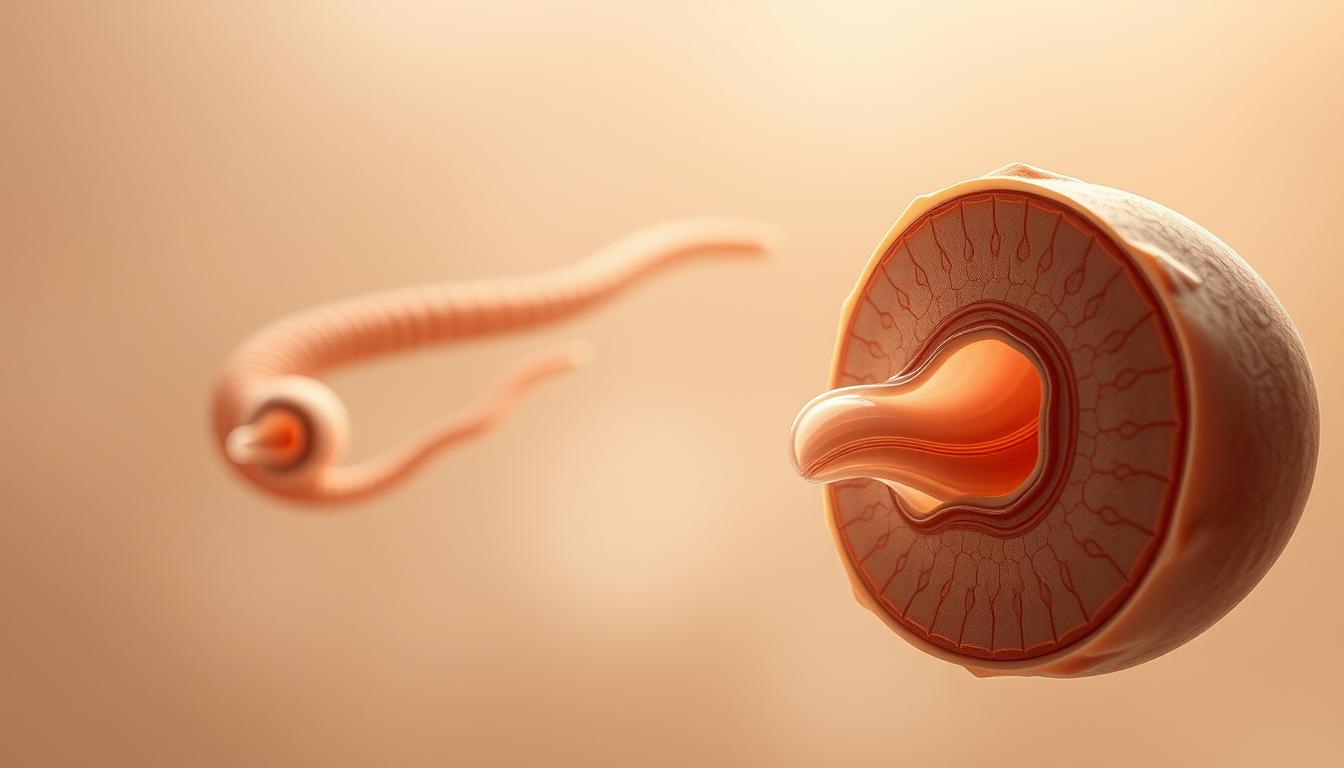
by The neurenteric canal is a temporary structure in early development. It’s key in creating the central nervous system. Knowing how it develops helps us understand how the human body forms.
Advances in data mining and machine learning, thanks to Ross Quinlan, have improved our study of early development. These methods, like decision trees, give us a deeper look into how life begins.
Studying the neurenteric canal is also vital for medical research. It helps us understand and possibly treat developmental issues.
The Biological Significance of the Neurenteric Canal
Understanding the neurenteric canal is key to grasping embryology and developmental biology. It’s a temporary link between the amniotic sac and the yolk sac during early development.
Embryological Definition and Function
The neurenteric canal is a short-lived structure that connects the gut to the amniotic cavity. It helps exchange materials between the amniotic sac and the yolk sac. This is vital for the growth of the embryo.
Critical Developmental Stages
The neurenteric canal is present at certain stages of embryonic growth. Here’s a table showing the important developmental stages it’s involved in:
| Developmental Stage | Description |
|---|---|
| Gastrulation | The neurenteric canal starts forming during gastrulation, a key stage in development. |
| Neurulation | It’s essential during neurulation, helping form the neural tube. |
| Organogenesis | It usually disappears during organogenesis, as the embryo grows and changes. |
The neurenteric canal’s role and disappearance are vital for proper development. Any issues with its formation or disappearance can cause developmental problems.
Challenges in Studying Embryonic Development Patterns
Studying how embryos grow is very hard. It’s a complex process with many parts working together. This includes cells and molecules talking to each other.
The main problem is the complexity of developmental processes. Many things like genes, environment, and how cells are set up interact in complex ways. For example, making the neurenteric canal is a big deal in growth. It needs lots of cell movements and interactions to happen.
Complexity of Developmental Processes
It’s hard to figure out what’s important in growth. Some of the reasons include:
- Development changes fast, happening in a short time.
- Many cell types and tissues are involved, each with its own job.
- Genes and the environment both play a part.
Traditional Research Limitations
Old ways of studying embryos have big problems. These include:
- Looking at embryos by hand is slow and can be wrong.
- It’s hard to look at big amounts of data and find patterns.
- Mixing data from different sources is tough.
But, new tools like machine learning can help. They let researchers look at lots of data, find patterns, and understand how embryos grow.
The Evolution of Computational Approaches in Developmental Biology
Computational methods have changed how we study developmental biology. They give us new views into complex biological processes. Now, researchers can look at big datasets, find patterns, and predict results more accurately.
From Manual Analysis to Automated Systems
The move from manual to automated analysis is a big step forward. Before, researchers spent a lot of time on manual data analysis, which was slow and often wrong. Now, with computational tools and algorithms, many tasks are done automatically. This makes things faster and less likely to have mistakes.
Automated systems can deal with huge amounts of data. They do complex math and find insights that humans might miss.
Benefits of Data-Driven Research
Data-driven research is key in today’s developmental biology. It uses big datasets and advanced computer methods to understand developmental processes better. Data-driven approaches help spot trends and patterns that old methods can’t see. This leads to new ideas and a deeper understanding of developmental biology.
The good things about data-driven research are better accuracy, better predictions, and handling complex data. As computer methods keep getting better, they will be even more vital in understanding developmental biology.
Ross Quinlan: Pioneer in Decision Tree Algorithms and Data Mining
Ross Quinlan is a top researcher in machine learning. He has greatly helped develop decision trees. His work has shaped data mining and machine learning.
Academic Background and Career Trajectory
Ross Quinlan studied computer science, focusing on artificial intelligence and machine learning. He has reached many important milestones. One key achievement is the ID3 algorithm, which started the journey of decision tree algorithms.
- Earned his Ph.D. in Computer Science from the University of Sydney
- Worked at various prestigious institutions, contributing to advancements in machine learning
- Published numerous papers on decision trees and their applications
Fundamental Contributions to Machine Learning
Quinlan’s work on decision tree algorithms, like C4.5 and C5.0, is widely used in machine learning. These algorithms help analyze data better and faster. This has greatly helped data-driven research.
His work impacts many areas, from predictive modeling to data classification. His algorithms are in many software packages. This makes them available to researchers in various fields.
Ross Quinlan’s work is key to machine learning’s success. His contributions are seen in many areas. As machine learning grows, Quinlan’s work remains essential.
Understanding the C4.5 Algorithm and Its Biological Applications
The C4.5 algorithm is key in machine learning, focusing on decision trees. It’s used in many fields, including biology, because it works well with complex data.
Technical Framework and Functionality
The C4.5 algorithm builds a decision tree from the top down. It starts with a root node that covers the whole dataset. Then, it splits the data into smaller groups based on important attributes.
This splitting continues until all instances in a node are the same class. This is when the algorithm stops.
Key features of the C4.5 algorithm include:
- Handling both categorical and continuous attributes
- Ability to handle missing values
- Pruning techniques to avoid overfitting
Advantages Over Previous Algorithms
The C4.5 algorithm beats its predecessors, like ID3, in many ways. It can work with continuous attributes, which earlier versions couldn’t. It also uses pruning to prevent overfitting, making the model more reliable.
In biology, the C4.5 algorithm helps with tasks like predicting gene function or finding disease-linked genes. It’s easy to use thanks to tools like Weka, even for those who aren’t programmers.
The C4.5 algorithm’s role in biology shows how important machine learning is. As research grows, so will the use of algorithms like C4.5, leading to new discoveries.
ID3 to C5.0: The Evolution of Quinlan’s Decision Tree Methods
Quinlan’s decision tree methods have seen big changes, from ID3 to C5.0. This change shows big steps forward in machine learning. It makes decision-making smarter and more efficient.
Historical Development Timeline
The journey of Quinlan’s decision tree algorithms started with ID3 in the late 1970s. ID3 was revolutionary for its time. It gave a clear way to make decision trees from data. But, it had some limits, like only working with categorical data and being prone to overfitting.
Then, C4.5 came along, improving on ID3. C4.5 could work with both categorical and continuous data. It also had ways to avoid overfitting. After that, C5.0 was developed. It made things even better, handling bigger datasets and missing values better.
Key Improvements and Innovations
The move from ID3 to C5.0 brought big improvements. One key change was the ability to work with more data types, including continuous variables. Another big innovation was adding techniques to prevent overfitting, like pruning. This made the decision trees more reliable.
C5.0 also introduced boosting. This method combines models to boost predictive power. This change has been very important in machine learning. It helps make more accurate and dependable models.
The growth of Quinlan’s decision tree methods has greatly influenced machine learning. It keeps shaping research and applications today.
Applying Decision Trees to Analyze Neurenteric Canal Formation
Decision trees are a key tool for studying neurenteric canal development. They help researchers spot patterns and forecast outcomes in early development. This gives us important clues about how the neurenteric canal forms.
Data Preparation and Feature Selection
The first step is getting and preparing data on embryonic development. This includes genetic and environmental factors. Feature selection is vital here, as it picks the most important variables for neurenteric canal growth.
Researchers must gather and check data from many sources. This might include gene expression, imaging, and clinical data. By choosing the best features, they can make their decision tree models more accurate.
Model Training and Validation Approaches
After preparing the data, the next step is training the decision tree model. Algorithms like C4.5 or C5.0 are used to build a tree that can classify or predict outcomes. Model validation is key to making sure the tree accurately shows developmental processes.
Researchers use methods like cross-validation to check their models. By comparing predictions with real data, they can make their models better. This ongoing process is vital for creating strong decision tree models that offer deep insights into neurenteric canal formation.
Using decision trees to study neurenteric canal formation could change how we understand early development. Machine learning helps uncover complex patterns and connections that traditional methods might miss.
The Weka Platform: Implementation of Quinlan’s Algorithms in Biological Research
The Weka platform is a key player in biological research. It uses Quinlan’s algorithms to analyze complex data. This is very helpful in the study of embryology.
Tool Architecture and Capabilities
Weka’s design makes it great for many machine learning tasks. It can prepare data and show it in different ways. It also has Quinlan’s decision trees for classifying biological data.
It’s perfect for working with big datasets. This makes it a top choice for studying embryos.
Practical Applications in Embryology
In embryology, Weka helps study how embryos grow and predict their development. It uses Quinlan’s algorithms to find patterns in data. This helps researchers understand developmental issues better.
Using Weka in embryology is a big step forward. It lets researchers dive deeper into how embryos develop. This knowledge can help improve our understanding of embryonic growth.
Case Studies: Successful Applications in Developmental Biology Research
Developmental biology research has seen a big change with machine learning and data mining. These tools help scientists understand complex biological data better. This leads to new insights into how life develops.
Using these methods has been a big win in spotting developmental problems and finding key genes. Big datasets help researchers find patterns and links that were hidden before. This has greatly helped the field.
Predicting Developmental Anomalies
Machine learning is great for spotting developmental problems early. It uses big datasets of how embryos grow. For example, it can predict heart defects in babies by looking at genes and environment.
- Machine learning algorithms can analyze complex datasets to predict developmental anomalies.
- Early prediction enables timely intervention, potentially reducing the severity of anomalies.
- The use of data mining techniques helps in identifying risk factors associated with developmental anomalies.
Identifying Critical Genetic Factors
Machine learning is also key in finding important genes in developmental biology. It looks at genomic data to find specific genes and mutations. This is vital for understanding how we develop and for new treatments.
For instance, decision tree algorithms have found genetic markers for developmental disorders. This could change the field by opening up new ways to diagnose and treat.
- Decision tree algorithms are used to analyze genomic data and identify critical genetic factors.
- The identification of genetic markers can lead to better diagnosis and treatment options.
- Machine learning models can integrate genetic and environmental data to predict developmental outcomes.
In conclusion, adding machine learning and data mining to developmental biology has made big strides. It helps spot developmental problems and find key genes. This opens up new paths for research and treatments.
Integrating Machine Learning with Traditional Embryological Methods
The mix of machine learning and traditional embryology is a big step forward. It helps us understand how things develop better. This combo makes research more accurate and detailed.
Complementary Research Approaches
Traditional embryology gives us a solid base in developmental biology. It uses direct observation and experimentation. Adding machine learning lets researchers quickly sort through big data. They find patterns that might not show up with old methods.
This mix of methods gives us a fuller view of how things develop. For example, machine learning can forecast what will happen next. Then, traditional embryology checks these forecasts with real experiments.
Validation Techniques and Considerations
When we mix machine learning with traditional embryology, we must check our results carefully. We use strong validation methods. This includes checking our work against other data and using cross-validation.
| Validation Technique | Description | Application in Embryology |
|---|---|---|
| Cross-validation | A method used to assess the performance of machine learning models by training and testing them on multiple subsets of data. | Ensures that predictive models are generalizable across different datasets. |
| Comparison with Established Data | Validating new findings against existing knowledge and datasets in embryology. | Provides a basis for confirming the accuracy of new insights gained from machine learning analyses. |
By thinking about these validation steps, researchers make sure their findings are trustworthy. This helps us learn more about how things develop. It’s all thanks to the complementary approaches of machine learning and traditional embryology.
Challenges and Limitations of Computational Approaches
Computational methods in developmental biology show great promise but face many hurdles. These obstacles can affect the research’s accuracy and trustworthiness.
Data Quality and Availability Issues
Ensuring data quality and availability is a major challenge. High-quality data is key for training precise models. Yet, getting such data is hard because of experimental variability and data differences.
The table below shows common data quality problems and how they can harm computational models.
| Data Quality Issue | Impact on Computational Models |
|---|---|
| Inconsistent data formatting | Difficulty in data integration and analysis |
| Missing data | Reduced model accuracy and reliability |
| Experimental variability | Increased complexity in model training |
Interpretability of Complex Models
Another big challenge is making complex models understandable. As models get more advanced, figuring out how they work can be very hard.
To tackle this, researchers use simpler models and techniques like feature importance analysis. This helps them better understand the biological processes behind the models.
Future Directions: Advanced AI Techniques in Embryological Research
The future of studying embryos is set to change with advanced AI. As we dive deeper into developmental biology, AI will be key. This section will explore new technologies and breakthroughs in embryological research.
Emerging Technologies and Methods
AI, like deep learning and machine learning, is being used more in studying embryos. These tools can analyze big data better than old methods. For example, deep learning can spot patterns in embryo growth, helping find problems early.
AI isn’t just for data analysis. It can also simulate how embryos grow. This helps scientists predict what might happen in different situations. It’s great for understanding developmental disorders.
Potential Breakthroughs and Applications
AI could lead to big changes in studying embryos. It could help predict and prevent developmental problems. AI can look through lots of data to find important factors that cause these issues.
Also, AI research might reveal new things about how genes and environment affect embryo growth. This could lead to new ways to prevent or treat developmental disorders.
- Improved predictive models for developmental anomalies
- Enhanced understanding of genetic and environmental factors
- Development of novel therapeutic strategies
Conclusion: Bridging Computer Science and Developmental Biology
Combining computer science and developmental biology is a big step forward. It helps us understand complex developmental processes better. By using computer tools, researchers can look at big data to find patterns and predict outcomes.
Machine learning, thanks to pioneers like Ross Quinlan, is making a big impact in this area. Tools like Weka make it easier for scientists to dive into developmental biology’s details.
This joining of fields not only deepens our understanding of development. It also paves the way for more research. As new tech emerges, we’ll learn more about developmental issues and key genetic factors.
Working together, we can uncover more about developmental biology’s complex interactions. This could lead to new research and even treatments.