 by
by The history of photography is filled with depth and complexity. It began with understanding camera obscura and how light affects materials.
The first attempts to capture images were in the 18th century. The 19th century saw major breakthroughs. These laid the foundation for our photography timeline today.
Let’s dive into the photographic progression. We’ll follow its journey from the start to now. We’ll highlight the key moments and advancements along the way.
The Dawn of Photography: Early Experiments and Innovations
The journey of photography started with the camera obscura. This device was the first step towards capturing images. It projects an inverted image of the outside world onto a surface.
Camera Obscura and the Foundation of Photographic Principles
The camera obscura has been known for centuries. It works by letting light pass through a small hole. This creates an inverted image on a surface inside.
This principle was key in understanding how to capture images.
Niépce, Daguerre, and the First Permanent Images
Nicéphore Niépce and Louis Daguerre worked hard to get the first permanent photos. Niépce captured a permanent image in 1826. But it took at least eight hours of exposure.
The First Photograph: “View from the Window at Le Gras”
Niépce’s “View from the Window at Le Gras” is the oldest surviving photo. This achievement was a big step in photography history. It showed that permanent images could be captured.
Niépce and Daguerre’s work opened the door for photography. Their success in capturing permanent images was a big leap in camera evolution and historical photography progression.
- The camera obscura laid the foundation for photography.
- Niépce and Daguerre were pioneers in achieving permanent images.
- “View from the Window at Le Gras” is the earliest surviving photograph.
The Daguerreotype Era: First Commercial Photography (1839-1860)
Photography started as a business with the daguerreotype in 1839. Louis Daguerre created this method. It made clear images in just a few minutes.
Technical Process and Limitations of Early Plates
The daguerreotype process used a silver-coated copper plate. It created detailed, positive images quickly. But, it had big problems like not being able to make copies and the plates breaking easily.
- The plates were very sensitive to light, needing careful handling.
- Each daguerreotype was one-of-a-kind, making copies hard to make.
- The process took a lot of time and needed special tools.
Social Impact and the Portraiture Revolution
The daguerreotype changed society, mainly in portraits. For the first time, many could get their pictures taken. This made portrait photography more common.
Notable advancements in portraiture included:
- More people could get their portraits taken.
- Photography studios popped up in big cities.
- A new job was created: professional photographers.
Notable Daguerreotypists and Their Contributions
Many photographers made big impacts during this time. Richard Beard opened the first daguerreotype studio in the U.S. Antoine Claudet tried color and made some of the first color daguerreotypes.
The daguerreotype era was key for photography’s growth. It led to new tech and social changes. Photography kept growing, always remembering its daguerreotype roots.
Wet Plate Collodion Process: Expanding Photographic Possibilities (1851-1880)
The collodion process started in 1851 and changed photography a lot. It made pictures better and easier to copy. This method mixed the quality of daguerreotypes with the ability to print many copies like calotypes. It opened up new ways to take and share photos.
Technical Advancements Over Daguerreotypes
The wet plate collodion process was better than earlier methods in many ways. It let photographers make negative images that could be used to print many positives. This made photography more useful and easier for everyone.
To make a picture, a glass plate was coated with a special solution called collodion. Then, it was exposed in the camera while wet. After that, the image was developed.
War Photography and Documentary Applications
The wet plate collodion process was key in starting war photography and documentaries. It could make many prints from one negative. This was perfect for sharing important event photos.
Mathew Brady and the American Civil War Documentation
Mathew Brady used this process to document the American Civil War. His photos showed the war’s harsh side to the public. This was a big step in visual storytelling in photography.
Brady’s work showed the wet plate collodion process’s power for documenting history. It helped shape the photographic history timeline.
The Gelatin Dry Plate Revolution (1870s-1890s)
The 1870s saw a big change in photography with the gelatin dry plate. This made photography easier and more fun. It helped more people start taking pictures.
Manufacturing Innovations and Accessibility
Gelatin dry plates were coated with a special gelatin that could be used later. This was a big step forward. It meant photographers didn’t have to make plates right before taking pictures.
Impact on Amateur Photography Movement
More people started taking pictures because of gelatin dry plates. They were easy to use. This made photography fun for those who didn’t know a lot about it.
Early Mass Production of Photographic Materials
Because of gelatin dry plates, making photos became cheaper. Companies started making lots of these plates. This made photography even more popular.
Photography became a big business. Companies like Kodak grew because people wanted more photo materials.
The Birth of Roll Film and Kodak’s “You Press the Button, We Do the Rest” (1880s-1900s)
In the 1880s, George Eastman created roll film, changing photography forever. This made taking pictures easier for everyone. It was a big step towards making photography more accessible to the public.
George Eastman’s Innovations in Film Technology
George Eastman’s roll film was a huge leap forward. It let people take many pictures without reloading. This made photography much simpler.
- Enabled multiple exposures without reloading
- Simplified the photographic process
- Paved the way for more accessible photography
Democratization of Photography for the Masses
Roll film and the Kodak camera made photography for everyone. It was no longer just for experts. Photography became a hobby for many.
The Original Kodak Camera and Its Cultural Impact
The first Kodak camera came out in 1888. It used roll film and was easy to use. Kodak’s slogan, “You Press the Button, We Do the Rest,” made photography simple for all.
Key features of the original Kodak camera included:
- Use of roll film for 100 exposures
- Simple operation, requiring no technical expertise
- A revolutionary business model that included film processing and camera reloading
This change didn’t just affect how we take pictures. It also had a big cultural impact. Photography became a popular hobby, changing how we share our lives.
Photographic Progression Through the Early 20th Century (1900-1920)
The 20th century brought big changes to photography. This time saw major tech improvements and photography becoming a real job, thanks to photojournalism.
Technical Improvements in Cameras and Film Sensitivity
In the early 20th century, camera tech and film got a lot better. Cameras were easier to carry and use, and film could handle more light. This meant photographers could take better pictures in different lights.
The Rise of Photojournalism as a Profession
As cameras got better, photojournalism became a real job. People like Lewis Hine and Jacob Riis took pictures of big issues. Their work was seen in newspapers and magazines, making a big impact.
Photography in World War I: Documenting Global Conflict
World War I was a big deal for photography. Photographers went to the front lines to show us the war’s true face. Their pictures helped people back home understand the war better.
Photography’s growth in the early 20th century set the stage for its future. It became more important for telling stories and documenting history.
The Leica Revolution and 35mm Format (1920s-1930s)
Oskar Barnack’s design innovations led to the creation of the Leica camera, changing photography forever. The introduction of the 35mm format was a big image advancement. It gave photographers a more compact and versatile tool.
Compact Camera Design Innovations
The Leica, designed by Oskar Barnack, was revolutionary. It was small and used 35mm film. This made photography more discreet and flexible.
Photographers could now capture moments that were hard to record before.
Street Photography and New Visual Aesthetics
The Leica’s compactness and the 35mm format’s versatility changed street photography. Photographers could easily navigate crowded streets and capture candid moments.
This led to new visual aesthetics. Photographers started experimenting with different angles and perspectives.
Henri Cartier-Bresson and the “Decisive Moment”
Henri Cartier-Bresson was a key photographer of this time. He coined the term “decisive moment.” Cartier-Bresson used the Leica to capture the essence of street life and human interaction.
His work showed the 35mm format and Leica camera’s power. It influenced many photographers and added to the photographic history timeline.
The Leica revolution changed photography’s technical and creative sides. It played a key role in shaping modern photography. This includes street, documentary, fine art, and photojournalism.
Color Photography Development and Popularization (1930s-1950s)
The rise of color photography was a big step forward in photography’s history. With new tech, color photography became a real choice for photographers, not just black and white.
Kodachrome and Early Color Processes
The 1930s saw the launch of Kodachrome film, a game-changer for color photography. This film brought out vivid, true-to-life colors, changing the game. Kodachrome became known for top-notch color images, letting photographers capture colors like never before.
Artistic Resistance and Acceptance of Color in Fine Art
At first, some artists and photographers were hesitant about color photography. They thought black and white was more beautiful and fitting for art. But as color tech got better, it won over the art world.
National Geographic and the Mainstream Adoption of Color
National Geographic was key in making color photography popular. The magazine’s use of color images showed its power in storytelling. This helped color photography become widely accepted.
The growth of color photography showed how fast photography technology growth and photography innovation were moving in the mid-20th century. As color film kept getting better, it opened doors for more tech advancements in photography.
Post-War Photography: New Directions and Influences (1945-1960)
Photography changed a lot after World War II. New tech and changing values led to big changes. Many new styles and ways of taking photos emerged.
Documentary and Humanist Photography Movements
Photographers started focusing more on people and social issues after the war. They took a more personal and caring approach to their work.
Magnum Photos was a key player in this shift. Started in 1947 by famous photographers, it became known for top-notch documentary photos.
Magnum Photos and the Collective Approach to Visual Storytelling
Magnum Photos brought photographers together to tell big stories. This teamwork brought many different views and styles to documentary photography.
Fashion and Advertising Photography Evolution
Fashion and advertising photography also saw big changes after the war. Richard Avedon and Irving Penn led the way with their new and elegant styles.
These photographers’ work had a big impact. They helped shape photography for years to come.
The SLR Revolution and Technical Advancements (1960s-1970s)
The 1960s and 1970s were big for SLR cameras, thanks to Japanese makers. This time saw big steps forward in camera tech, changing how we take photos.
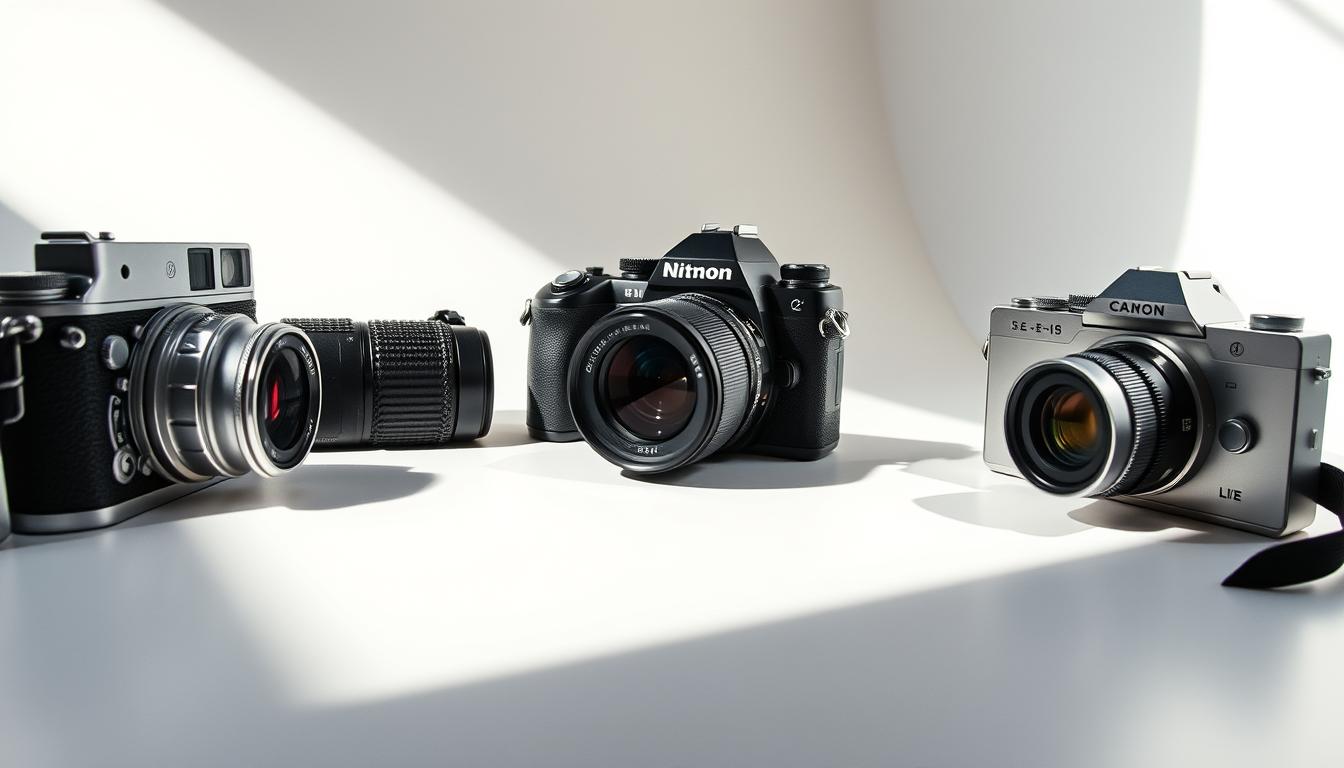
Japanese Camera Industry Dominance: Nikon and Canon
In the 1960s and 1970s, Nikon and Canon became top names in cameras. They made SLR cameras that were good, strong, and easy to use. This made better cameras for everyone, helping more people take great photos.
Technological Innovations in Exposure and Focus Systems
SLR cameras from the 1960s and 1970s had big tech wins. Exposure metering got better, helping measure light right. And autofocus systems made photos sharper with less work. These changes made photography easier and more fun, opening up new ways to create.
The Impact of Vietnam War Photography on Visual Culture
The Vietnam War changed how we see things, thanks to photos. Photographers like Nick Ut and Eddie Adams showed us war’s true face. Their photos made us think differently about war and its effects.
The SLR revolution of the 1960s and 1970s was key to today’s photography. Japanese makers led the way with new tech. Their work is seen in today’s cameras and how we take photos.
The Polaroid Phenomenon: Instant Photography (1950s-1980s)
Edwin Land changed how we take and share photos with Polaroid. His work made instant photography possible. This changed visual storytelling development and image advancement forever.
Edwin Land’s Innovations in Instant Development
Edwin Land created the first instant camera in 1948. This was a big step forward. It let people see and share photos right away.
His technology used a special film. It made images appear in just minutes. This made photography easier and more fun for everyone.
Cultural Impact and Artistic Applications of Instant Images
Polaroid cameras quickly became a big deal. They changed how we see and share photos.
Artists like Andy Warhol loved using them. They made photos a big part of art and culture.
Andy Warhol and the Polaroid Portrait Revolution
Andy Warhol used Polaroids to take portraits. He photographed famous people and regular folks. His work showed how powerful instant photos could be.
| Year | Event | Impact |
|---|---|---|
| 1948 | First instant camera introduced | Revolutionized photography with instant development |
| 1960s | Polaroid cameras become popular | Influenced artistic and cultural practices |
Autofocus and Electronic Advancements (1980s-1990s)
The 1980s and 1990s saw big changes in photography, thanks to autofocus and new electronics. This time made taking pictures easier and more fun for everyone.
Consumer Impact: The Point-and-Shoot Revolution
Point-and-shoot cameras with autofocus changed the game for everyone. They made taking great photos simple. Brands like Canon and Nikon led the way with their advanced autofocus.
This made photography fun for more people. You didn’t need to know a lot to take amazing photos.
Professional Camera System Evolution
Pro photographers also saw big improvements. Autofocus SLR cameras focused faster and better. This was great for sports and wildlife photos.
Camera systems got better in design, strength, and features. They were made for the needs of pros.
The Birth of Electronic Image Stabilization
Electronic image stabilization was another big step. It cut down on camera shake and blur. This made photos sharper, even in dark places.
This feature was a hit in both everyday and pro cameras. It made photos better for everyone.
The 1980s and 1990s set the stage for today’s cameras. Photography technology kept growing. This opened up new ways for photographers and fans to express themselves.
The Digital Revolution: Transformation of the Medium (1990s-2010)
The 1990s saw a big change in photography with the start of the digital revolution. This change moved us from film to digital images.
Early Digital Cameras and Technical Limitations
Early digital cameras had big problems like low quality, small storage, and slow speeds. But, they were the first steps towards better digital cameras.
These cameras were big and not as good as film cameras. But, they let you see and delete photos right away. This was a big change from waiting for film to be developed.
DSLR Development and Professional Adoption Timeline
DSLR cameras changed professional photography a lot. They mixed digital tech with the ability to change lenses. This gave better pictures and more control.
| Year | DSLR Model | Resolution |
|---|---|---|
| 1999 | Nikon D1 | 2.7 MP |
| 2003 | Canon EOS 1D | 4.1 MP |
| 2006 | Nikon D200 | 10.2 MP |
The Decline of Film Photography in Mainstream Use
As digital cameras got better, film photography became less popular. Digital cameras were easier to use, cheaper, and gave instant feedback. This made them the top choice for many.
“The digital revolution has transformed photography, making it more accessible and versatile. The shift from film to digital has been driven by technological advancements and changing consumer preferences.”
Photojournalism’s Transition to Digital Workflow
Photojournalism was quick to switch to digital. This was because they needed to send photos fast. The switch to digital changed how news was shared and seen.
The digital revolution was a key moment in photography’s history. It led to photography innovation and helped the art grow. As tech keeps getting better, photography will keep changing, bringing new chances and challenges.
Smartphone Photography and Democratization of Image-Making (2010-Present)
Smartphones have made photography accessible to everyone. This change has altered how we take, share, and view photos.
Camera Technology Evolution in Mobile Devices
Smartphone cameras have seen big improvements. Better sensors, lenses, and algorithms have made them almost as good as cameras.
Social Media Platforms and New Visual Languages
Social media has changed how we share photos. Sites like Instagram and Facebook focus on quick, real, and story-driven images.
Computational Photography Advancements and AI Integration
Computational photography combines tech and software to enhance photos. AI has made these cameras even better, adding features like portrait mode and night mode.
Instagram’s Influence on Contemporary Visual Culture
Instagram has shaped today’s visual culture. It emphasizes storytelling and community. Features like Stories and Reels have opened up new creative ways.
The mix of smartphone tech, social media, and AI has made photography more accessible. As these technologies grow, we’ll see even more creative ways to tell stories through images.
Conclusion: Reflecting on Photography’s Journey and Future Horizons
The history of photography is a long and complex photography timeline. It started with camera obscura experiments and now we have smartphone cameras. Photography has grown a lot, thanks to new tech and creative minds.
Looking back, we see important moments in photographic history timeline. From the daguerreotype era to the digital age, each step has made photography more accessible. It has changed how we share our lives through images.
Now, photography keeps changing with new tech and AI. The future will bring more ways to make and share photos. It’s exciting to think about what’s next in photography.
Photography’s story shows our ability to be creative and innovative. It will keep amazing people and inspiring artists for years to come.