 by
by Glycolysis is a key metabolic process. It breaks down glucose to make energy.
This process happens in the cell’s cytoplasm. It turns glucose into pyruvate, creating ATP and NADH. This pathway is found in almost all living things, from bacteria to humans.
The glucose metabolism process is key for energy creation, mainly when there’s little oxygen. Knowing this metabolic pathway helps us understand how cells turn glucose into energy.
The Fundamental Role of Glucose in Cellular Metabolism
Glucose is key to making energy in cells. It’s the main fuel for glycolysis and other energy-making steps. Cells break down glucose into ATP, their energy source. This process starts with glycolysis and goes further in the mitochondria when there’s enough oxygen.
Cells control glucose breakdown with enzymes and hormones. This control keeps energy levels balanced. It helps cells adapt to changes in energy needs.
Glucose as the Primary Energy Source
Glucose is the main energy source for cells. It’s the first step in making energy through glycolysis. This step gives a bit of ATP and NADH. It’s vital for cells to function properly.
Glucose is used by all kinds of cells and living things. It’s important for energy production, whether there’s oxygen or not. This shows how essential glucose is for cells.
Glycolysis: Definition and Biological Significance
Understanding glycolysis is key to knowing how cells make energy from glucose. Glycolysis is a metabolic pathway that turns glucose into pyruvate. This process releases energy that becomes ATP and NADH.
What is Glycolysis?
Glycolysis is a metabolic pathway that changes one glucose molecule into two pyruvate molecules. It creates a net gain of 2 ATP molecules and 2 NADH molecules. This process is vital for energy production in cells and is universally conserved across nearly all organisms.
The glycolytic pathway involves a series of biochemical reactions. These reactions are catalyzed by specific enzymes. The key steps include the conversion of glucose to glucose-6-phosphate, fructose-6-phosphate to fructose-1,6-bisphosphate, and ultimately the production of pyruvate.
Evolutionary Conservation and Universal Importance
The evolutionary conservation of glycolysis across diverse organisms shows its vital role in cellular metabolism. Glycolysis is important because it provides energy to cells, mainly under anaerobic conditions. It also serves as a precursor for further energy production through the citric acid cycle and oxidative phosphorylation under aerobic conditions.
The universal importance of glycolysis is highlighted by its role in various metabolic processes. Some key aspects include:
- Energy production through ATP and NADH generation
- Precursor for the citric acid cycle and oxidative phosphorylation
- Critical for cellular metabolism under both aerobic and anaerobic conditions
Historical Development of Glycolysis Research
The study of glycolysis has seen big changes over time. It started with simple observations and grew into a deep understanding of its role and how it works.
Pioneering Work
Early researchers like Embden, Meyerhof, and Parnas started it all. They found important parts and enzymes, setting the stage for glycolysis. Embden’s work was key, revealing many important steps.
| Researcher | Contribution |
|---|---|
| Embden | Identified key intermediates |
| Meyerhof | Elucidated enzyme mechanisms |
| Parnas | Described regulatory aspects |
Modern Breakthroughs
Today’s research uses new tools like biochemical techniques and molecular biology. Recent studies have looked into how glycolysis is controlled and its link to diseases like cancer. We’ve found new enzymes and pathways, showing how complex glycolysis is.
Cellular Location and Biochemical Context
Glycolysis is a key metabolic process that happens in the cell’s cytosol. It’s vital for making energy. Being in the cytosol lets glycolysis work well under different conditions.
Cytosolic Process: The Intracellular Environment
The cytosol is perfect for glycolysis because it has all the needed enzymes. This environment is key for breaking down glucose efficiently. Biochemist Alberts notes, “The cytosolic location of glycolysis shows its importance as a universal metabolic pathway” (Source: Alberts et al., Molecular Biology of the Cell).
“The cytosolic location of glycolysis shows its importance as a universal metabolic pathway.”
Here’s a table comparing glycolytic activity in different parts of the cell:
| Cellular Compartment | Glycolytic Activity |
|---|---|
| Cytosol | High |
| Mitochondria | Low |
Organisms and Cell Types Utilizing Glycolysis
Glycolysis is used by many cell types, like muscle and red blood cells. It’s also key for some microorganisms in anaerobic environments.
The pathway’s wide use proves its essential role in energy production. It’s vital across different organisms and cell types.
Overview of the 10-Step Glycolytic Pathway
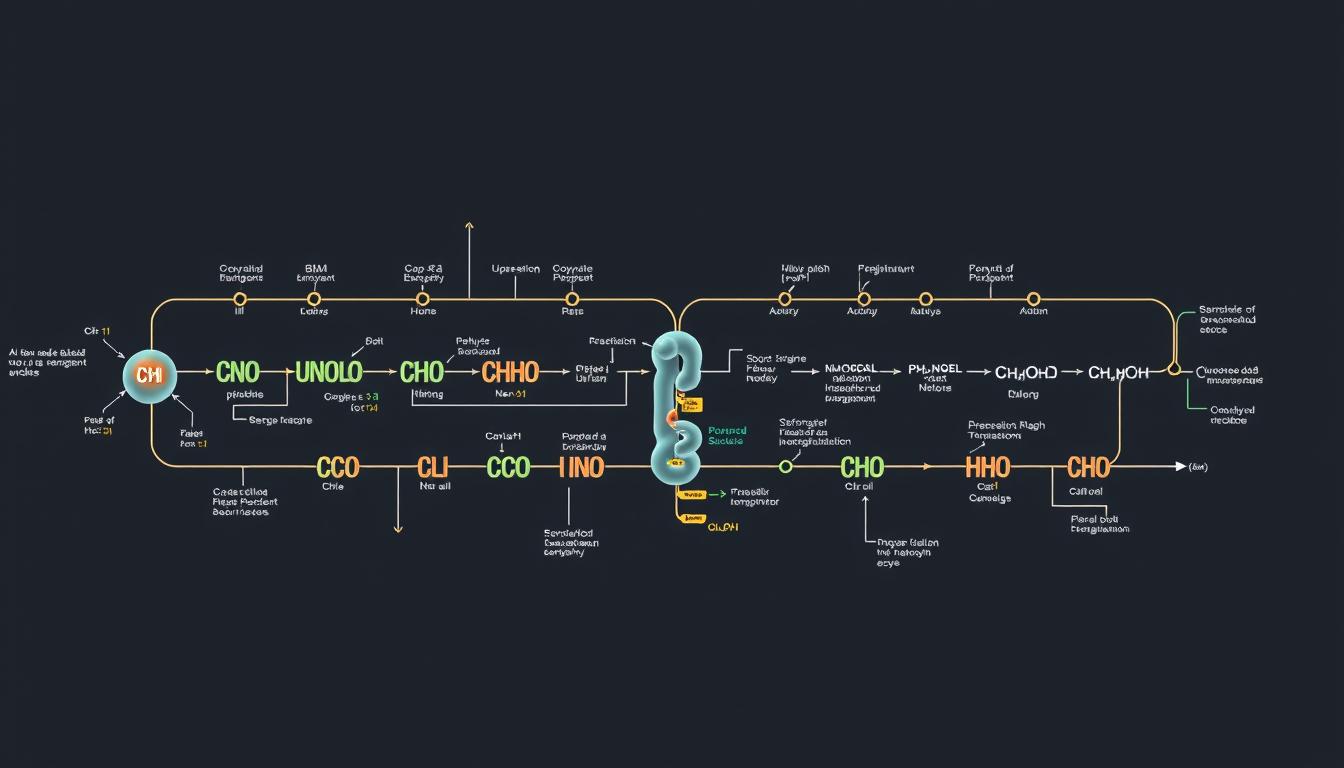
Glycolysis is a series of ten steps that turn glucose into pyruvate. It releases energy as ATP and NADH. This pathway is key for making energy in cells and has two main parts.
The Two Phases: Energy Investment and Energy Generation
The glycolytic pathway has two phases. The first phase uses ATP to change glucose into fructose-1,6-bisphosphate. This step gets the glucose ready for breakdown.
The second phase is where the real energy making happens. It releases energy from intermediates, making ATP and NADH. This is vital for cell energy.
Key Intermediates and Products
Many important intermediates are formed in glycolysis. These include glucose-6-phosphate, fructose-1,6-bisphosphate, and phosphoenolpyruvate. They are essential for energy conversion.
The final products are pyruvate, ATP, and NADH. Pyruvate can go to the mitochondria or be used in fermentation. ATP is a direct energy source. NADH helps in the electron transport chain, boosting energy production.
The Preparatory Phase: Steps 1-5 in Detail
The glycolytic pathway’s preparatory phase is key for energy production in cells. It starts with the first five steps of glycolysis. Here, glucose turns into fructose-1,6-bisphosphate, using 2 ATP molecules.
Step 1: Glucose to Glucose-6-Phosphate
The first step is glucose’s phosphorylation to glucose-6-phosphate. This is done by hexokinase (or glucokinase in the liver).
Hexokinase: Structure and Function
Hexokinase starts glycolysis by adding a phosphate to glucose. Its work is carefully controlled for good glucose use.
Step 2: Glucose-6-Phosphate to Fructose-6-Phosphate
The second step changes glucose-6-phosphate to fructose-6-phosphate. This is thanks to phosphoglucose isomerase.
Phosphoglucose Isomerase Mechanism
Phosphoglucose isomerase changes glucose-6-phosphate to fructose-6-phosphate. It does this through an enediol intermediate.
Step 3: Fructose-6-Phosphate to Fructose-1,6-Bisphosphate
In the third step, fructose-6-phosphate gets phosphorylated to fructose-1,6-bisphosphate. This is done by phosphofructokinase-1, a key enzyme in glycolysis.
Phosphofructokinase as a Rate-Limiting Enzyme
Phosphofructokinase-1 controls glycolysis flow. Its activity changes based on ATP and citrate levels.
Step 4-5: Splitting and Isomerization of Sugar Molecules
Steps 4 and 5 split fructose-1,6-bisphosphate into glyceraldehyde-3-phosphate and dihydroxyacetone phosphate. Then, dihydroxyacetone phosphate turns into glyceraldehyde-3-phosphate. This is done by aldolase and triose phosphate isomerase.
Aldolase and Triose Phosphate Isomerase Functions
Aldolase breaks fructose-1,6-bisphosphate into two triose phosphates. Triose phosphate isomerase makes sure both are glyceraldehyde-3-phosphate. This lets them continue through glycolysis.
| Step | Reaction | Enzyme |
|---|---|---|
| 1 | Glucose to Glucose-6-Phosphate | Hexokinase |
| 2 | Glucose-6-Phosphate to Fructose-6-Phosphate | Phosphoglucose Isomerase |
| 3 | Fructose-6-Phosphate to Fructose-1,6-Bisphosphate | Phosphofructokinase-1 |
| 4 | Fructose-1,6-Bisphosphate to Glyceraldehyde-3-Phosphate and Dihydroxyacetone Phosphate | Aldolase |
| 5 | Dihydroxyacetone Phosphate to Glyceraldehyde-3-Phosphate | Triose Phosphate Isomerase |
The Pay-Off Phase: Steps 6-10 in Detail
The pay-off phase of glycolysis, steps 6 through 10, is where energy is turned into ATP and NADH. This process ends with pyruvate as the final product. It’s key for the cell’s energy production.
Step 6: Glyceraldehyde-3-Phosphate Oxidation
In this step, glyceraldehyde-3-phosphate is changed to 1,3-bisphosphoglycerate by glyceraldehyde-3-phosphate dehydrogenase (GAPDH). This reaction is important because it turns NAD+ into NADH.
GAPDH and NAD+ Reduction
GAPDH helps change glyceraldehyde-3-phosphate into something else. This process reduces NAD+ to NADH. NADH is vital for energy in the cell.
Step 7: 1,3-Bisphosphoglycerate to 3-Phosphoglycerate
Phosphoglycerate kinase helps change 1,3-bisphosphoglycerate to 3-phosphoglycerate. This step makes ATP through a special process called substrate-level phosphorylation.
Phosphoglycerate Kinase and First ATP Generation
Phosphoglycerate kinase makes ATP and 3-phosphoglycerate from 1,3-bisphosphoglycerate. This is the first time ATP is made in the pay-off phase.
Step 8-9: Preparation for Final Energy Extraction
Steps 8 and 9 change 3-phosphoglycerate to phosphoenolpyruvate (PEP). This is done by phosphoglycerate mutase and enolase. These steps get the molecule ready for the last energy extraction.
Phosphoglycerate Mutase and Enolase Activities
Phosphoglycerate mutase changes 3-phosphoglycerate to 2-phosphoglycerate. Then, enolase turns it into PEP. This is a key step for making more ATP.
Step 10: Formation of Pyruvate and ATP
The last step is when PEP is turned into pyruvate by pyruvate kinase. This step also makes ATP through substrate-level phosphorylation.
Pyruvate Kinase and Its Regulatory Importance
Pyruvate kinase is a key enzyme. It makes ATP and pyruvate from PEP and ADP. Pyruvate is the end product of glycolysis.
| Step | Reaction | Enzyme | Product |
|---|---|---|---|
| 6 | Glyceraldehyde-3-P oxidation | GAPDH | 1,3-Bisphosphoglycerate, NADH |
| 7 | 1,3-Bisphosphoglycerate to 3-Phosphoglycerate | Phosphoglycerate Kinase | 3-Phosphoglycerate, ATP |
| 8-9 | 3-Phosphoglycerate to Phosphoenolpyruvate | Phosphoglycerate Mutase, Enolase | Phosphoenolpyruvate |
| 10 | Phosphoenolpyruvate to Pyruvate | Pyruvate Kinase | Pyruvate, ATP |
Critical Enzymes of the Glycolytic Pathway
The glycolytic pathway is controlled by key enzymes like hexokinase, phosphofructokinase-1, and pyruvate kinase. These enzymes are vital for the pathway’s function. Their imbalance can cause metabolic disorders.
Rate-Limiting Enzymes and Their Regulation
The enzymes hexokinase, phosphofructokinase-1, and pyruvate kinase are key to glycolysis. Hexokinase is slowed by high glucose-6-phosphate levels. Phosphofructokinase-1 is held back by ATP and citrate. Pyruvate kinase is boosted by fructose-1,6-bisphosphate.
These controls keep glycolysis in check, matching it to the cell’s energy needs. When energy is plentiful, these enzymes are inhibited. This prevents too much glucose use.
Structural and Functional Characteristics of Glycolytic Enzymes
Glycolytic enzymes have unique features that let them perform specific steps in the pathway. For example, hexokinase grabs onto glucose tightly. This lets it turn glucose into glucose-6-phosphate efficiently.
The shape and parts of these enzymes are key to their work. Knowing about these helps us understand how they’re managed. It also shows how they affect the glycolytic pathway’s flow.
Energy Production and NADH Generation
Glycolysis is key for making energy in the form of ATP. It goes through many biochemical reactions. These reactions lead to the creation of ATP and NADH, vital for cell functions.
ATP Balance Sheet: Input vs. Output
Glycolysis starts by using 2 ATP molecules. But then, it produces 4 ATP molecules. This means there’s a net gain of 2 ATP molecules for each glucose molecule. This is a direct way to make ATP, unlike the process in mitochondria.
The Role of NADH in Cellular Redox State
In glycolysis, 2 NADH molecules are made. They come from glyceraldehyde-3-phosphate turning into 1,3-bisphosphoglycerate. NADH is important for keeping the cell’s redox balance.
Under oxygen, NADH helps make more ATP in the mitochondria. For more on this, check out NCBI’s guide on cellular respiration.
NADH’s creation in glycolysis shows its importance. It’s not just for energy but also for keeping the cell’s redox balance.
Regulatory Mechanisms of Glycolysis
Glycolysis regulation is complex, involving many mechanisms to keep energy levels balanced. It’s vital for cells to produce and use energy efficiently. This balance is maintained through different control methods.
Allosteric Regulation and Feedback Inhibition
Allosteric regulation is key in controlling glycolysis. Enzymes like phosphofructokinase-1 (PFK-1) are controlled this way. When ATP and citrate levels are high, it means there’s enough energy and building blocks.
But when AMP and fructose-2,6-bisphosphate levels rise, it’s a sign of low energy. This triggers PFK-1 to work harder, helping cells use energy when needed.
- Allosteric activators: AMP, fructose-2,6-bisphosphate
- Allosteric inhibitors: ATP, citrate
Hormonal Control and Signal Transduction Pathways
Hormones like insulin and glucagon also play a big role in glycolysis. Insulin helps glycolysis by turning on important enzymes. On the other hand, glucagon slows it down.
Insulin makes phosphofructokinase-2 (PFK-2) work more, boosting fructose-2,6-bisphosphate levels. This is a strong activator of PFK-1. But glucagon does the opposite, stopping PFK-2 and reducing glycolysis.
Key hormonal regulators:
- Insulin: promotes glycolysis
- Glucagon: inhibits glycolysis
Glycolysis Under Different Oxygen Conditions
Glycolysis is a key metabolic pathway that changes based on oxygen levels. It’s vital for energy production in cells. The presence or lack of oxygen affects what happens to pyruvate, glycolysis’s end product.
Aerobic Conditions: Connection to Mitochondrial Respiration
When oxygen is present, glycolysis connects to mitochondrial respiration. Pyruvate goes into the mitochondria and is broken down further in the citric acid cycle. This step creates NADH and FADH2, which help make lots of ATP through oxidative phosphorylation. This link is key for cells to make energy efficiently when they have enough oxygen.
Anaerobic Conditions: Fermentation and Lactate Production
Without oxygen, pyruvate turns into lactate through fermentation. This process makes NAD+ available again, letting glycolysis keep making ATP. This is important for cells in low oxygen conditions or high energy needs, like muscles during hard exercise. Lactate is a key sign of anaerobic glycolysis and can be used by other tissues or turned back into glucose in the liver.
“The adaptation of glycolysis to different oxygen conditions highlights its importance in cellular metabolism and energy homeostasis.”
Altered Glycolysis in Cancer Metabolism
Cancer cells change their metabolism to grow faster. They use more glycolysis, even with plenty of oxygen. This is called the Warburg effect. It helps cancer cells grow and multiply quickly.
The Warburg Effect: Aerobic Glycolysis in Tumor Cells
The Warburg effect is key to understanding how tumors work. Tumor cells prefer glycolysis for energy, even with lots of oxygen. This helps them use a lot of glucose, supporting their fast growth.
Targeting Glycolysis in Cancer Therapy
Targeting glycolysis is a new way to fight cancer. Scientists are looking at ways to block glycolysis in tumor cells. By understanding the Warburg effect, they can make treatments that attack cancer’s weak spots.
Clinical Relevance: Glycolysis-Related Disorders
It’s key to understand glycolysis-related disorders to find new treatments. Glycolysis is vital for energy in cells. Problems here can cause many metabolic diseases.
Genetic Enzyme Deficiencies
Genetic issues with glycolytic enzymes can cause big health problems. For example, pyruvate kinase deficiency leads to hemolytic anemia. This is because the enzyme’s job is to make ATP, but it fails, causing red blood cells to break down.
Here’s a table of some enzyme deficiencies linked to glycolysis:
| Enzyme Deficiency | Clinical Manifestation |
|---|---|
| Pyruvate Kinase | Hemolytic Anemia |
| Phosphoglucose Isomerase | Nonspherocytic Hemolytic Anemia |
| Triosephosphate Isomerase | Neurological Dysfunction, Hemolytic Anemia |
Metabolic Diseases and Diagnostic Approaches
Glycolysis disorders can also be metabolic diseases. Finding the right diagnosis is key. New tests like genetic testing and metabolic profiling help doctors find the cause and treat it.
Diagnostic Approaches: Doctors use biochemical tests and genetic tests to find the problem. Knowing the genetic cause helps in finding new treatments like gene therapy.
Integration with Other Metabolic Pathways
Glycolysis works closely with other metabolic pathways. This creates a complex network that helps cells adjust to different situations. It’s key for keeping cells stable and responding to energy needs.
Glycolysis and Gluconeogenesis: Opposing Processes
Glycolysis and gluconeogenesis are two important pathways for glucose. Glycolysis breaks down glucose, while gluconeogenesis makes glucose from other sources. These pathways are carefully controlled to avoid waste and meet the cell’s needs. The balance between glycolysis and gluconeogenesis is critical for maintaining blood glucose levels within a narrow range.
A well-known biochemist once said, “The interplay between glycolysis and gluconeogenesis is a prime example of the delicate balance in cellular metabolism.”
This balance is achieved through a complex system of allosteric controls, hormonal regulation, and transcriptional regulation.
Connections to the TCA Cycle and Electron Transport Chain
The pyruvate from glycolysis goes into the mitochondria. There, it becomes acetyl-CoA, a key for the TCA cycle. The TCA cycle makes NADH and FADH2, which fuel the electron transport chain to produce ATP. This connection between glycolysis and the TCA cycle/electron transport chain is essential for the efficient production of energy in aerobic conditions.
Interactions with Lipid and Amino Acid Metabolism
Glycolysis also connects with lipid and amino acid metabolism. For example, glycolytic intermediates can make glycerol, needed for triglyceride production. Pyruvate from glycolysis can turn into alanine, linking glycolysis to amino acid metabolism. These interactions highlight the central role of glycolysis in the overall metabolic network of the cell.
- Glycolytic intermediates can be diverted into various biosynthetic pathways.
- The regulation of glycolysis affects the flux through these related pathways.
- The integration of glycolysis with other metabolic pathways allows for a coordinated response to changes in cellular energy status.
Conclusion: The Essential Nature of Glycolysis in Cellular Function
Glycolysis is key to how cells make energy. It’s important for all kinds of living things. This process turns glucose into energy, which is vital for life.
Glycolysis does more than just make energy. It affects many health and disease processes. Problems with glycolysis can lead to metabolic disorders. This shows why we need to understand it well.
Learning about glycolysis helps scientists and doctors. They can find new ways to treat diseases. This knowledge is important for creating new treatments.
In short, glycolysis is more than just a process. It’s a vital part of how cells work. Studying it helps us understand energy, metabolism, and disease better.