 by
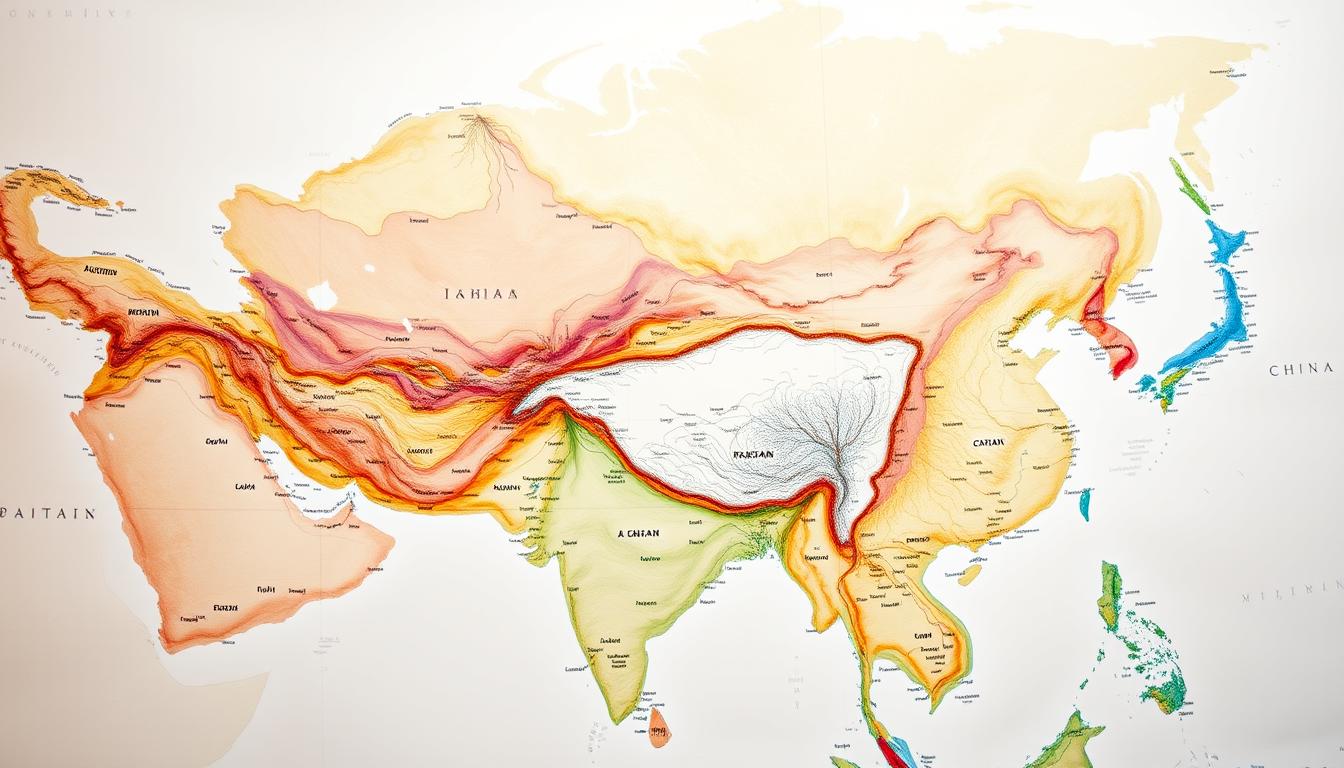
by Understanding the geography and politics of different areas is key in today’s world. Maps are essential for showing data in a way that’s easy to get. They help us understand complex information better.
Maps are important, as seen in books like Yuval Noah Harari’s “21 theses for the 21st century.” He points out how they help us understand the new world order.
In the Asia region, countries like Pakistan and China are shown with unique symbols. This makes it easier to see their importance in geography and politics.
This introduction prepares us to dive into the role of detailed mapping. It’s all about Pakistan and China’s roles in Asia.
The Vast Landscape of Asia: A Geographical Overview
Asia is a vast continent with many landscapes. It has the highest mountains and deepest seas. Countries like Pakistan and China have their own special features.
Continental Boundaries and Major Regions
Asia is surrounded by the Pacific, Indian, and Arctic Oceans. It is split into South Asia, Southeast Asia, and East Asia. For more info, check out National Geographic’s Asia resource page.
Diverse Topography and Natural Features
Asia’s landscape includes the Himalayas, the Tibetan Plateau, and the Gobi Desert. It also has big rivers like the Yangtze and Indus. These rivers are key for the ecosystem and human life.
| Region | Major Features | Countries |
|---|---|---|
| South Asia | Himalayas, Indo-Gangetic Plain | India, Pakistan |
| East Asia | Yangtze River, Tibetan Plateau | China, Japan |
| Southeast Asia | Mekong River, Islands of Indonesia | Indonesia, Malaysia |
Population Distribution and Cultural Diversity
Asia is not just diverse in geography but also in culture. It has a wide range of ethnic, linguistic, and religious groups. Cities like Tokyo, Shanghai, and Mumbai are hubs of both old and new cultures.
Asia Map (Pakistan/China): Understanding the Strategic Significance
Pakistan and China stand out on the Asia map with special symbols. Their importance comes from history, economy, and global politics. These factors make them key players worldwide.
Geopolitical Importance of Pakistan and China
Pakistan and China are vital due to their strategic spots. Pakistan connects South Asia to the Middle East. China is a big player in East Asia. Their close ties affect regional and global stability.
Historical Context of These Nations in Asia
Pakistan and China have rich histories. They’ve been shaped by many cultures and empires. This has influenced their roles in Asia today.
Economic and Political Relevance in Global Affairs
China is a major economic force. Pakistan is growing fast and has big economic hopes. Both countries are important in global politics and economic plans.
The interactive Asia map shows how Pakistan and China connect with others. This connection is key to understanding the region’s politics and economy.
Types of Maps Depicting the Asian Continent
Maps of Asia come in different types, each with its own purpose. They help us understand the continent’s geography, from deserts to mountains.
Political Maps: Boundaries and Capitals
Political maps show Asia’s countries, their borders, and capitals. They are key for grasping the region’s politics. A printable Asia Map featuring Pakistan and China is great for learning. It clearly shows these countries in Asia.
Physical and Topographical Representations
Physical maps focus on Asia’s natural features like mountains and rivers. A physical map of Asia with Pakistan and China shows their varied landscapes. These maps are essential for understanding the environment’s role in human life and economy.
Thematic Maps: Population, Climate, and Resources
Thematic maps offer deeper insights than basic maps. They cover topics like population, climate, and resources. These maps help us see Asia’s people and environment, including crowded areas and resource-rich zones.
Economic Activity Maps
Economic maps show Asia’s economic areas. They highlight industrial spots, farms, and trade paths. These maps give us a peek into the economic life of countries like China and Pakistan.
Cultural and Linguistic Maps
Cultural and linguistic maps display Asia’s rich heritage. They show ethnic groups, languages, and religions. These maps help us appreciate Asia’s cultural diversity.
Cartographic Symbols and Conventions for Asian Nations
Cartographic symbols are key in showing geographical data on Asian maps. They help us tell apart different features, boundaries, and cultural spots.
Standard International Mapping Symbols
Standard symbols are used worldwide to keep maps clear and consistent. Rivers are shown as blue lines, and mountains use contour lines or shading. These symbols are vital for making a detailed Asia Map with Pakistan and China that’s easy to understand.
Distinctive Symbols Used for Pakistan
Pakistan’s maps use special symbols to show its unique features. For example, the Karakoram mountains are shown with contour lines and shading to highlight their tough terrain.
Unique Cartographic Representations for China
China’s maps use many symbols to show its vast area. The Great Wall of China, for instance, has a special symbol to mark its historical and cultural value.
Color Coding Systems in Asian Maps
Color coding is a big part of cartography, helping to show different features. For example, different colors might be used for different countries or areas on an Asia Map outline including Pakistan and China.
| Feature | Symbol/Color |
|---|---|
| Rivers | Blue lines |
| Mountains | Contour lines/shading |
| International Boundaries | Dashed lines |
Pakistan’s Geographical Profile on Continental Maps
Pakistan is unique on continental maps because of its geography and location. It has a strategic spot, varied landscapes, and different areas to manage.
Location, Borders, and Strategic Position
Pakistan is in South Asia. It shares borders with India, Afghanistan, Iran, China, and the Arabian Sea. This makes it a key link between South Asia, the Middle East, and Central Asia.
The country’s borders are marked by mountains and deserts. The Karakoram range separates it from China to the north. The west is rugged and dry, bordering Afghanistan and Iran.
Major Cities, Rivers, and Mountain Ranges
Islamabad is Pakistan’s capital, and Karachi, Lahore, and Peshawar are big cities. The Indus River runs through, supporting farming and industry.
Pakistan boasts the Karakoram and Himalayas, home to K2, the second-highest peak. These mountains are awe-inspiring.
Administrative Divisions and Provincial Boundaries
Pakistan is split into four provinces: Punjab, Sindh, Khyber Pakhtunkhwa, and Balochistan. Each has its own capital and government.
Special Status Regions
Gilgit-Baltistan in the north has special status. It’s known for its culture and geography.
Coastal Areas and Maritime Boundaries
Pakistan’s Arabian Sea coast is vital for shipping. Ports like Karachi and Gwadar are key to its economy.
| Province | Capital | Major Cities |
|---|---|---|
| Punjab | Lahore | Faisalabad, Multan |
| Sindh | Karachi | Hyderabad, Sukkur |
| Khyber Pakhtunkhwa | Peshawar | Abbottabad, Mardan |
| Balochistan | Quetta | Gwadar, Turbat |
“Pakistan’s geographical diversity is a significant factor in its economic and cultural identity.”
In conclusion, Pakistan’s geography makes it important globally. Its diverse landscapes and divisions show its role in the world.
China’s Vast Territory on Asian Maps
The Asian continent map shows China’s huge area. It has different landscapes and big rivers. China’s big size affects its climate, culture, and economy in the region.
Territorial Extent and International Borders
China covers a huge area, bordered by many countries like Pakistan. The map of China shows its long borders. These borders are key in regional politics and trade.
Administrative Regions: Provinces, Autonomous Regions, and Municipalities
China is split into provinces, autonomous regions, and municipalities. This helps with governance and planning. The map of China and Pakistan shows these areas, giving insight into how China is managed.
Geographical Diversity: From Deserts to Mountains
Major River Systems and Water Bodies
The Yangtze and Yellow Rivers are vital for China. They support farming, industry, and cities. Maps of China highlight these rivers, showing their role in the economy and culture.
Population Centers and Urban Developments
China’s people live mainly in cities like Shanghai and Beijing. These cities are key economic centers. The map of Asia with Pakistan and China shows where people live, showing urban growth.
| Region | Population (Million) | Major Cities |
|---|---|---|
| East China | 400 | Shanghai, Nanjing |
| North China | 200 | Beijing, Tianjin |
| South China | 300 | Guangzhou, Shenzhen |
Learning about China’s vast territory on Asian maps is important. It helps us understand its geography, divisions, and people. This knowledge is key to seeing China’s impact on the world.
The Pakistan-China Border: Cartographic Challenges
The Pakistan-China border is a complex area. It spans the Karakoram mountain range. This region is not just a marvel of nature but also holds great strategic value.
The Karakoram Highway and Mountain Passes
The Karakoram Highway is known as the “Eighth Wonder of the World.” It connects Pakistan and China through the Karakoram range. Cartographers face big challenges here due to the area’s tough terrain and harsh weather.
Disputed Territories and Representation Issues
The border region includes disputed areas, like parts of Kashmir. These issues make it hard for cartographers to map accurately. They must carefully show the current political situation on maps.
Changing Border Demarcations Over Time
The border’s lines have changed over time. This is due to new agreements and political shifts. Cartographers must keep maps up to date to show these changes correctly.
| Aspect | Cartographic Challenge | Significance |
|---|---|---|
| Karakoram Highway | Complex topography, harsh weather | Strategic connectivity between Pakistan and China |
| Disputed Territories | Geopolitical sensitivities, accuracy | Reflects geopolitical realities |
| Border Demarcations | Updating maps to reflect changes | Ensures accuracy and relevance |
In conclusion, the Pakistan-China border is a unique challenge for cartographers. They must consider geography, politics, and history. Accurate maps of this area are key for understanding its importance and for various uses like education and research.
Historical Evolution of Asian Cartography
Asian cartography has a rich history. It has evolved through ancient mapping, colonial influences, and modern satellite tech. Maps in Asia have been shaped by cultural exchange, tech advancements, and political shifts.
Ancient Maps of the Region
Ancient Asian maps were symbolic, not always accurate. They showed the beliefs of the time. Early Chinese maps highlighted the emperor and the capital city.
Colonial Era Mapping
The colonial era changed Asian cartography a lot. New surveying methods and tech were introduced. This led to more accurate maps, often for colonial goals.
| Era | Characteristics | Notable Features |
|---|---|---|
| Ancient | Symbolic, cosmologically oriented | Emphasis on central authority |
| Colonial | More accurate, European techniques | Surveying for territorial control |
| Post-Independence | Nationalistic, sovereignty focus | Accurate border demarcation |
| Modern | Technologically advanced, satellite-based | High-resolution mapping, GIS |
Post-Independence Cartographic Developments
Countries like Pakistan and China worked on their mapping skills. They wanted to show their national identity and sovereignty. They made maps that showed their claimed territories accurately.
Modern Satellite-Based Mapping Technologies
Satellite tech has changed cartography in Asia. It allows for very accurate and detailed maps. Modern tools like GIS and remote sensing have greatly improved the field.
Now, we combine old cartography with new tech. This has improved our view of Asia, like in Pakistan and China. It helps make interactive Asia Maps with Pakistan and China.
Digital and Interactive Resources for Asian Geography
Digital and interactive tools have changed how we learn about Asian geography. They give us easy access to detailed maps and data. This is great for learning about countries like Pakistan and China.
Online Mapping Platforms Featuring Detailed Asian Maps
Online mapping sites are key for studying Asian geography. They have detailed maps of Asia with political and physical features. You can also see maps of printable Asia Maps featuring Pakistan and China to understand the area better.
GIS Applications for Studying Pakistan and China
GIS (Geographic Information System) tools have changed geography studies. They help analyze and show geographical data. For Pakistan and China, GIS lets researchers study land use, climate change, and disaster risks.
Mobile Apps for Exploring Asian Geography
Mobile apps make it easy to explore Asian geography anywhere. They have interactive maps and educational content. They’re great for students and travelers wanting to learn more about the region.
Educational Applications of Asia Maps
Maps of the Asia continent, like those showing Pakistan and China, are key in schools. They help teach geography, history, and culture.
Classroom Resources and Teaching Tools
Asia maps are vital in classrooms. They show the continent’s varied geography, political lines, and culture. These maps help students see how countries and regions are connected.
Research Applications in Academia
In research, Asia maps are used to study things like climate change and economic growth. Researchers use these maps to spot trends and patterns across the continent.
Public Education and Geographic Literacy
Maps of Asia also help in public education. They make complex global issues easier to understand. They also highlight the region’s cultural diversity.
| Educational Use | Description | Benefits |
|---|---|---|
| Classroom Education | Teaching geography, history, and culture | Enhances spatial awareness and cultural understanding |
| Academic Research | Studying climate change, economic trends, and political dynamics | Facilitates in-depth analysis and research |
| Public Education | Promoting geographic literacy and awareness | Improves public understanding of geopolitical issues |
Printable and High-Resolution Asia Maps
Printable Asia maps with Pakistan and China are great for learning and work. They show detailed geography, perfect for many uses.
Sources for Quality Downloadable Maps
Many websites have high-quality Asia maps ready for download. These maps have the latest geographical data. They’re perfect for schools, research, and work.
Customization Options for Educational and Professional Use
Downloadable maps often let you customize them. You can mark certain areas, add labels, or change the scale. This makes the maps fit your needs.
Print Specifications and Format Considerations
When printing Asia maps, think about the details. Choose the right file type, like PDF or JPEG. Make sure the map is the right size to keep its clarity and detail.
Neighboring Countries and Regional Context
The region of Asia is influenced by Pakistan and China’s strategic locations. It’s important to understand the relationships between these countries and their neighbors. This helps us see the complex politics of Asia.
India and Its Borders with Both Nations
India borders both Pakistan and China, making it key in regional politics. The disputes over Kashmir with Pakistan and the border issues with China are major concerns. These tensions affect the whole region.
Central Asian States and Their Connections
Central Asian states have deep ties with Pakistan and China. The stability of this region is important to both countries. China is investing heavily through its Belt and Road Initiative (BRI).
Southeast Asian Nations and Regional Dynamics
Southeast Asian countries have ties with both Pakistan and China. China’s growing role in the area, thanks to BRI, changes the dynamics. This has big implications for the region.
| Country | Relation with Pakistan | Relation with China |
|---|---|---|
| India | Complex, with tensions over Kashmir | Border disputes and strategic competition |
| Central Asian States | Historical and cultural ties | Significant investment through BRI |
| Southeast Asian Nations | Diplomatic and economic relations | Growing influence through BRI and economic initiatives |
Geopolitical Considerations in Mapping Asia
Mapping Asia is a complex task. It involves dealing with border disputes and political sensitivities. This is true, political map of Asia including Pakistan and China is a big challenge.
It’s not just about the geography. It’s also about showing the complex political landscape.
Territorial Disputes and Their Cartographic Representation
Asia faces many territorial disputes. These include issues between Pakistan and India, and China and India. Cartographers must show these disputes carefully to avoid upsetting anyone.
International Recognition of Boundaries
Maps must show borders that are recognized by the world. But, this can be hard when there are disagreements or disputed areas.
The Asia Map outline including Pakistan and China must show recognized borders. Yet, it also needs to be careful about the disputes.
Political Sensitivities in Map Production
Political sensitivities are key in making maps. Cartographers need to think about the political impact of their work. They aim to make maps that are accurate and respectful of all views.
Kashmir Region Representation
The Kashmir region is very sensitive. The dispute between Pakistan and India makes maps of this area tricky. Cartographers must be careful to not make things worse.
Taiwan and South China Sea Issues
Maps of Taiwan and the South China Sea are also sensitive. China sees Taiwan as its own, and the South China Sea has many claims. These issues make map-making complex.
“The geopolitical landscape of Asia is complex, with numerous territorial disputes and political sensitivities that cartographers must navigate.”
Cartographers can make accurate and sensitive maps by understanding these issues. This way, they can show the true political landscape of Asia.
The Belt and Road Initiative: New Mapping Paradigms
The Belt and Road Initiative has brought new ways of mapping. It focuses on building infrastructure and creating economic paths. This has changed how we see Asia, with a big focus on Pakistan and China.
China-Pakistan Economic Corridor on Maps
The China-Pakistan Economic Corridor (CPEC) is a key part of the BRI. Maps now show its importance. CPEC links China’s west to Pakistan’s Gwadar Port, crossing many areas.
“The CPEC is more than just a project,” said a well-known economist. “It’s a path to wealth for the area,” he added.
Infrastructure Development and Cartographic Updates
The BRI’s projects need maps to be updated often. This has led to better mapping tools and methods.
- Maps now show remote areas more accurately
- Satellite images help update maps quickly
- Maps show new infrastructure projects clearly
Future Projections and Planning Maps
Looking ahead, the BRI needs detailed planning and mapping. Strategic planning maps are being made. They show where new economic areas and transport links might be.
The BRI’s growth will keep changing how we map and understand the area. It will give us new views on the region’s growth and possibilities.
Environmental and Climate Mapping of the Region
It’s important to understand the environment and climate of Asia, focusing on Pakistan and China. Their geography, shown on a physical map of Asia with Pakistan and China, affects their climate and environment.
Climate Zones Across Pakistan and China
Pakistan and China have many climate zones, from tropical to arctic. The Asia continent map showing Pakistan and China shows how their varied landscapes shape these climates. In Pakistan, you can find everything from hot deserts to cold mountains. China’s climate also varies, from subtropical in the south to very cold in the north.
Environmental Challenges and Conservation Areas
Pakistan and China face big environmental problems like deforestation, pollution, and losing biodiversity. They have set up conservation areas to protect nature and keep ecosystems balanced. For example, Pakistan has national parks and protected areas. China has focused on reforestation and conservation efforts.
Natural Disaster Risk Mapping
Natural disasters like earthquakes, floods, and landslides are common here. It’s key to map these risks to find vulnerable areas and plan how to prevent or mitigate them. By studying the physical map of Asia with Pakistan and China, experts can spot areas at high risk for certain disasters.
| Country | Major Environmental Challenges | Conservation Efforts |
|---|---|---|
| Pakistan | Deforestation, water scarcity | National parks, reforestation programs |
| China | Air and water pollution, desertification | Reforestation, protected areas, eco-friendly policies |
Conclusion: The Continuing Relevance of Detailed Asian Cartography
Detailed maps are key to grasping the Asian continent’s complexities. This is true, even more so when looking at countries like Pakistan and China. A detailed Asia Map with Pakistan and China helps a lot.
The Asia Map outline including Pakistan and China offers deep insights. It shows the region’s politics, economy, and environment. As the world changes, having accurate maps is more important than ever.
For schools, detailed maps are essential. They help teach geography and show the area’s cultural variety. They also help in studying the environment, showing climate zones and natural disaster risks in Pakistan and China.
Looking ahead, we need to keep improving our mapping tech. This will help us understand the region better. It will also support smart decisions in many areas.