 by
by The keratinized stratified squamous epithelium is key to our body’s defense. It’s mainly in the skin’s outer layer and where skin gets a lot of wear. This helps protect us from the outside world.
This type of skin is essential for keeping our skin strong and helping new skin cells grow. wearable technology, like special protective clothes, can make this skin even stronger.
Learning about the keratinized stratified squamous epithelium function shows us why Wired Glove tech is great for our skin. It helps keep our skin healthy.
Understanding Keratinized Stratified Squamous Epithelium
It’s key to know how keratinized stratified squamous epithelium works for our health. This tissue has many layers and goes through keratinization. This makes it very protective.
Definition and Basic Structure
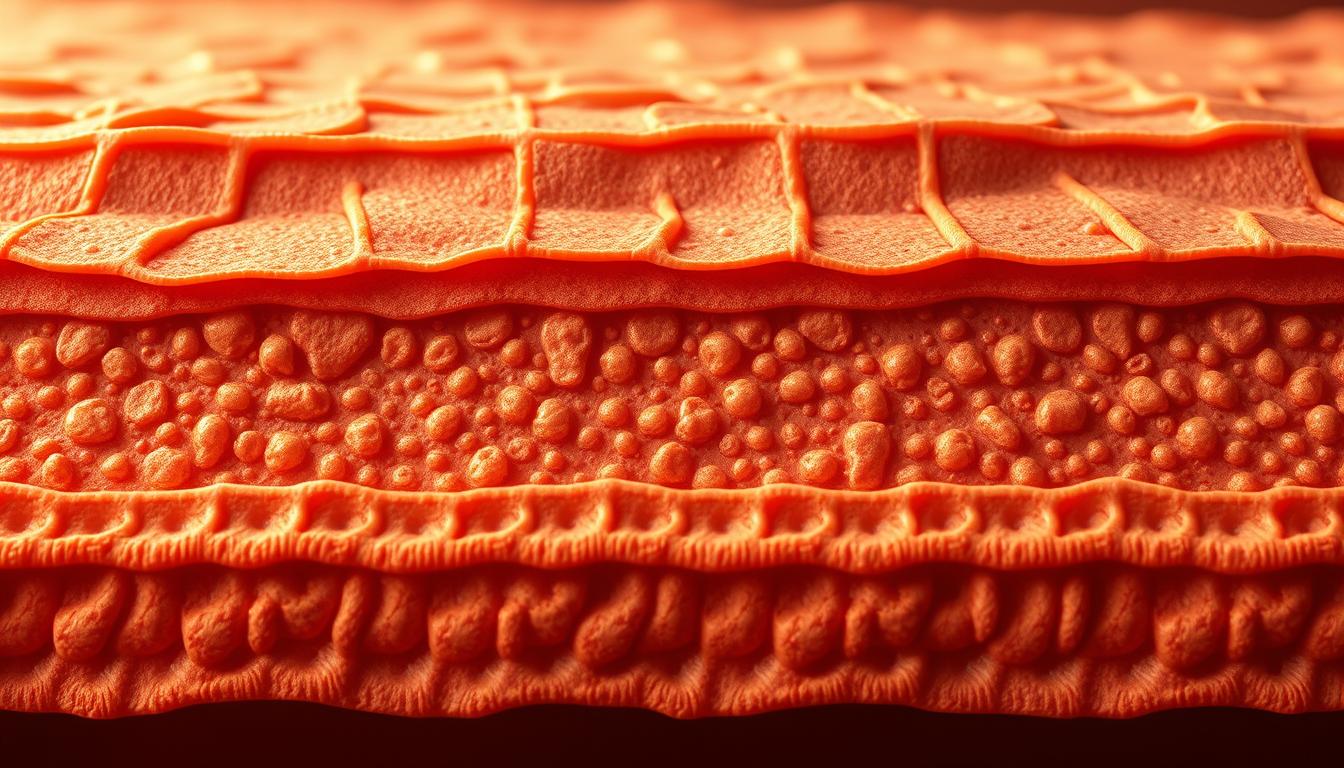
This tissue is made up of many cell layers. It has five main layers: stratum basale, stratum spinosum, stratum granulosum, stratum lucidum, and stratum corneum. As cells move up, they change a lot. This leads to the tough outer layer.
Location in the Human Body
This tissue is found in many parts of our body. It acts as a shield against harm.
Skin Epidermis
In the skin, it makes up the epidermis. It protects us from damage, germs, and keeps moisture in.
Oral Cavity and Esophagus
It’s also in the mouth and esophagus. It helps these areas handle food and forces.
This tissue is vital for keeping our body’s surfaces strong and working right.
The Fundamental Functions of Keratinized Stratified Squamous Epithelium
Keratinized stratified squamous epithelium plays a key role in protecting our bodies. It acts as a shield against many dangers. This layer is vital for keeping us safe from harm.
Protection Against Physical Trauma
This layer is strong against physical stress. It protects our skin from cuts, scrapes, and other injuries. This is why it’s so important for our skin’s health.
Barrier Against Pathogens and Chemicals
It also keeps out harmful germs and chemicals. The tight connections and keratin help block these invaders. This keeps our bodies safe and healthy.
Prevention of Water Loss
Another important job is keeping water in our bodies. The keratinized layer helps stop water from escaping. This helps us stay hydrated.
Transepidermal Water Loss Regulation
Keeping water in is key for healthy skin. The keratinized layer helps by creating a barrier. This barrier reduces water loss, keeping our skin moist.
| Function | Description | Importance |
|---|---|---|
| Protection Against Physical Trauma | Acts as a barrier against mechanical stress | Prevents damage to underlying tissues |
| Barrier Against Pathogens and Chemicals | Prevents entry of harmful substances | Essential for overall health and immunity |
| Prevention of Water Loss | Minimizes transepidermal water loss | Maintains body’s hydration balance |
Cellular Composition and Organization
The keratinized stratified squamous epithelium is a complex tissue with multiple layers. Each layer has a key role in its function. It is made up of different cell types, arranged in a specific way to protect and act as a barrier.
Basal Layer Characteristics
The basal layer is the deepest part of the epithelium. It has a single layer of cuboidal or columnar cells. These cells are actively proliferating, creating new cells that move up to form the other layers.
Spinous and Granular Layers
On top of the basal layer is the spinous layer. It has polyhedral cells with short spines for mechanical cohesion. The granular layer, above the spinous, has flattened cells that are keratinizing. They produce keratin proteins and other substances for barrier function.
Cornified Layer Structure
The cornified layer is the outermost layer. It’s made of fully differentiated keratinocytes, now called corneocytes, filled with keratin filaments. This layer is the main barrier against water loss and external pathogens.
Corneocyte Formation
Corneocytes form through keratinization. In this process, cells lose their nuclei and organelles. They become tightly packed with keratin filaments.
| Layer | Cell Type | Characteristics |
|---|---|---|
| Basal | Cuboidal/Columnar | Actively proliferating |
| Spinous | Polyhedral | Short spines for cohesion |
| Granular | Flattened | Undergoing keratinization |
| Cornified | Corneocytes | Fully differentiated, keratin-filled |
The Process of Keratinization
Understanding keratinization is key to knowing how our skin stays protected. It’s a complex process where cells change and keratin proteins are made. This leads to the creation of the cornified envelope.
Cell Differentiation Stages
The journey of keratinization starts with cells in the basal layer. These cells go through changes as they move up. They pass through the spinous and granular layers, changing a lot.
In these stages, cells make important proteins and organelles. They reach the stratum corneum, becoming the outermost skin layer.
Keratin Protein Production
Keratin proteins are vital for the skin’s strength and rigidity. The genes for these proteins are carefully controlled during cell differentiation.
These proteins form filaments that create a strong network in cells. This network is essential for the skin’s structure and its ability to handle stress.
Formation of the Cornified Envelope
The cornified envelope is a key part of the skin’s barrier. It’s formed in the later stages of keratinization. It’s a strong, cross-linked protein structure that adds to the skin’s strength.
Role of Filaggrin and Loricrin
Filaggrin and loricrin are important for the cornified envelope. Filaggrin helps keratin filaments come together. Loricrin is a main part of the envelope itself.
The way these proteins work with others in the envelope is vital for the skin’s barrier. Problems with these proteins can lead to skin disorders. This shows how important they are for healthy skin.
Physiological Importance in Different Body Regions
Keratinized stratified squamous epithelium is a versatile tissue. It meets different needs in various body parts. Its role in keeping us healthy and functional is key.
Skin Function and Protection
The skin is the largest organ in our body. Its outer layer, made of keratinized stratified squamous epithelium, protects us. It keeps out harmful things like bacteria and prevents water loss.
Oral Mucosa Specialization
In the mouth, this tissue is found where we chew a lot. It’s in the gums and hard palate. It helps us chew food and keeps the mouth safe from germs.
Other Anatomical Locations
This tissue is not just in the skin and mouth. It’s also in the esophagus and parts of the genital tract. It protects these areas in its own way.
Variations in Thickness and Function
The thickness and job of this tissue change in different places. The skin on our palms and soles is thicker to handle more stress. Other areas have thinner layers because they need less protection.
| Body Region | Thickness of Epithelium | Primary Function |
|---|---|---|
| Skin (Palms and Soles) | Thick | Protection against mechanical trauma |
| Oral Mucosa (Gingiva and Hard Palate) | Moderate | Withstanding mastication stress |
| Esophagus | Thin to Moderate | Protection against friction during swallowing |
A study on epithelial physiology shows its importance. “The adaptability of keratinized stratified squamous epithelium to different mechanical and environmental stresses” (
This adaptability is key for the epithelium to stay strong under various demands.
Pathological Conditions Affecting Keratinized Epithelium
Keratinized epithelium is a key barrier against the outside world. It faces many diseases, from hyperkeratosis to genetic disorders. These diseases change its shape and how it works, causing different health problems.
Hyperkeratosis and Related Disorders
Hyperkeratosis makes the top layer of skin thick because of too much keratin. It can happen from too much rubbing, genes, or skin diseases. Managing it well means fixing the cause and using creams to lessen keratin.
Inflammatory Skin Conditions
Conditions like eczema and psoriasis harm keratinized epithelium. They cause redness, itching, and flaking. Using haptic feedback gloves in training doctors can help them better understand and spot these issues.
Genetic Disorders of Keratinization
Genetic problems, like ichthyosis and some psoriasis, mess with keratin making. They make skin dry and scaly, making it hard to handle.
Ichthyosis and Psoriasis
Ichthyosis makes skin dry and scaly because keratin doesn’t work right. Psoriasis makes skin cells grow too fast.
“Understanding the genetic underpinnings of these conditions is key for making better treatments.”
Using tech, like gloves with haptic feedback, helps us learn more about these diseases.
Studying diseases of keratinized epithelium is vital for finding good treatments. New tech, like haptic feedback gloves, is helping us understand and treat these conditions better.
Modern Research Methods in Epithelial Study
New tools in microscopy, molecular analysis, and 3D modeling have changed how we study epithelial tissues. These tools let scientists see more details about these tissues. They help us understand how they work and what goes wrong.
Microscopy Techniques
Confocal microscopy and electron microscopy are key in studying epithelial tissues. They let researchers see the tiny details of these cells and how they are arranged.
Molecular Analysis Approaches
Studies on gene expression profiling and proteomics have shed light on how epithelial tissues function and fail. This knowledge is vital for understanding their role in the body.
3D Tissue Modeling
3D tissue modeling is a new way to study epithelial tissues. It helps scientists see how these cells interact with their surroundings. This method is closer to real-life conditions.
Limitations of Traditional Methods
Old methods can’t fully capture the complex interactions in epithelial tissues. New methods aim to fill this gap. They provide more detailed and accurate information.
| Research Method | Advantages | Limitations |
|---|---|---|
| Microscopy Techniques | High-resolution imaging | Limited to morphological analysis |
| Molecular Analysis Approaches | Insights into molecular mechanisms | Requires sophisticated equipment |
| 3D Tissue Modeling | Physiologically relevant models | Complex and time-consuming |
The Emergence of Wired Glove Technology in Biological Research
The introduction of wired glove technology has changed biological research, mainly in tissue analysis. This change is thanks to haptic feedback devices. They have made biological studies more precise and sensitive.
Evolution of Haptic Feedback Devices
Haptic feedback technology has grown a lot. It moved from simple vibration motors to complex systems. These new systems can mimic detailed touch sensations. This lets researchers work with virtual tissue models in a more real way.
Integration with Medical Imaging
Wired glove technology combined with medical imaging has opened new ways to study tissues. It mixes haptic feedback with clear images. This lets researchers handle and study virtual tissue models with great detail.
Applications in Tissue Analysis
Wired gloves are used in many ways for tissue analysis, including:
- Enhanced tactile feedback for surgeons during training
- Detailed examination of tissue structures in virtual environments
- Improved data collection and analysis capabilities
Bridging Virtual and Physical Examination
Wired gloves in biological research connect virtual and physical exams. They let researchers touch virtual models. This improves our understanding of complex biological processes.
How Wired Gloves Enhance the Study of Epithelial Tissues
In the world of studying epithelial tissues, wired gloves are a game-changer. They offer precision manipulation and better data collection. These tools are changing the game by giving researchers new ways to study epithelial tissues.
Tactile Feedback Mechanisms
Wired gloves have tactile feedback mechanisms that let researchers feel the texture and elasticity of tissues. This is key for understanding the complex nature of these tissues.
Precision Manipulation Capabilities
The precision manipulation of wired gloves lets researchers handle tissue samples with great care. This reduces damage and makes observations more accurate.
Data Collection Advantages
Wired gloves make data collection better by measuring various tissue parameters. This includes:
- Measuring tissue elasticity and resilience
- Recording tactile data for analysis
- Improving the accuracy of tissue exams
Quantifying Tissue Elasticity and Resilience
Wired gloves can measure the elasticity and resilience of tissues. They use advanced sensors to track how tissues react to forces. This gives researchers valuable data for research and diagnosis.
By using wired gloves, scientists can learn more about epithelial tissues. This knowledge helps in fields like dermatology and tissue engineering.
The Wired Glove: Technical Specifications and Capabilities
The wired glove is a big step forward in studying skin. It gives amazing feedback and lets users handle things with great precision. It has sensor technology, motion tracking systems, and haptic feedback components. These features make it a key tool for skin research.
Sensor Technology Overview
The wired glove’s sensors are key. They pick up on different body signals.
- These sensors give live data, helping us learn more about skin.
- The pressure and temperature sensors check the skin’s mechanical and thermal properties.
Pressure and Temperature Sensors
The pressure sensors track the forces on skin. The temperature sensors watch for temperature changes. Together, they give a detailed look at how skin reacts to things.
Motion Tracking Systems
The motion tracking systems in the glove help with precise skin study. They follow the glove’s movement, letting researchers check the skin’s mechanical properties.
Haptic Feedback Components
The haptic feedback in the glove simulates different skin textures and resistances.
- This is great for training, helping users get better at feeling different textures.
Mimicking Epithelial Texture and Resistance
The haptic feedback system makes the glove feel like real skin. This is key for learning and research. It helps us understand and work with skin better.
Applications in Dermatological Training and Education
Advanced haptic feedback technology, like wired gloves, is now used in dermatological training. It makes learning better with immersive simulations and real touch feedback.
Virtual Examination Simulations
Wired gloves let trainees do virtual exams. They practice and get better at diagnosing in a safe space. It’s a fun and real way to learn about skin diseases.
Tactile Recognition of Epithelial Conditions
Wired gloves give trainees a feel for different skin conditions. This is key in dermatology, where feeling skin lesions is important for diagnosis.
Assessment of Pathological Changes
Wired gloves help trainees learn about changes in skin tissues. This hands-on learning is great for getting ready for real dermatology challenges.
Distinguishing Normal vs. Abnormal Keratinization
Wired gloves are great for learning the difference between normal and abnormal skin growth. Trainees get a detailed understanding through interactive lessons.
| Training Aspect | Traditional Method | Wired Glove Technology |
|---|---|---|
| Tactile Feedback | Limited to real patient interactions | Simulated tactile feedback for various conditions |
| Diagnostic Skills | Developed through observation and practice | Enhanced through realistic simulations |
| Pathological Assessment | Relies on visual aids and case studies | Interactive assessment of pathological changes |
Surgical Applications and Procedural Training
The use of wired gloves in surgical training has changed the game in epithelial research. These advanced tools, like motion sensing gloves, are making surgeries more precise and improving skills.
Microsurgery Simulation for Epithelial Tissues
Wired gloves are now key in microsurgery training. They help surgeons practice with delicate tissues. The precision and tactile feedback they offer make training more realistic and effective.
Dermatological Procedure Practice
In dermatology, wired gloves help trainees get better at their craft. They practice biopsies, suturing, and more with better tactile sensitivity.
Skill Development and Assessment
Wired gloves also help assess surgical skills. They measure how precise and skilled trainees are. This helps figure out if they’re ready for real surgeries.
Measuring Precision and Tissue Handling
Wired gloves can track how well you handle tissues. They use advanced sensors to monitor movement and pressure during simulations.
| Feature | Description | Benefit |
|---|---|---|
| Motion Tracking | Advanced sensors track hand movements | Enhanced precision in surgical training |
| Tactile Feedback | Provides realistic sensation during simulation | Improved skill development |
| Pressure Measurement | Measures the pressure applied to tissues | Better tissue handling techniques |
Research Advancements Through Wired Glove Implementation
Wired glove technology has changed how researchers study epithelial tissues. This tech has become key in learning more about keratinized stratified squamous epithelium.
Epithelial Tissue Response Measurement
The wired glove helps measure how epithelial tissues react under different conditions. This is important for seeing how stimuli change tissue behavior.
Comparative Analysis of Normal vs. Pathological Samples
Researchers use the wired glove to compare normal and abnormal epithelial samples. This helps find the key differences in how tissues behave and respond.
Data Visualization of Keratinization Processes
Data visualization is key in understanding complex processes like keratinization. The wired glove, with advanced tools, helps researchers dive deeper into these processes.
Real-time Feedback Systems
Adding real-time feedback to the wired glove makes measurements more accurate. It gives instant insights into tissue responses. This data is very useful for research and teaching.
The use of wired gloves in research has greatly improved our knowledge of epithelial tissues. It has also opened up new areas for study. As this technology grows, we can look forward to even more discoveries.
Case Studies: Wired Glove Applications in Epithelial Research
The use of wired gloves in epithelial research has brought new ways to simulate and train. It has been used in many studies, showing its value in improving research methods and results.
Burn Treatment and Skin Grafting Simulations
Wired gloves help in simulating burn treatment and skin grafting. They allow for precise control and feel. This has made training for medical staff better, helping them handle sensitive skin tissues.
Psoriasis Management Training
Wired gloves help trainees feel the touch of different psoriasis stages. This skill is key for diagnosing and treating psoriasis well.
Oral Mucosa Examination Techniques
Wired gloves are used in training for oral mucosa exams. They make these exams more sensitive and accurate. Trainees get to practice with real-like simulations, boosting their skills.
Measurable Improvements in Diagnostic Accuracy
Research shows that using wired gloves in training leads to measurable improvements in diagnostic accuracy. The gloves’ tactile feedback helps understand epithelial conditions better.
- Enhanced simulation capabilities
- Improved diagnostic accuracy
- Better training outcomes for medical professionals
Future Directions in Epithelial Research with Smart Glove Technology
Looking ahead, smart glove technology in epithelial research is very promising. There are many areas ready for big advancements.
Integration with Artificial Intelligence
One exciting area is combining smart gloves with artificial intelligence (AI). This mix will help researchers understand epithelial function and diseases better. AI can spot patterns in data that humans might miss.
“The integration of AI with smart glove technology will revolutionize the field of epithelial research by providing unprecedented levels of data analysis and interpretation.”
Miniaturization and Sensitivity Improvements
Another key area is making smart gloves smaller and more sensitive. As tech improves, we’ll see tiny sensors that catch even small changes in tissues. This will help researchers do more precise studies and get better data.
| Feature | Current State | Future Development |
|---|---|---|
| Sensor Size | Moderate | Miniaturized |
| Sensitivity | High | Enhanced |
| User Interface | Complex | User-Friendly |
Expanded Biological Applications
Smart glove technology won’t just be for epithelial research. It will also be used in studying other tissues and diseases. This will make it a valuable tool in many areas of biomedical research.
Personalized Medicine Applications
Smart gloves with AI could also change personalized medicine. They can analyze patient data to create custom treatments. This could lead to more effective treatments with fewer side effects for epithelial diseases.
Ethical Considerations and Limitations
The use of gesture control gloves in skin research raises important questions. As this technology grows, we must talk about its ethical side and its limits.
Accuracy and Reliability in Epithelial Assessment
One big worry is how well gesture control gloves work in studying skin. They are precise, but their success depends on the sensors and the person using them.
| Factor | Impact on Accuracy | Impact on Reliability |
|---|---|---|
| Sensor Quality | High-quality sensors improve accuracy | Reliable sensors reduce variability |
| User Expertise | Trained users achieve better results | Experienced users enhance reliability |
Cost and Accessibility Issues
The price of gesture control gloves is a big problem. They can be very expensive. This makes them hard for some places to get.
Training Requirements and Learning Curve
Using these gloves well needs a lot of training. This can take a lot of time. It might make some people not want to use them.
Balancing Technology with Traditional Methods
To get the most out of gesture control gloves, we need to mix them with old ways. This way, we can get better and more reliable results.
Conclusion: The Transformative Impact of Wired Glove Technology on Epithelial Research
The use of wired glove technology is changing how we study and use epithelial research. It brings new chances for growth in this area.
The motion sensing glove is a key tool for researchers. It gives them better touch feedback and more precise control. This helps them understand keratinized stratified squamous epithelium better.
This change will lead to new ideas in many fields. This includes better training in dermatology, new surgical methods, and ways to do research. It will help in diagnosing and treating skin problems.
As wired glove technology gets better, it will open up more chances for discovery. It will help in making medical education and practice better in the future.